


Three out of 10 adolescents in Taiwan have experienced bullying, either as victims or witnesses, with verbal and physical bullying being the most common, a survey conducted by the Taiwan International Association for Advancement of Children Rights has found.
A total of 30.58 percent of respondents — comprising junior and senior-high school students — said they have either been the victims of bullying or have seen or heard people around them being bullied.
The types of bullying were verbal bullying (86.3 percent), physical bullying (70.8 percent), relational bullying (67 percent), cyberbullying (18 percent) and sexual bullying (13.6 percent), the survey found.
When asked about the possible cause of bullying, respondents attributed 59 percent of the cases to the victim’s personality, 49.5 percent to physical appearance and 27 percent to personal hygiene.
The survey found that 13 percent of the respondents were victims of bullying, which resulted in polarized reactions, said Chang An-tzu (張安慈), a consultant at the association.
Some of the victims changed their attitudes in an attempt to fit in, but others became depressed and were reluctant or afraid to make friends, Chang said.
Bullied adolescents might refuse to attend school, injure themselves deliberately, have nightmares or even lash out when they think they are about to be bullied, Chang said.
Judging from the reasons cited for bullying, adolescent people’s character, including their ability to make friends, and their self-image and sense of worth, can be improved, Chang said.
Efforts to prevent bullying should be improved, because as many as 70 percent of adolescents ignore, choose not to get involved or do not know what to do when they witness bullying, Chang said.
The survey was conducted last month and collected 1,205 valid samples.
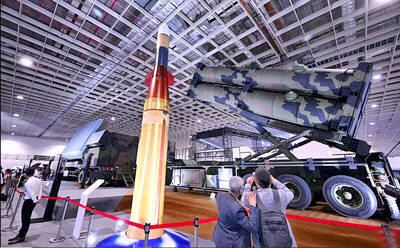
Taiwan is to commence mass production of the Tien Kung (天弓, “Sky Bow”) III, IV and V missiles by the second quarter of this year if the legislature approves the government’s NT$1.25 trillion (US$39.78 billion) special defense budget, an official said yesterday. Commenting on condition of anonymity, a defense official with knowledge of the matter said that the advanced systems are expected to provide crucial capabilities against ballistic and cruise missiles for the proposed “T-Dome,” an advanced, multi-layered air defense network. The Tien Kung III is an air defense missile with a maximum interception altitude of 35km. The Tien Kung IV and V
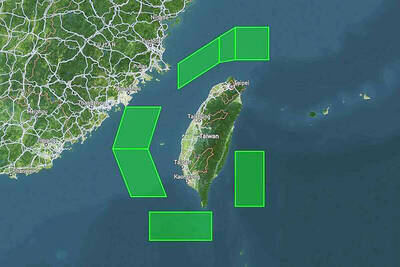
The disruption of 941 flights in and out of Taiwan due to China’s large-scale military exercises was no accident, but rather the result of a “quasi-blockade” used to simulate creating the air and sea routes needed for an amphibious landing, a military expert said. The disruptions occurred on Tuesday and lasted about 10 hours as China conducted live-fire drills in the Taiwan Strait. The Civil Aviation Administration (CAA) said the exercises affected 857 international flights and 84 domestic flights, affecting more than 100,000 travelers. Su Tzu-yun (蘇紫雲), a research fellow at the government-sponsored Institute for National Defense and Security Research, said the air
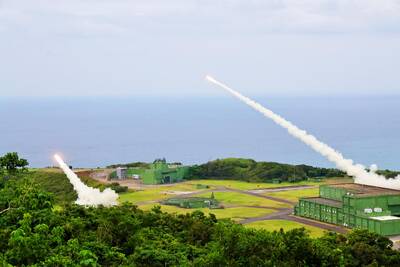
Taiwan lacks effective and cost-efficient armaments to intercept rockets, making the planned “T-Dome” interception system necessary, two experts said on Tuesday. The concerns were raised after China’s military fired two waves of rockets during live-fire drills around Taiwan on Tuesday, part of two-day exercises code-named “Justice Mission 2025.” The first wave involved 17 rockets launched at 9am from Pingtan in China’s Fujian Province, according to Lieutenant General Hsieh Jih-sheng (謝日升) of the Office of the Deputy Chief of the General Staff for Intelligence at the Ministry of National Defense. Those rockets landed 70 nautical miles (129.6km) northeast of Keelung without flying over Taiwan,
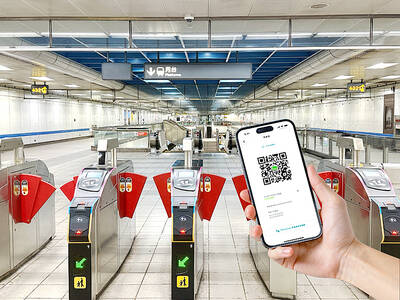
City buses in Taipei and New Taipei City, as well as the Taipei MRT, would on Saturday begin accepting QR code payments from five electronic payment providers, the Taipei Department of Transportation said yesterday. The new option would allow passengers to use the “transportation QR code” feature from EasyWallet, iPass Money, iCash Pay, Jkopay or PXPay Plus. Passengers should open their preferred electronic payment app, select the “transportation code” — not the regular payment code — unlock it, and scan the code at ticket readers or gates, General Planning Division Director-General Liu Kuo-chu (劉國著) said. People should move through the


 RSS
RSS