


Amusement parks across the nation have rolled out rebates and deals for special events to boost domestic tourism during the nine-day Lunar New Year holiday.
The Formosan Aboriginal Cultural Village in Taichung on Friday said that it has organized the only cherry blossom festival outside of Japan certified by the Japan Cherry Blossom Association.
The festival takes place from today to Feb. 28 and visitors can take the gondola to see the park’s 5,500 cherry trees, it said, adding that the flower season is to last until March 10.
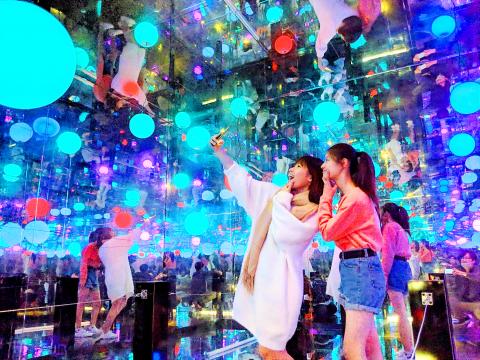
Photo courtesy of the Leofoo Village Theme Park.
Lihpao Land in Taichung said that it hopes the Lihpao International Circuit, a three-course race track which was completed in November, would draw visitors to the park.
The main circuit — a 3.5km-long, 23-curve affair with an 20m elevation difference built to the Federation Internationale de l’Automobile’s grade two standards — is cleared for purpose-built racers, supercars and sport cars, it said.
Additionally, the circuit has a cross-country track and is the only Commission Internationale de Karting-certified go-kart course in Taiwan, it said.
The E-Da Theme Park in Kaohsiung bills itself as the sole amusement park inspired by ancient Greece. It consists of three areas — the Parthenon, Santorini and Trojan Citadel — which at 15,000 ping (4,545m2) is the nation’s largest indoor amusement facility.
Leofoo Village Theme Park in Hsinchu this year has an Arabian-themed Sweet Charms Palace, a romantic outing for couples that is also family-friendly, it said.
The facility features bubble machines, kaleidoscopes and a 3m crystal ball, and stylists, princess gowns and parades are available for families with children, it said.

Considering that most countries issue more than five denominations of banknotes, the central bank has decided to redesign all five denominations, the bank said as it prepares for the first major overhaul of the banknotes in more than 24 years. Central bank Governor Yang Chin-lung (楊金龍) is expected to report to the Legislative Yuan today on the bank’s operations and the redesign’s progress. The bank in a report sent to the legislature ahead of today’s meeting said it had commissioned a survey on the public’s preferences. Survey results showed that NT$100 and NT$1,000 banknotes are the most commonly used, while NT$200 and NT$2,000

The Centers for Disease Control (CDC) yesterday reported the first case of a new COVID-19 subvariant — BA.3.2 — in a 10-year-old Singaporean girl who had a fever upon arrival in Taiwan and tested positive for the disease. The girl left Taiwan on March 20 and the case did not have a direct impact on the local community, it said. The WHO added the BA.3.2 strain to its list of Variants Under Monitoring in December last year, but this was the first imported case of the COVID-19 variant in Taiwan, CDC Deputy Director-General Lin Ming-cheng (林明誠) said. The girl arrived in Taiwan on

South Korea is planning to revise its controversial electronic arrival card, a step Taiwanese officials said prompted them to hold off on planned retaliatory measures, a South Korean media report said yesterday. A Yonhap News Agency report said that the South Korean Ministry of Foreign Affairs is planning to remove the “previous departure place” and “next destination” fields from its e-arrival card system. The plan, reached after interagency consultations, is under review and aims to simplify entry procedures and align the electronic form with the paper version, a South Korean ministry official said. The fields — which appeared only on the electronic form

The Ministry of Foreign Affairs (MOFA) is suspending retaliation measures against South Korea that were set to take effect tomorrow, after Seoul said it is updating its e-arrival system, MOFA said today. The measures were to be a new round of retaliation after Taiwan on March 1 changed South Korea's designation on government-issued alien resident certificates held by South Korean nationals to "South Korea” from the "Republic of Korea," the country’s official name. The move came after months of protests to Seoul over its listing of Taiwan as "China (Taiwan)" in dropdown menus on its new online immigration entry system. MOFA last week


 RSS
RSS