


The New Taipei City Election Commission yesterday held a televised debate between New Power Party (NPP) Executive Chairman Huang Kuo-chang (黃國昌) and Sun Chi-cheng (孫繼正), chairman of the Greater Taipei Stability Power Alliance, a group opposed to gay marriage, over the second round of voting for the legislator’s recall scheduled for Dec. 16.
Sun criticized Huang for supporting amending of the Civil Code to legalize gay marriage and said it would destroy values that are intrinsic to families, adding that this was his primary reason for launching the recall effort against Huang.
More than half of New Taipei City residents are opposed to the proposed amendments, as well as 60 percent of all Taiwanese, Sun said.
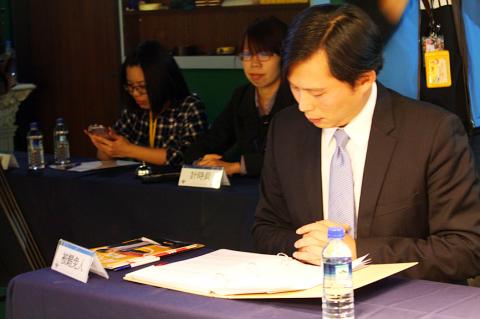
Photo: Chiu Shu-yu, Taipei Times
There is neither legal nor public consensus on the issue, but Huang insists on “pushing it through,” Sun said, adding that such actions go against Huang’s touted belief that “people should determine public policies.”
Huang’s actions have gone against his campaign promise to make “the next generation happier,” Sun said.
Using his daughter’s school textbook, Sun said that its contents, such as sections on masturbation, fellatio and anal sex, are not only inappropriate, but absurd.
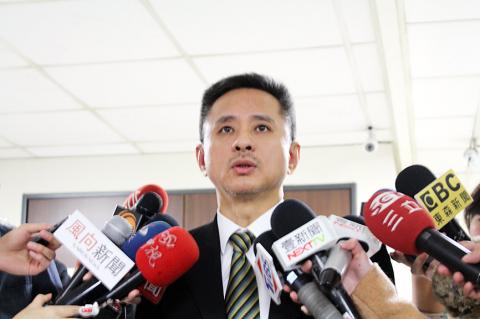
Photo: Chiu Shu-yu, Taipei Times
Such material drives students toward sexual liberalism, making them susceptible to orgies, sadism and masochism, threesomes and more, Sun said, adding that it was inappropriate handling of the subject of sexual education.
Sun called on constituents in the city’s Sijhih (汐止), Jinshan (金山), Wanli (萬里), Juifang (瑞芳), Pingsi (平溪) and Gongliao (貢寮) districts to vote and witness how their votes would become a milestone in Taiwan’s governance.
Huang said he respects that people oppose same-sex marriage out of religious beliefs, adding that he had not verbally abused Christians and called on everyone to respect different opinions.
Citing the Council of Grand Justices’ Constitutional Interpretation No. 748 in May, Huang said that same-sex marriage has been declared a basic human right and by law, the Legislative Yuan has to conclude the amendments within a two-year period.
Public issues must be based on facts and common sense, and should be in line with the law, Huang said, adding that those who spread hateful commentaries are themselves the source of social instability.
Huang thanked the public for its support and said that he has not disappointed his supporters since his election, adding that the televised debate was due to the amendments to the Civil Servants Election and Recall Act (公務人員選舉罷免法).
His attendance at legislative affairs, including inquiries and budget reviews, was in accordance with his campaign promises, Huang said.
Rejecting Sun’s claim that he has not tended to the needs of his constituents, Huang said he has asked the Taiwan Railway Administration (TRA) to ameliorate and improve the crowded conditions on Siko TRA Station platforms near the Sijhih Science Park.
Huang also said he was involved in the environmental assessment of a planned extension of the Taipei MRT System into New Taipei City’s Sijhih District (汐止), adding that all of his actions are recorded on the publicly viewable platforms associated with the Legislative Yuan.
The debate is positive for the deepening of democracy in Taiwan, Huang said.
According to the recall act, the recall vote — the last of three phases — needs the approval of at least 25 percent of the total eligible voters in an electoral district to be considered successful.
Huang’s constituency, the 12th electoral district of New Taipei City, has 251,191 eligible voters, requiring 62,798 “yes” votes to remove the NPP lawmaker from his post.


China has reserved offshore airspace in the Yellow Sea and East China Sea from March 27 to May 6, issuing alerts usually used to warn of military exercises, although no such exercises have been announced, the Wall Street Journal (WSJ) reported yesterday. Reserving such a large area for 40 days without explanation is an “unusual step,” as military exercises normally only last a few days, the paper said. These alerts, known as Notice to Air Missions (Notams), “are intended to inform pilots and aviation authorities of temporary airspace hazards or restrictions,” the article said. The airspace reserved in the alert is
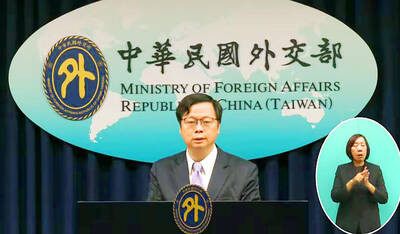
NAMING SPAT: The foreign ministry called on Denmark to propose an acceptable solution to the erroneous nationality used for Taiwanese on residence permits Taiwan has revoked some privileges for Danish diplomatic staff over a Danish permit that lists “Taiwan” as “China,” Eric Huang (黃鈞耀), head of the Ministry of Foreign Affairs’ Department of European Affairs, told a news conference in Taipei yesterday. Reporters asked Huang whether the Danish government had responded to the ministry’s request that it correct the nationality on Danish residence permits of Taiwanese, which has been listed as “China” since 2024. Taiwan’s representative office in Denmark continues to communicate with the Danish government, and the ministry has revoked some privileges previously granted to Danish representatives in Taiwan and would continue to review

More than 6,000 Taiwanese students have participated in exchange programs in China over the past two years, despite the Mainland Affairs Council’s (MAC) “orange light” travel advisory, government records showed. The MAC’s publicly available registry showed that Taiwanese college and university students who went on exchange programs across the Strait numbered 3,592 and 2,966 people respectively. The National Immigration Agency data revealed that 2,296 and 2,551 Chinese students visited Taiwan for study in the same two years. A review of the Web sites of publicly-run universities and colleges showed that Taiwanese higher education institutions continued to recruit students for Chinese educational programs without

A bipartisan group of US senators has introduced a bill to enhance cooperation with Taiwan on drone development and to reduce reliance on supply chains linked to China. The proposed Blue Skies for Taiwan Act of 2026 was introduced by Republican US senators Ted Cruz and John Curtis, and Democratic US senators Jeff Merkley and Andy Kim. The legislation seeks to ease constraints on Taiwan-US cooperation in uncrewed aerial systems (UAS), including dependence on China-sourced components, limited access to capital and regulatory barriers under US export controls, a news release issued by Cruz on Wednesday said. The bill would establish a "Blue UAS


 RSS
RSS