


A Double Ten National Day celebration yesterday organized by the Chinese Nationalist Party (KMT) highlighted the significance and widespread presence of the national flag, and affirmed the existence of the Republic of China (ROC).
The Democratic Progressive Party (DPP) government has been accused by critics of deliberately minimizing imagery associated with China by removing the ROC flag from the invitations for the official Double Ten National Day ceremony and dinner, as well as not mentioning the ROC.
However, Legislative Speaker Su Jia-chyuan (蘇嘉全), whose job includes the role of National Day Celebration Organizing Committee chairman, said the national flag “lives in our hearts,” adding that the flags were displayed at the ceremony and dinner.
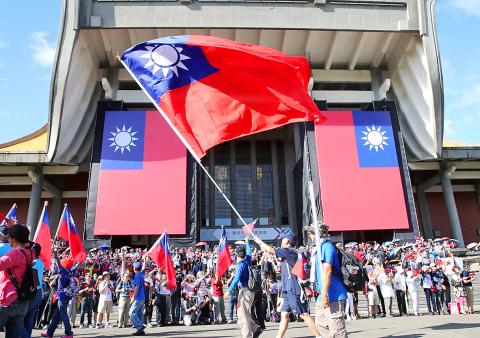
Photo: CNA
The invitation to a celebration hosted by the KMT at Sun Yat-sen Memorial Hall in Taipei featured a national flag on one side and the portraits of Sun Yat-sen (孫中山) and Chiang Kai-shek (蔣介石) on the other.
The ceremony began with marching bands carrying national flags and portraits of Sun and Chiang, which were followed by a group of veterans bearing a huge national flag.
In his speech to the ceremony, former president Ma Ying-jeou (馬英九) highlighted the differences between it and the national celebrations, saying that the number of national flags he saw in the afternoon far exceeded that of the official ceremony in the morning, which he had also attended.
“This is what a National Day celebration should look like. This flag has borne the ideas, feelings, struggles, humility and dignity of millions of Chinese people over the past 100 years. It has become the symbol recognized, affirmed and supported by 23 million people in Taiwan as well. Surely we should bring our national flags out and raise them high at important occasions like National Day celebrations,” Ma said.
Former KMT chairwoman Hung Hsiu-chu (洪秀柱) said “our love for the national flag and our use of the ROC as the name of the nation should not be hidden inside.”
“To us, addressing our nation as the ROC and respecting our flag is just as natural as facing the sun and walking on the land. We neither have to fabricate nor hide those feelings,” she said.
Former representative to the US Shen Lyu-shun (沈呂巡) said that he was invited to attend the pan-blue event because during his time in Washington the ROC flag was raised at Twin Oaks — the estate owned by the ROC government and used for official receptions —for the first time in 2015, 37 years after the US and Taiwan severed diplomatic ties.
KMT Chairman Wu Den-yih (吳敦義) said that seeing the national flag should strengthen the faith and reignite the hope of party supporters that the KMT would soon rule the nation again.
Wu asked KMT supporters to unite and work together to help it to win next year’s “nine-in-one” elections for special municipality mayors, county commissioners and city and county councils.
“Let our flags fly in more cities and counties than they do now. If we make significant progress next year, it would open up a chance for us return to power,” he said.
Ma said that he was deeply concerned with the direction in which the DPP administration is heading.
The KMT needs to seize any opportunity it can to convince the public that it has the most effective solution to achieve cross-strait peace and prosperity, he said.
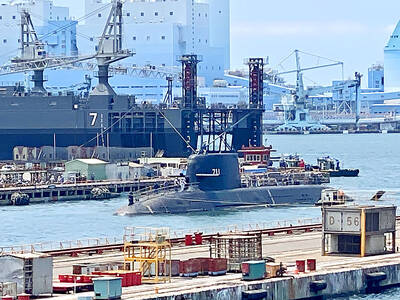
AGING: While Japan has 22 submarines, Taiwan only operates four, two of which were commissioned by the US in 1945 and 1946, and transferred to Taiwan in 1973 Taiwan would need at least 12 submarines to reach modern fleet capabilities, CSBC Corp, Taiwan chairman Chen Cheng-hung (陳政宏) said in an interview broadcast on Friday, citing a US assessment. CSBC is testing the nation’s first indigenous defense submarine, the Hai Kun (海鯤, Narwhal), which is scheduled to be delivered to the navy next month or in July. The Hai Kun has completed torpedo-firing tests and is scheduled to undergo overnight sea trials, Chen said on an SET TV military affairs program. Taiwan would require at least 12 submarines to establish a modern submarine force after assessing the nation’s operational environment and defense

A white king snake that frightened passengers and caused a stir on a Taipei MRT train on Friday evening has been claimed by its owner, who would be fined, Taipei Rapid Transit Corp (TRTC) said yesterday. A person on Threads posted that he thought he was lucky to find an empty row of seats on Friday after boarding a train on the Bannan (Blue) Line, only to spot a white snake with black stripes after sitting down. Startled, he jumped up, he wrote, describing the encounter as “terrifying.” “Taipei’s rat control plan: Release snakes on the metro,” one person wrote in reply, referring
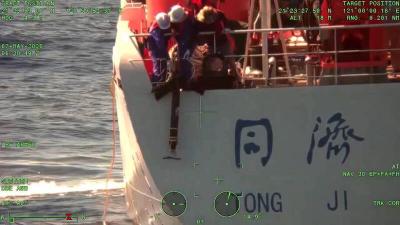
The coast guard today said that it had disrupted "illegal" operations by a Chinese research ship in waters close to the nation and driven it away, part of what Taipei sees a provocative pattern of China's stepped up maritime activities. The coast guard said that it on Thursday last week detected the Chinese ship Tongji (同濟號), which was commissioned only last year, 29 nautical miles (54km) southeast of the southern tip of Taiwan, although just outside restricted waters. The ship was observed lowering ropes into the water, suspected to be the deployment of scientific instruments for "illegal" survey operations, and the coast
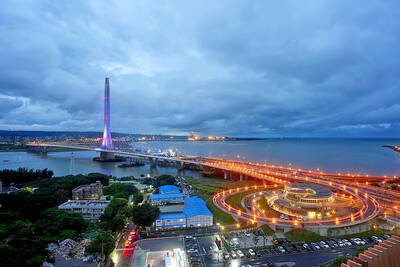
An inauguration ceremony was held yesterday for the Danjiang Bridge, the world’s longest single-mast asymmetric cable-stayed bridge, ahead of its official opening to traffic on Tuesday, marking a major milestone after nearly three decades of planning and construction. At the ceremony in New Taipei City attended by President William Lai (賴清德), Premier Cho Jung-tai (卓榮泰), Minister of Transportation and Communications Chen Shih-kai (陳世凱) and New Taipei City Mayor Hou Yu-ih (侯友宜), the bridge was hailed as both an engineering landmark and a long-awaited regional transport link connecting Tamsui (淡水) and Bali (八里)


 RSS
RSS