


Taipei police yesterday questioned a man for allegedly organizing an online campaign for an “Occupy the Taipei MRT” protest, amid criticism that the government is resorting to clamping down on “thought crime” to curb freedom of expression.
Police located the man, surnamed Chou, a resident of Chiayi County’s Fanlu Township (番路), through the Internet protocol address he used to post a message about the campaign. They said the campaign is against the law.
Reporting to the police department’s Mobile Division, Chou said he did not initiate the campaign and only reposted a message on Facebook, which he did not know was illegal.
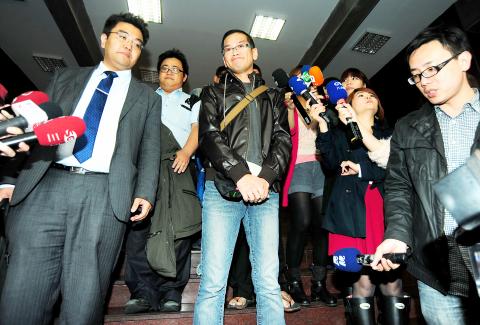
Photo: Lo Pei-der, Taipei Times
The campaign called for 33,000 people to board Tamsui Line MRT trains at the same time to protest against what the organizers said was the government’s failure to respond to the public’s demand that construction on the Fourth Nuclear Power Plant in New Taipei City’s Gongliao District (貢寮) be halted.
Police said Chou may have violated Article 153 of the Criminal Code by “inciting others to violate the law or disobey a legal order.” If tried and convicted, he could face a maximum of two years in prison.
The police and the Taipei Rapid Transit Corp on Wednesday warned antinuclear protesters against organizing or participating in the campaign, saying such a protest would violate the Criminal Code and participants could face a five-year jail term.
The police launched an investigation a few hours after the message was posted on the Internet.
However, the investigation has been questioned by legal experts and netizens, with lawyer Tseng Wei-kai (曾威凱) saying that it was a “ridiculous political investigation.”
Chou did not break the law even if he initiated the campaign, Tseng said, adding that prosecutors and the police could try to use the case as a warning to stop people from participating in mass demonstrations and expressing their views.
The administration should not distort the law in an attempt to threaten the public, Democratic Progressive Party Legislator Kuan Bi-ling (管碧玲) said.
The Taipei Rapid Transit Corp is wrong to cite Article 50 of the Mass Rapid Transit Act (大眾捷運法) because the proposed activity would neither damage its trains, facilities or equipment, nor interfere with normal operations, Kuan said.
“I do not see any violation in it,” he said.
The government’s response to recent protests has raised concerns among legal experts and rights advocates, who say that it appears to be resorting to punishing “thought crime” and threats to scare people off the streets.
Deputy Minister of the Interior Jonathan Chen (陳純敬) said on Wednesday that the ministry and the National Police Agency were considering implementing preventive detention against “radical protesters and repeat offenders” in mass demonstrations.
Premier Jiang Yi-huah (江宜樺), Minister of Justice Luo Ying-shay (羅瑩雪) and Minister of the Interior Chen Wei-zen (陳威仁) reiterated the government’s “determination to maintain social order and harmony,” and said that protesters had “hijacked Taiwan’s democracy with their illegal behavior.”
Preventive detention is an absurd measure and the government seems to have adopted an iron-fist policy to oppress the public’s freedom of expression, lawyer Chiu Hsien-chih (邱顯智) said.
“If the Ministry of the Interior has adopted such a policy, it would be the re-emergence of a police state,” lawyer Chan Shun-keui (詹順貴) said.

Travel agencies in Taiwan are working to secure alternative flights for travelers bound for New Zealand for the Lunar New Year holiday, as Air New Zealand workers are set to strike next week. The airline said that it has confirmed that the planned industrial action by its international wide-body cabin crew would go ahead on Thursday and Friday next week. While the Auckland-based carrier pledged to take reasonable measures to mitigate the impact of the workers’ strike, an Air New Zealand flight arriving at Taipei from Auckland on Thursday and another flight departing from Taipei for Auckland on Saturday would have to

The manufacture of the remaining 28 M1A2T Abrams tanks Taiwan purchased from the US has recently been completed, and they are expected to be delivered within the next one to two months, a source said yesterday. The Ministry of National Defense is arranging cargo ships to transport the tanks to Taiwan as soon as possible, said the source, who is familiar with the matter. The estimated arrival time ranges from late this month to early next month, the source said. The 28 Abrams tanks make up the third and final batch of a total of 108 tanks, valued at about NT$40.5 billion
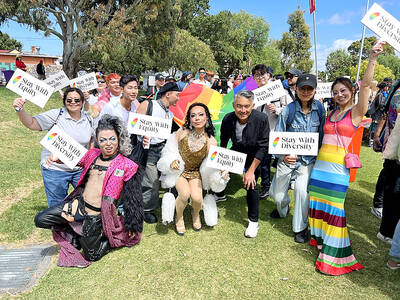
A group from the Taiwanese Designers in Australia association yesterday represented Taiwan at the Midsumma Pride March in Melbourne. The march, held in the St. Kilda suburb, is the city’s largest LGBTQIA+ parade and the flagship event of the annual Midsumma Festival. It attracted more than 45,000 spectators who supported the 400 groups and 10,000 marchers that participated this year, the association said. Taiwanese Designers said they organized a team to march for Taiwan this year, joining politicians, government agencies, professionals and community organizations in showing support for LGBTQIA+ people and diverse communities. As the first country in Asia to legalize same-sex
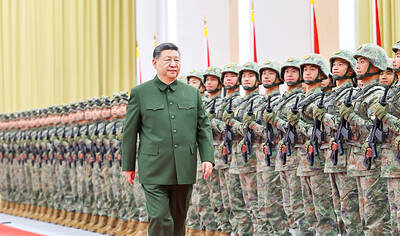
MOTIVES QUESTIONED The PLA considers Xi’s policies toward Taiwan to be driven by personal considerations rather than military assessment, the Epoch Times reports Chinese President Xi Jinping’s (習近平) latest purge of the Chinese People’s Liberation Army (PLA) leadership might have been prompted by the military’s opposition to plans of invading Taiwan, the Epoch Times said. The Chinese military opposes waging war against Taiwan by a large consensus, putting it at odds with Xi’s vision, the Falun Gong-affiliated daily said in a report on Thursday, citing anonymous sources with insight into the PLA’s inner workings. The opposition is not the opinion of a few generals, but a widely shared view among the PLA cadre, the Epoch Times cited them as saying. “Chinese forces know full well that


 RSS
RSS