


Members of the Wuchiang River Protection Union from Kinmen held a demonstration in front of the Control Yuan in Taipei yesterday and filed a complaint with the government watchdog asking it to investigate and stop the construction of a hotel next to the Taihu Reservoir, an important water source for the outlying island.
The group’s representative, Syril Hung (洪篤欽), said the Taihu Reservoir is an important water source for Kinhu Township (金湖) and has been determined to be a drinking water source quality protection area under the Drinking Water Management Act (飲用水管理條例).
Amid water shortages on the island, existing water resources should be protected, in addition to developing new sources, he said.

Photo: Chien Jung-fong, Taipei Times
However, a 50-year build-operate-transfer (BOT) agreement with the Kinmen County Government signed in 2009 has allowed Ever Rich DFS Corp (昇恆昌) to build a hotel next to the Taihu Reservoir, he said.
The protesters said they are concerned that the project would affect not only the already limited quantity of water on Kinmen, but that waste water from the hotel may also damage the reservoir’s water quality.
Citing the Drinking Water Management Act, a member of the group surnamed Chang (張) said that hotels located near water source protection areas may only provide fewer than 20 rooms and are banned from any water polluting behavior.
“However, the planned hotel is only about 40m from the reservoir and has 264 rooms. That’s about 13 times the limit,” she said.
She said the group had asked the local environmental protection bureau to reveal the project’s wastewater treatment plan last month, but that was refused on the grounds that the plan is part of the developer’s assets and cannot be revealed.
“The Taihu Reservoir is the largest water source in the area and it has already been found to have the most serious eutrophication problem among Taiwan’s reservoirs, so we are worried that the project will have further negative effects on the area’s water supply and water quality,” she said.
Eutrophication is a process by which a body of water accumulates a high concentration of plant nutrients, such as phosphates and nitrates, promoting excessive growth of algae.
“BOT projects should benefit the public, yet [in this case,] while the hotel may attract tourists, it may also damage the public interest by demanding too much of the already scarce water supply on the island,” Hung said, urging the Control Yuan to look into the matter.

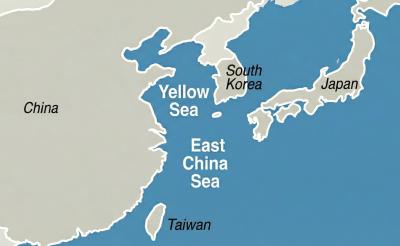
China has reserved offshore airspace in the Yellow Sea and East China Sea from March 27 to May 6, issuing alerts usually used to warn of military exercises, although no such exercises have been announced, the Wall Street Journal (WSJ) reported yesterday. Reserving such a large area for 40 days without explanation is an “unusual step,” as military exercises normally only last a few days, the paper said. These alerts, known as Notice to Air Missions (Notams), “are intended to inform pilots and aviation authorities of temporary airspace hazards or restrictions,” the article said. The airspace reserved in the alert is

South Korea is planning to revise its controversial electronic arrival card, a step Taiwanese officials said prompted them to hold off on planned retaliatory measures, a South Korean media report said yesterday. A Yonhap News Agency report said that the South Korean Ministry of Foreign Affairs is planning to remove the “previous departure place” and “next destination” fields from its e-arrival card system. The plan, reached after interagency consultations, is under review and aims to simplify entry procedures and align the electronic form with the paper version, a South Korean ministry official said. The fields — which appeared only on the electronic form

A bipartisan group of US senators has introduced a bill to enhance cooperation with Taiwan on drone development and to reduce reliance on supply chains linked to China. The proposed Blue Skies for Taiwan Act of 2026 was introduced by Republican US senators Ted Cruz and John Curtis, and Democratic US senators Jeff Merkley and Andy Kim. The legislation seeks to ease constraints on Taiwan-US cooperation in uncrewed aerial systems (UAS), including dependence on China-sourced components, limited access to capital and regulatory barriers under US export controls, a news release issued by Cruz on Wednesday said. The bill would establish a "Blue UAS
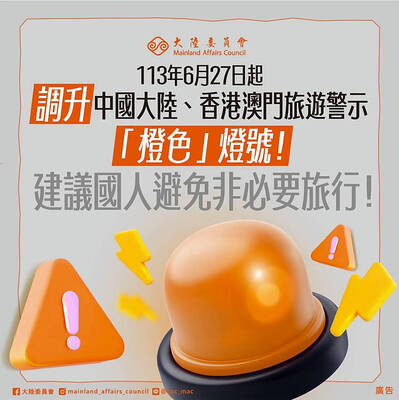
More than 6,000 Taiwanese students have participated in exchange programs in China over the past two years, despite the Mainland Affairs Council’s (MAC) “orange light” travel advisory, government records showed. The MAC’s publicly available registry showed that Taiwanese college and university students who went on exchange programs across the Strait numbered 3,592 and 2,966 people respectively. The National Immigration Agency data revealed that 2,296 and 2,551 Chinese students visited Taiwan for study in the same two years. A review of the Web sites of publicly-run universities and colleges showed that Taiwanese higher education institutions continued to recruit students for Chinese educational programs without


 RSS
RSS