


Lawmakers across party lines said yesterday that the government should stand tough in dealing with a Philippine attack on a Taiwanese fishing vessel and provide better protection for the country’s fishing boats.
Fisherman Hung Shih-cheng (洪石成), 65, was shot dead on Thursday after a Philippine Coast Guard vessel fired at the fishing boat he was working on about 164 nautical miles (304km) off the southern coast of Taiwan.
Chinese Nationalist Party (KMT) Legislator Lin Kuo-cheng (林國正), who had previously been an official in a fishermen’s association in Kaohsiung, said the navy should help to protect fishing boats in the area, at least during the bluefin tuna season, as most disputes are reported then.
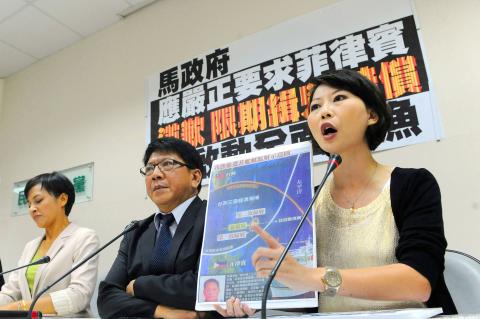
Photo: CNA
Another KMT lawmaker, Su Ching-chuan (蘇清泉), called on the government to launch air and naval forces to safeguard Taiwanese fishing boats during the bluefin tuna season, which begins in March and ends in June.
In accordance with international law, the manner in which the Philippines attacked the unarmed fishing vessels was tantamount to “an act of piracy,” KMT Legislator Chiu Wen-yen (邱文彥) said.
People First Party Legislator Thomas Lee (李桐豪) agreed with Chiu, saying the government “should not be soft-hearted in the face of pirate attacks.”
In addition to defending against aggressive behavior, the government could also consider imposing economic sanctions on the Philippines, including reducing the number of migrant workers allowed into Taiwan and elevating the travel advisory notice to the Philippines to the highest level, Lee said.
Meanwhile, KMT Legislator Alex Tsai (蔡正元) posted a message on his Facebook page saying: “It’s not an incident. It’s a war. Taiwan should attack and sink all Philippines government vessels once they sail into the waters, without exception.”
KMT Legislator Lin Yu-fang (林郁方) urged the Coast Guard Administration and the navy to “make proper preparations for possible conflict” in the South China Sea.
“The government should increase the frequency of patrols and extend the airport runway at [Taiwan-controlled] Taiping Island (太平島, Itu Aba),” Lin said.
Democratic Progressive Party (DPP) Legislator Hsiao Bi-khim (蕭美琴) said she did not want to see the incident escalate into a more serious conflict, but stressed that the Philippines needed to conduct a thorough investigation and handle the issue with the utmost sincerity.
Meanwhile, DPP Chairman Su Tseng-chang (蘇貞昌) yesterday demanded that President Ma Ying-jeou’s (馬英九) government ask for international reparations from the Philippine government.
Su said in a Facebook post that “only by such a move could Hung’s death be justified and his spirit appeased.”
Taiwan is a maritime nation and the government should establish a comprehensive security web for the nation’s fishing industry, he added.
This is not a singular incident, Su said, adding that it was a topic concerning national security and regional relations.
Taiwan must interact with its neighboring nations and in the process set up systems and standards for future governments, he said
Former DPP chairperson Tsai Ing-wen (蔡英文) also issued a statement, saying she was sad and regretted to learn of the incident.
The government must do something about the incident, Tsai said, who also issued a call for the Philippine government to immediately launch a judicial investigation into the incident.
Additional reporting by CNA
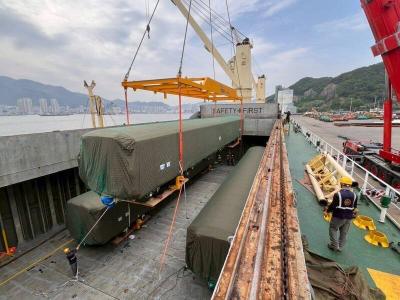
The first of 10 new high-capacity trains purchased from South Korea’s Hyundai Rotem arrived at the Port of Taipei yesterday to meet the demands of an expanding metro network, Taipei Rapid Transit Corp (TRTC) said yesterday. The train completed a three-day, 1,200km voyage from the Port of Masan in South Korea, the company said. Costing NT$590 million (US$18.79 million) each, the new six-carriage trains feature a redesigned interior based on "human-centric" transportation concepts, TRTC said. The design utilizes continuous longitudinal seating to widen the aisles and optimize passenger flow, while also upgrading passenger information displays and driving control systems for a more comfortable
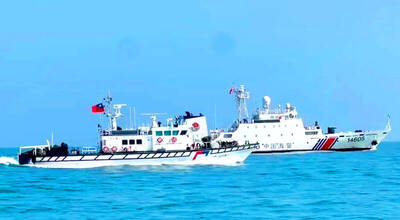
Instead of focusing solely on the threat of a full-scale military invasion, the US and its allies must prepare for a potential Chinese “quarantine” of Taiwan enforced through customs inspections, Stanford University Hoover fellow Eyck Freymann said in a Foreign Affairs article published on Wednesday. China could use various “gray zone” tactics in “reconfiguring the regional and ultimately the global economic order without a war,” said Freymann, who is also a nonresident research fellow at the US Naval War College. China might seize control of Taiwan’s links to the outside world by requiring all flights and ships entering or leaving Taiwan
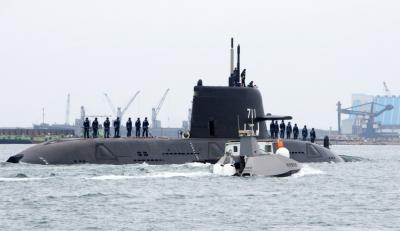
Taiwan's first indigenous defense submarine, the SS-711 Hai Kun (海鯤, or Narwhal), departed for its 13th sea trial at 7am today, marking its seventh submerged test, with delivery to the navy scheduled for July. The outing also marked its first sea deployment since President William Lai (賴清德) boarded the submarine for an inspection on March 19, drawing a crowd of military enthusiasts who gathered to show support. The submarine this morning departed port accompanied by CSBC Corp’s Endeavor Manta (奮進魔鬼魚號) uncrewed surface vessel and a navy M109 assault boat. Amid public interest in key milestones such as torpedo-launching operations and overnight submerged trials,
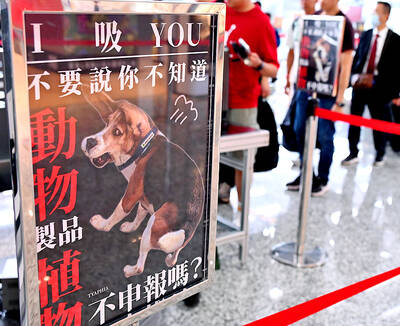
Quarantine awareness posters at Taiwan Taoyuan International Airport have gone viral for their use of wordplay. Issued by the airport branch of the Animal and Plant Health Inspection Agency, the posters feature sniffer dogs making a range of facial expressions, paired with advisory messages built around homophones. “We update the messages for holidays and campaign needs, periodically refreshing materials to attract people’s attention,” quarantine officials said. “The aim is to use the dogs’ appeal to draw focus to quarantine regulations.” A Japanese traveler visiting Taiwan has posted a photo on X of a poster showing a quarantine dog with a


 RSS
RSS