


Nearly 100 residents of Taipei’s Huaguang Community (華光社區) and their supporters yesterday clashed with police outside the Executive Yuan during a protest against a forced demolition of their houses scheduled to take place next week.
“Premier, come out,” the residents and their supporters chanted as they pushed forward and clashed with police officers holding riot shields.
“The land on which our community stands used to be unwanted, but now that real-estate prices are going up, we’re facing forced eviction,” Chu Yi-chen (朱義珍) said. “We are not trying to make some illegal profits, we just want a home where we may stay without any worries.”
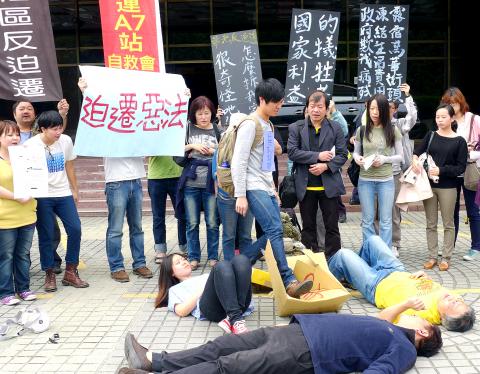
Photo: CNA
The residents are angry because despite their protests and petitions, the government has decided to start the demolition on Thursday and has filed lawsuits against residents for “illegally profiting” by occupying government property.
Chen Wei-hui (鄭偉慧), a resident and spokesman for the movement to save the community, said that in addition to some people who have lived in the community for generations, most of the residents are low-ranking soldiers who retreated to Taiwan with the Chinese Nationalist Party (KMT) regime in 1949 after it lost the Chinese Civil War against the Chinese Communist Party.
“They came with the KMT government, they had nowhere to stay and were told that they may settle where they live now because the government had nowhere else to settle them,” Cheng said. “Despite the living conditions, most of the residents and their families have lived in the community for decades without any problems, they are provided with electricity and water, and they pay taxes.”
“All of a sudden, they are told to leave without any settlement plan — although the Taipei City Government once promised them a new community — and those who are unwilling or unable to move are being sued and will have to pay millions of New Taiwan dollars in compensation to the government,” Cheng said. “How does that make any sense?”
Not having received a positive response from the government, the protesters vowed to launch larger protests on the days the demolitions are scheduled.
Separately yesterday, the Taipei City Government said it would provide public housing units for Huaguang Community residents and help them with their relocation.
Taipei City Government spokesman Chang Chi-chiang (張其強) said the city government would take the initiative to offer 57 public housing units in Nankang District (南港) and Shilin District (士林) to residents of the community and would relax limitations on applications to help the residents settle in their new homes.
The Taipei City Government’s Department of Urban Development has given information about the housing units to the central government, and the city government would start preparing to move people after the central government provides a list of eligible applicants, Chang said.
“The city government has also urged the Executive Yuan to delay the demolition of the community until the city government comes up with a relocation plan,” he said.
Chien Se-fang (簡瑟芳), a division chief in the department, said the department would relax regulations on applications for the public housing as most of the residents are aged 45 years and older.
The regulations on the public housing rentals state that applicants must be between 20 and 45 and have their household registered in Taipei. The applicants should also be recently married and have children, and should not own any property, while their annual income must be less than NT$1.7 million.
Chien said the department would ignore the regulations relating to age and marital status for residents of the community, and would assist eligible applicants moving to public housing units.
The monthly rent of the housing units ranges from NT$12,500 to NT$13,800.
The city government would also help six low-income families move to low-cost housing units in Wenshan District (文山) and Wanhua District (萬華), she said.

Considering that most countries issue more than five denominations of banknotes, the central bank has decided to redesign all five denominations, the bank said as it prepares for the first major overhaul of the banknotes in more than 24 years. Central bank Governor Yang Chin-lung (楊金龍) is expected to report to the Legislative Yuan today on the bank’s operations and the redesign’s progress. The bank in a report sent to the legislature ahead of today’s meeting said it had commissioned a survey on the public’s preferences. Survey results showed that NT$100 and NT$1,000 banknotes are the most commonly used, while NT$200 and NT$2,000

The Centers for Disease Control (CDC) yesterday reported the first case of a new COVID-19 subvariant — BA.3.2 — in a 10-year-old Singaporean girl who had a fever upon arrival in Taiwan and tested positive for the disease. The girl left Taiwan on March 20 and the case did not have a direct impact on the local community, it said. The WHO added the BA.3.2 strain to its list of Variants Under Monitoring in December last year, but this was the first imported case of the COVID-19 variant in Taiwan, CDC Deputy Director-General Lin Ming-cheng (林明誠) said. The girl arrived in Taiwan on

South Korea is planning to revise its controversial electronic arrival card, a step Taiwanese officials said prompted them to hold off on planned retaliatory measures, a South Korean media report said yesterday. A Yonhap News Agency report said that the South Korean Ministry of Foreign Affairs is planning to remove the “previous departure place” and “next destination” fields from its e-arrival card system. The plan, reached after interagency consultations, is under review and aims to simplify entry procedures and align the electronic form with the paper version, a South Korean ministry official said. The fields — which appeared only on the electronic form

The Ministry of Foreign Affairs (MOFA) is suspending retaliation measures against South Korea that were set to take effect tomorrow, after Seoul said it is updating its e-arrival system, MOFA said today. The measures were to be a new round of retaliation after Taiwan on March 1 changed South Korea's designation on government-issued alien resident certificates held by South Korean nationals to "South Korea” from the "Republic of Korea," the country’s official name. The move came after months of protests to Seoul over its listing of Taiwan as "China (Taiwan)" in dropdown menus on its new online immigration entry system. MOFA last week


 RSS
RSS