

This weekend about 20 wooden boats, 30m-long and powered by about 100 rowers each, would slice through Kerala’s backwaters to compete for the most prestigious trophy in the centuries-old sport of vallam kali, or snake boat racing.
Thousands are to cheer on from the shore and houseboats as the slender vessels, whose raised sterns give them a cobra-like appearance, race for village pride on a 1.4km course at Punnamada Lake.
As well as the splashing of hundreds of oars hitting the water in unison more than 90 times per minute, the rowing is accompanied by a cacophony of chants and whistles as well as the thunderous beat of thick wooden poles pounding on the deck.
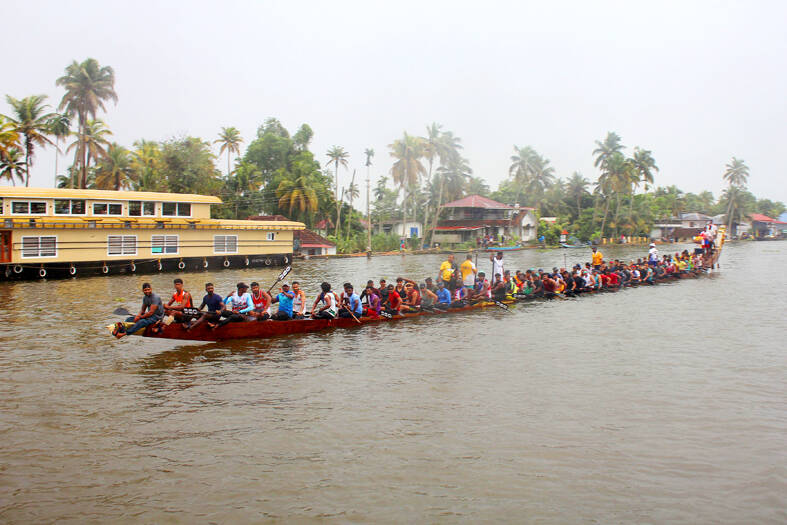
Photo: Reuters
The Alappuzha district, which used to be known as the rice bowl of Kerala because of the proliferation of paddy fields, contain some of the lowest lying land in India and is prone to flooding during the monsoon rains.
However, while most villagers check the swollen Pamba River each monsoon morning with trepidation, Vakkachan Theverkkat sees opportunity — another chance to train his roster of 150-odd rowers.
Vakkachan is a former senior oarsman with a lot of experience of racing the massive boats that compete across a three-to-five month season, including Saturday’s prestigious Nehru Trophy.
“It runs in my family,” said Vakkachan, the leading captain of the Kainakary-based United Boat Club (UBC), which has been competing for the Nehru Trophy since 1963 and won it 12 times.
“Our club has won the Nehru Trophy the most times and also lost it the most times,” he said.
Deadly floods killed 28 people and displaced thousands across Kerala this month and parts of Kainakary were also affected.
Several roads became inaccessible as houses and churches stood half-submerged, surrounded by paddy fields that had swollen into lakes.
Yet UBC’s rowers — mostly locals, but including oarsmen from distant states such as Uttarakhand and Manipur — maintained their rigorous practice schedule, often twice daily.
UBC are rated a decent chance for a 13th triumph as they have been hired to row Veeyapuram, the boat which won the Nehru Trophy and the Champions Boat League last season in the hands of the Village Boat Club.
Like most chundan vallam, or snake boats, Veeyapuram is community-owned and belongs to a village of the same name some 30km south of Kainakary.
Hundreds of villagers raised about 9 million Indian rupees (US$94,300) to launch the boat — nicknamed Vicious Veeru — in 2019.
Funding each season costs nearly 7 million rupees (US$73,000), with the boat owners earning back only a fraction from sponsors and prize money.
While the Kerala government often uses snake boat races to promote tourism, shareholder Manikanthan Nair TM said the boat-owning communities get little help as they battle financial hardship and natural disasters to keep the sport alive.
However, Kamarudeen KA, the secretary of the Veeyapuram ownership group, said that they would not give up the tradition despite the challenges.
“As long as we’re here, we’ll keep [this boat] running,” he said.
“People speak of it proudly and with admiration. We feel proud that this boat has given us that recognition and identity.”
Originally designed as battle canoes in the 13th century, the snake boats have become unlikely symbols of unity in a culturally diverse state.
A green Islamic prayer cloth, a Hindu flower garland and a Christian cross hang together on Veeyapuram, which was blessed by priests of all three religions.
“There’s no barrier like religion or caste when it comes to the boat... we all pray for its success,” said Robin Varghese, a Christian priest and member of the Veeyapuram committee.
The sport weaves prayer into competition as well with the rhythmic songs chanted during the race drawing on Hindu, Christian and Islamic religious traditions.
“This is our blood and culture,” UBC secretary Sajimon B said.
Boats can compete for decades. The Karichal snake boat, launched in 1970, narrowly beat Veeyapuram to win the 2024 Nehru Trophy.
When a snake boat is retired, it is cremated like a person and a ritual is held to transfer its soul to a new vessel.
“He’s our kid... he decides what to do with himself,” Manikanthan said of Veeyapuram.
“The holy river gives him everything he needs to win this season, that’s what we pray.,” he said.

The Toronto Blue Jays’ Louis Varland and Spencer Miles hold up puppies after the president of the Humane Society threw the ceremonial first pitch before a baseball game against the New York Yankees in Toronto on Friday.

On a Manila court made of crushed seashells, an earnest four-year-old sends a forehand sailing wide — one of dozens of children aiming to follow in the footsteps of the Philippines’ first homegrown tennis sensation, Alexandra Eala. The 21-year-old’s rise has sparked a rush of interest in a sport typically seen as the preserve of the elite in a country best known for its love of basketball, boxing and cockfighting. Racket sales are up and scoring one of the few available playing venues has become next to impossible as parents cram their pre-schoolers onto practice courts. “Apart from just bringing in people to

Freddie Freeman apparently avoided serious injury on Wednesday when the Los Angeles Dodgers’ first baseman took a frightening tumble down the stairs and into the visitors’ dugout while trying to catch a foul popup in the eighth inning. Freeman was not sure whether he would play when the Dodgers begin an important four-game series with the MLB-leading Milwaukee Brewers, but he is grateful his freefall to the dugout floor was not worse. “I didn’t hit my head, so that was the key part there,” Freeman said. “I am sore. Kneecaps are sore. Shoulder is sore. Hand sore. Wrist sore. I mean, I

Paul O’Donnell was struggling in the marathon on Sunday morning. The Irish fans got him home. “It was incredible, to see green and the tricolors all over the course,” the Irishman said. “The support kept me going. It was much appreciated. It was just a roar, ‘Go Ireland, go Paul.’” Whether waving flags or roaring for their athletes, Irish fans have made their mark at the European Athletics Championships in Birmingham. Ireland’s athletes have noticed, as have broadcasters and organizers. “It feels like a home championships,” said O’Donnell, who finished 43rd. The Games’ official social media account posted: “Beginning to think the Irish fans


 RSS
RSS