


Japanese players are moving to English soccer in record numbers and more look set to follow with clubs attracted by their quality, strong work ethic and value for money.
Kaoru Mitoma is the standout talent of five Japanese players in the English Premier League, with eight more in the Championship and two in League One.
Liverpool midfielder Wataru Endo, the captain of Japan, believes his compatriots are “being held in higher esteem” by English clubs compared with the past.
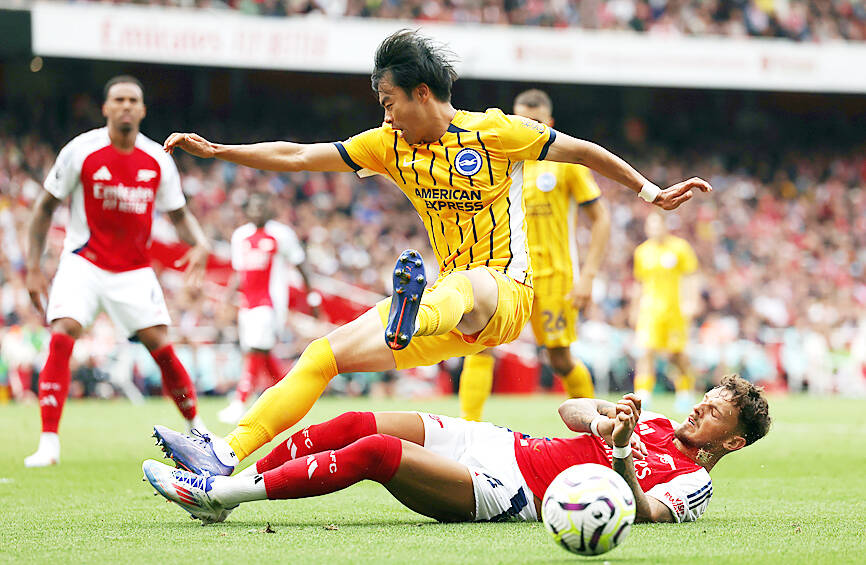
Photo: EPA-EFE
“The staff at Liverpool ask me about lots of Japanese players, not necessarily with a view to a transfer, but just saying this or that player is a good player,” Endo said. “It feels like there is more interest in Japanese players from around the world.”
Currently also in England’s top flight are Daichi Kamada (Crystal Palace), Takehiro Tomiyasu (Arsenal) and Yukinari Sugawara (Southampton).
Japanese players have had mixed success in the Premier League since Junichi Inamoto became the first when he joined Arsenal in 2001. Inamoto left for Fulham after a single season where he failed to make a league appearance for the Gunners.
Shinji Kagawa won the Premier League with Manchester United in 2012-2013, but drifted to the margins after a bright start and returned to Borussia Dortmund after an up-and-down two years.
FIFA-registered agent Joel Pannick, who has 50 Japanese players on his books, says English clubs previously had “a bit of a fear of Japanese players.”
“The stereotypical approach would be that the player would be technically very good, but would they be physical enough? Would they be strong enough?” Pannick said. “Previously maybe Japanese players were pigeonholed — they go to Germany or Holland [Netherlands], where it’s more technical.”
Pannick says the recent success of Japanese players at British clubs, especially at Celtic under former J.League and now Tottenham Hotspur coach Ange Postecoglou, has helped change perceptions.
He also says the COVID-19 pandemic changed the way clubs scout players, making video footage and data from around the world more readily available.
“Teams wouldn’t want to spend the time and money taking a risk going to a place far away when they don’t know what they’re going to see when they get there,” he said. “Now that everything is available to watch hours or minutes after the match, it has removed any fear of ‘should the Japanese market be one that we look at?’”
Relatively cheap transfer fees have made Japanese players a canny investment, with Pannick calling them “more attractively valued than the equivalent player from anywhere else in the world.”
Brighton paid just £2.5 million (US$3.3 million) to sign the winger Mitoma from the J.League in 2021, while prolific goalscorer Kyogo Furuhashi joined Celtic for £4.5 million the same year.
Furuhashi was heavily linked with Manchester City this summer.
The prices mean that in recent transfer windows it has mostly been Championship clubs entering the market for Japanese players.
Japan coach Hajime Moriyasu says players are willing to play in the second tier and work their way up.
“The J.League is a very good league, but the players want to play at the highest level,” Moriyasu said. “The Premier League is where the best players in the world are and they want to be there, too. I think a lot of players have moved to the Championship with a view to making the step up.”
Pannick says post-Brexit changes to work permit rules have forced English clubs to look beyond Europe for signings and be “more open-minded and creative.”
Japan’s performances at the World Cup, which included wins over Germany and Spain in Qatar in 2022, have put their players firmly in the shop window.
Pannick says they have the mentality to make the most of the opportunity.
“With the players I’ve worked with, if something hasn’t gone right, if they’ve been taken out of the team or if they’re asked to play in a position that’s not their favorite, the default response is: ‘What can I do better?’” he said. “The players identify themselves as ambassadors of Japan and they want to give a good account of themselves.”

Brice Turang and Pete Crow-Armstrong’s consecutive RBI singles proved to be the difference in the US’ 5-3 win over Canada in a World Baseball Classic (WBC) quarterfinal on Friday night in Houston. The US faces the Dominican Republic, which crushed South Korea 10-0 in seven innings in its quarter-final, in a semifinal Sunday in Miami for a spot in Tuesday’s championship. The Dominican team has won all five games in this WBC by a combined margin of 51-10. It appeared the US squad was headed toward a cozy victory when it built a 5-0 lead by the sixth inning. A first-inning RBI groundout

Wilyer Abreu watched the ball leave the park and tossed his bat high in the air. His Venezuela teammates streamed out of the dugout in celebration. The comeback was on and the win over the reigning World Baseball Classic (WBC) champion Japan was within reach. Japan, their 11-game WBC winning streak on the line, held a 5-4 lead in the sixth inning of Saturday’s thrilling quarter-final matchup when Abreu put his team ahead with the biggest swing of the game: a three-run shot off Hiromi Itoh that sent the loanDepot Park crowd into a passionate roar and helped seize Venezuela’s 8-5
A BREATHLESS BATTLE: France clinched the championship in a vicious back-and-forth match with England, denying Ireland the title by just a few points France won back-to-back Six Nations titles after beating England 48-46 on a last-second penalty-kick by Thomas Ramos in a thriller for the ages on Saturday. England scored their seventh try in the 77th minute and converted for 46-45. If the score held for a few more minutes, Ireland would have been crowned the champion. But France pressed yet again with 14 men, lost possession, regained it, and earned two simultaneous penalties after the fulltime siren. Captain Antoine Dupont debated with referee Nika Amashukeli where the penalty spots were. Ramos, who did not miss a goal-kick all night, finally lined up his seventh

Uni-President 7-Eleven Lions’ outfielder Chen Chieh-hsien, who fractured his left index finger earlier during the World Baseball Classic (WBC), is expected to be sidelined for four to six weeks. The Uni-Lions confirmed in a news statement on Friday that Chen had a distal fracture in his left index finger. The diagnosis followed X-ray and CT scans conducted at the Kaohsiung Chang Gung Memorial Hospital earlier that day. According to the club, the injury would require four to six weeks to heal. During this period, Chen must wear a protective splint but is permitted to engage in light, sport-specific training. The team plans to


 RSS
RSS