


The WTA’s decision last week to return to China, despite unresolved questions around the safety of player Peng Shuai, betrays the financial and strategic importance of the country to the tennis organization, analysts and former players say.
Peng, a former doubles world No. 1, has not been seen outside China since 2021, when she made — and then withdrew — accusations of sexual assault against a high-ranking official.
The WTA had previously said they would not return to China without a formal investigation into the allegations and an opportunity to meet privately with Peng.
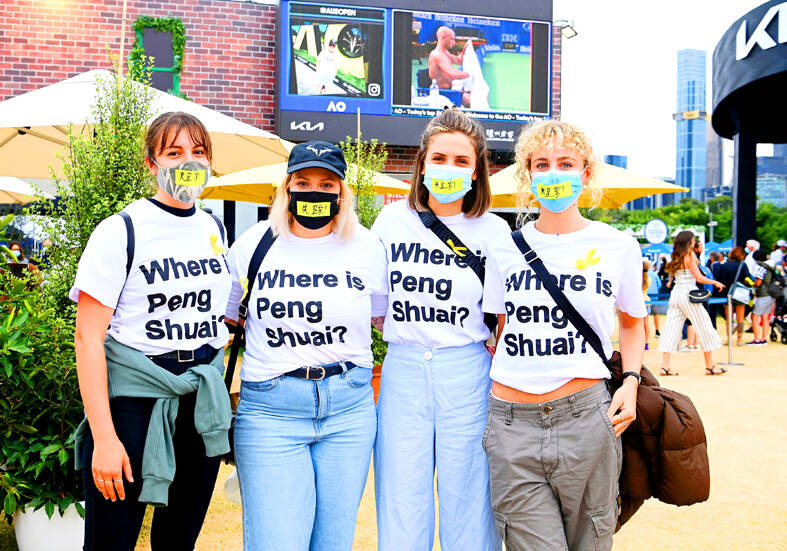
Photo: Reuters
However, on Thursday it backed down, saying it had concluded “we will never fully secure those goals, and it will be our players and tournaments who ultimately will be paying an extraordinary price for their sacrifices.”
The move was widely seen as a capitulation, and some questioned whether the boycott had ever been sincere.
Most major sports events in China were canceled anyway over the past few years because of Beijing’s strict COVID-19 policies.
The WTA’s Chinese-language statement announcing the return was just a few lines long, and did not mention Peng at all — in contrast to a lengthy English one that detailed the saga.
Human Rights Watch described the move as “a huge disappointment for the Chinese human rights community.”
“It is not surprising, though, given the money at stake and the record of other international businesses in China,” the organization said in a statement.
Former player Anne Keothavong put it more bluntly.
“Tennis is a business,” she told British media. “The WTA need to generate commercial revenue and the players need a circuit to compete.”
From 2015 onward, China became a huge source of income for the WTA, culminating in a 10-year contract in 2018 to make Shenzhen the host of its traditional end-of-season tournament.
Giving that event to a country that already had nine other tournaments worth tens of millions of dollars did not look like a risky strategy at the time. Shenzhen’s bid doubled the US$7 million total prize money for the event, with Ashleigh Barty claiming a record-setting US$4.4 million paycheck there in 2019 — the largest sum ever awarded in men’s and women’s tennis.
The WTA has suffered deep financial losses recently, with Chinese tournaments canceled due to the pandemic. The total prize money for the 2021 Guadalajara and last year’s Fort Worth WTA Finals was just US$5 million, which the WTA had to pay itself.
The ATP men’s circuit, which never joined the boycott, has scheduled four tournaments in China this year, raising fears the financial gap between the men’s and women’s games could widen even further.
The ATP “were straight back to China as soon as they could and almost before the pandemic had ended,” China-based sports analyst Mark Dreyer said. “They were like, we don’t want to get caught up in this thing because we’re going to lose out on Chinese money.”
The WTA told the BBC that the “great majority” of players were in support of going back to China.
World No. 5 Caroline Garcia called the return “very important.”
Aside from the huge sums currently up for grabs in China, the country is also crucial to the WTA’s blueprint for the future.
“China rapidly became the center of the WTA’s plans for growth” after Li Na became the country’s first Grand Slam champion in 2011, wrote the Guardian’s tennis reporter Tumaini Carayol.
The influx of money and interest in the sport was welcomed by athletes.
When the Shenzhen deal was announced, Maria Sharapova said the championship was heading to a place “that’s willing to invest in women’s tennis.”
In 2021, there were 50,000 tennis courts in China and 20 million players, the latter second only to the US, the International Tennis Federation said.

Brice Turang and Pete Crow-Armstrong’s consecutive RBI singles proved to be the difference in the US’ 5-3 win over Canada in a World Baseball Classic (WBC) quarterfinal on Friday night in Houston. The US faces the Dominican Republic, which crushed South Korea 10-0 in seven innings in its quarter-final, in a semifinal Sunday in Miami for a spot in Tuesday’s championship. The Dominican team has won all five games in this WBC by a combined margin of 51-10. It appeared the US squad was headed toward a cozy victory when it built a 5-0 lead by the sixth inning. A first-inning RBI groundout

Wilyer Abreu watched the ball leave the park and tossed his bat high in the air. His Venezuela teammates streamed out of the dugout in celebration. The comeback was on and the win over the reigning World Baseball Classic (WBC) champion Japan was within reach. Japan, their 11-game WBC winning streak on the line, held a 5-4 lead in the sixth inning of Saturday’s thrilling quarter-final matchup when Abreu put his team ahead with the biggest swing of the game: a three-run shot off Hiromi Itoh that sent the loanDepot Park crowd into a passionate roar and helped seize Venezuela’s 8-5

A BREATHLESS BATTLE: France clinched the championship in a vicious back-and-forth match with England, denying Ireland the title by just a few points France won back-to-back Six Nations titles after beating England 48-46 on a last-second penalty-kick by Thomas Ramos in a thriller for the ages on Saturday. England scored their seventh try in the 77th minute and converted for 46-45. If the score held for a few more minutes, Ireland would have been crowned the champion. But France pressed yet again with 14 men, lost possession, regained it, and earned two simultaneous penalties after the fulltime siren. Captain Antoine Dupont debated with referee Nika Amashukeli where the penalty spots were. Ramos, who did not miss a goal-kick all night, finally lined up his seventh

Uni-President 7-Eleven Lions’ outfielder Chen Chieh-hsien, who fractured his left index finger earlier during the World Baseball Classic (WBC), is expected to be sidelined for four to six weeks. The Uni-Lions confirmed in a news statement on Friday that Chen had a distal fracture in his left index finger. The diagnosis followed X-ray and CT scans conducted at the Kaohsiung Chang Gung Memorial Hospital earlier that day. According to the club, the injury would require four to six weeks to heal. During this period, Chen must wear a protective splint but is permitted to engage in light, sport-specific training. The team plans to


 RSS
RSS