


It is the world’s longest certified foot race: a 4,989km run that takes participants around the same New York block 5,649 times.
Thousands of people have climbed Everest — but just 49 have completed the Sri Chinmoy Self-Transcendence 3,100 Mile Race, organizers say.
Runners finish more than two marathons a day for almost two months, on less than five hours of sleep a night.
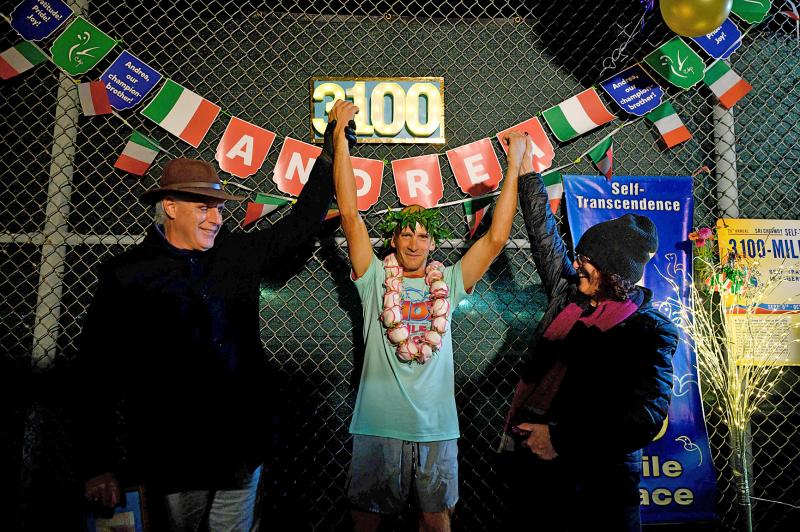
Photo: AFP
They cannot rely on changing scenery to keep them motivated as the route is a 883m loop on a concrete sidewalk around a high school in Jamaica, Queens. To mix things up a bit, they alternate between running clockwise one day and anti-clockwise the next.
“Definitely monotony,” said this year’s winner, Andrea Marcato, describing the biggest test of the race.
“The first week is quite challenging, especially for the mind, but after a while you get used to it. You have to accept that every day is going to be the same,” he said.
Participants have 52 days to run 4,989km, meaning they must average 96km every day.
They run, walk and hobble between 6am and midnight, eating as they go to make up for the estimated 10,000 calories they burn during every session. For the day’s other six hours they sleep, wash and care for their blistered feet in nearby accommodation.
Only ultramarathon veterans who have completed six-day races are allowed to enter.
“It’s a test of stamina, strength, inner determination and talent,” race director Sahishnu Szczesiul said.
Harita Davies, the only woman among this year’s seven competitors, said the race takes a physical toll, but “the kind of unbelievable thing is that as the days and weeks go by your body actually does adapt, you do get stronger.”
Indian spiritual leader Sri Chinmoy, who lived in New York before his death in 2007, founded the run in 1997. He advocated “self-transcendence,” using spirituality to go beyond the limits of what a person thinks they can achieve.
Runners in the 25th edition, which began on Sept. 5, said achieving a meditative state was key to completing the race.
“If the mind is focused, you don’t have other thoughts or fears or worries or doubts,” 39-year-old Marcato said.
However, meditating while navigating the loop around Thomas A. Edison Career and Technical Education High School is not easy. Runners go past a busy highway and basketball and handball courts. The route is not cordoned off from everyday life and twice a day 2,000 schoolchildren flood the sidewalk.
Forty-seven-year-old Davies listens to music, audiobooks and recordings of inspiring quotes.
“When you first come here you think: ‘Oh my god it’s a concrete jungle,’ but you can find beauty everywhere. You can look at the sky, the trees, the birds, the people,” the New Zealander said.
The runners, who are also from Taiwan, Japan, Russia, Slovakia and Ukraine, have a small aid station at their disposal where a doctor is on hand to tend to blisters and shin splints.
Volunteers hand participants copious helpings of food — from healthy vegan meals and juices to donut holes, ice-cream and sometimes Chinese takeout.
A recreational vehicle with a bed provides for quick power naps, while a rickety scoreboard displays the number of kilometers completed by each runner.
Supporters come by to clap, while residents shout words of encouragement, although not everyone is sure what is going on.
“I grew up here and had no idea that it was a race. I just figured they were really into jogging,” 34-year-old Julio Quezada said.
The race returned to New York after occurring in Austria last year due to the COVID-19 pandemic.
Marcato, from Italy, completed the race on Sunday in less than 43 days, with an average of more than 116km per day.
He tore through some 16 pairs of shoes in the process and receives a trophy but no prize money.
“This is the ultimate. It was my dream and here I am,” the ultra-marathoner said. “The last two laps I was completely disconnected from my body. I didn’t feel any pain. It was a really special sensation.”
When the race ends, the healing process begins, which means lots of rest, sleep, food and patience, but one element of the recovery is perhaps the hardest.
“Getting used to being back to regular life,” Davies said. “This race really simplifies your life, because you don’t have to think about anything else except running.”


“I don’t remember the moment, but ever since I was a kid, that’s the first thing I loved,” two-time NBA All-Star Isaiah Thomas said of his lifelong romance with basketball. However, that journey unfolded against the limitations of his size in a game where height often dictates opportunity — a reality he confronted throughout his career. At 175cm, Thomas is less than 2cm taller than the average Taiwanese adult male, while NBA players during his career stood at about 200cm on average. Compared with the NBA’s average career length of less than five years, Thomas’ 13-season career stands out as

Dakar and Rabat have longstanding ties, but relations have been strained since the Africa Cup of Nations (AFCON) final, which Senegal won in mid-January before being stripped of the title, which was transferred to Morocco. Now, the AFCON trophy is something of a thorn in the two countries’ sides. On Rue Mohamed V, the street where Moroccan vendors are based in the Senegalese capital, a police van is parked. “The police have been on high alert since the Confederation of African Football [CAF] decided to award the title to Morocco, but there have been no incidents,” a local resident said.

Top seeded Jessica Pegula on Friday once again fought back from a set down to reach the WTA Charleston Open semi-finals with a 3-6, 6-3, 6-2 win against Russia’s Diana Shnaider. Defending champion Pegula has lost the first set in all three of her matches at the tournament so far, but again dug deep to maintain her hopes of retaining the title. The world No. 5 from the US took 2 hours, 10 minutes to defeat 19th-ranked Shnaider, relying on a formidable service game that included eight aces. Shnaider battled well in the first two sets and broke early for a 2-0 lead
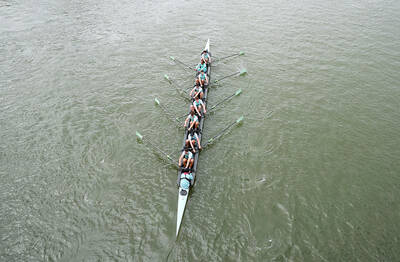
Cambridge on Saturday made it four wins in a row as they comprehensively defeated Oxford in the 171st University Boat Race on London’s River Thames. It was Cambridge’s seventh win in the past eight years of a rowing race between England’s two oldest universities first staged in 1829. A world-class Cambridge crew were heavy favorites for victory. However, four minutes into the race, the crews came close to a clash of oars which could have caused severe disruption, with Oxford repeatedly warned as both team chased faster conditions in the middle of the river. For the first time in the


 RSS
RSS