


Japanese nurse Arisa Tsubata has trained around her work shifts for more than a year to prepare for a final Olympic boxing qualifier in the hope of making it to the Tokyo Games this summer.
That dream was shattered after the International Olympic Committee (IOC) canceled the boxing qualifier to take place next month and said it would allocate spots to athletes based on their world rankings.
The change in criteria has effectively shut the door on many Olympic hopefuls such as Tsubata, whose rankings are not good enough to earn them an automatic qualification for the Olympic Games in Tokyo.
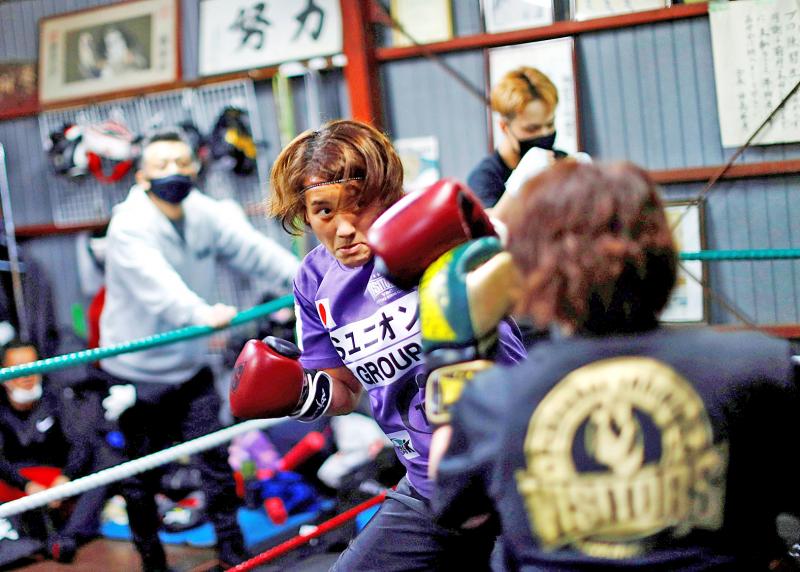
Photo: Reuters
Other qualifying competitions for the Olympics have also been canceled.
In order to focus on her boxing, the 27-year-old quit her job at a major hospital in January to take on a less demanding and lower paid position at a smaller psychiatric clinic.
Since then, she has trained more than three hours per day during the week and extra hours on Saturdays, only taking Sundays off to rest or to get a massage.
“It’s very disappointing,” said Tsubata, who works at the Life Support Clinic in Tokyo. “I had been working so hard for a year after the postponement of the Olympics, and it’s so frustrating that I don’t even have the right to compete.”
Japan has said that the Olympic Games, delayed last year due to the COVID-19 pandemic, would go ahead, but questions remain over how it would hold the massive sporting event as the country fights a fourth wave of COVID-19 infections.
“‘Why did I aim for the Olympics when the coronavirus happened?’ I asked myself,” she said, adding: “Who knew the coronavirus pandemic would come at this time?”
Her feelings of frustration and uncertainty are shared by many athletes whose careers have been thrown into limbo, after the pandemic dashed some people’s life-long dreams of participating in the global sporting event.
The IOC has a June 29 deadline to wrap up qualifications for this year’s Olympics and with the canceled qualifiers, it has to allocate about 53 spots in boxing across several regions based on ranking points since 2017.
In COVID-19-ravaged India, Santiago Nieva, the head coach of the country’s national boxing team, also remembers the “heartbreaking moment” when he delivered the news to four boxers.
“You feel like you’re taking away their dreams,” Nieva said. “They became depressed ... they were empty, felt empty in the head and body.”
Tsubata started boxing about three years ago to lose weight, but her training coaches quickly encouraged her to compete, and she went on to win Japan’s national boxing championship for the middleweight division in 2019.
As a nurse and a boxer, she has mixed feelings about whether the Olympics due to start in July should go ahead as cases rise.
“As an athlete, considering fellow athletes waiting for this moment, and especially seeing my chance being taken away, I think the Olympics should happen,” she said.
As a nurse, she said that it “might be difficult” for Japan to hold the Games if the spread of COVID-19 is not contained.
For now, Tsubata is trying to stay positive, and is preparing for her international debut at a tournament in Russia this month.
She said that it is too early to think about the Olympic Games in Paris in 2024 and worries she might be too old by then to keep up with the physical strength needed to compete.
“I can’t say I am aiming for the next Olympics in Paris, but what I can do is try to keep working hard step by step, at any competitions ahead, small or big,” Tsubata said.
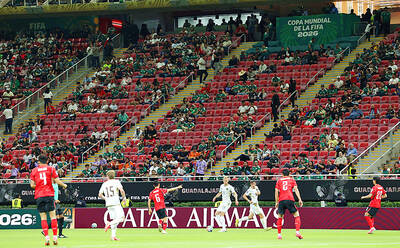
FIFA on Friday blamed the empty seats during the FIFA World Cup match between South Korea and the Czech Republic in Guadalajara, Mexico, on fans who watched from the concourses. There were many visible empty spots at the 45,664-capacity Guadalajara Stadium, with sections in the middle of the stands showing many unoccupied spaces and with other empty seats scattered around the venue. The announced attendance was 44,985 — including FIFA president Gianni Infantino. “Official attendance figures reflect the number of tickets scanned and spectators present within the stadium footprint, rather than visual assessments of seating occupancy at any given moment
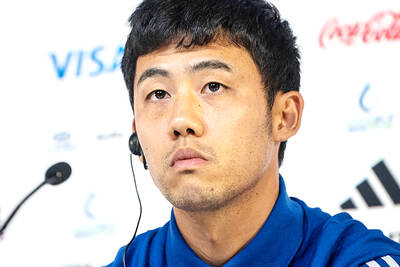
Japan captain Wataru Endo on Thursday was ruled out of the FIFA World Cup with injury and announced his international retirement, three days before his team’s opener against the Netherlands. The Liverpool midfielder pulled out of the tournament after failing to recover from a foot injury and was replaced in Japan’s squad by Shuto Machino. The 33-year-old Endo said on social media that he was “frustrated” at not being able to play, but backed his team to impress in Group F, where they face the Netherlands, Tunisia and Sweden. “There will definitely come a time in the future when Japan win the World

A rotting body was found on Friday in the trunk of a car parked near the stadium where Iran’s FIFA World Cup team is training in Mexico. The gruesome discovery came with games under way in the tournament, which is being jointly hosted by Mexico, the US and Canada. Reporters watched as police in Tijuana opened the trunk of the gray Toyota SUV, which had California plates, in the parking lot of a supermarket directly across from the Caliente Stadium, where Team Melli are training as they prepare for three games in the US. Specialists in white protective suits worked
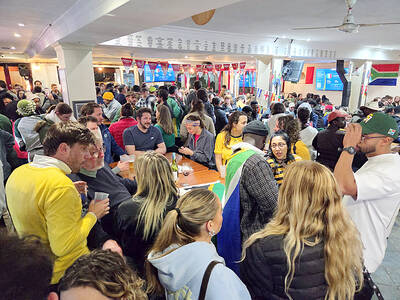
About 100 people gathered at a bar in Taipei to watch the FIFA World Cup start in Mexico, despite the early hour of 3am yesterday. All seats had been reserved before the game started, said a clerk at the Brass Monkey, a bar in Taipei where customers can watch live sports broadcasts. The Group A clash between Mexico and South Africa drew supporters from multiple continents to the venue. For Misael Alanis, a Mexican student who has lived in Taiwan for two-and-a-half years, the atmosphere was just as important as the game itself. “There are a lot of Mexicans here and you can tell


 RSS
RSS