


The postponement of the Tokyo Olympic Games was a heavy blow for many athletes, but a team of South Sudan sprinters training at a Japanese town are hoping to turn the delay into an advantage.
The four athletes and their coach have since November last year been in Maebashi, north of Tokyo, to take advantage of training facilities that are not available in their home country.
After the news that the Games had been postponed over the COVID-19 pandemic, they decided to stay until at least July, hoping to beef up their skills.
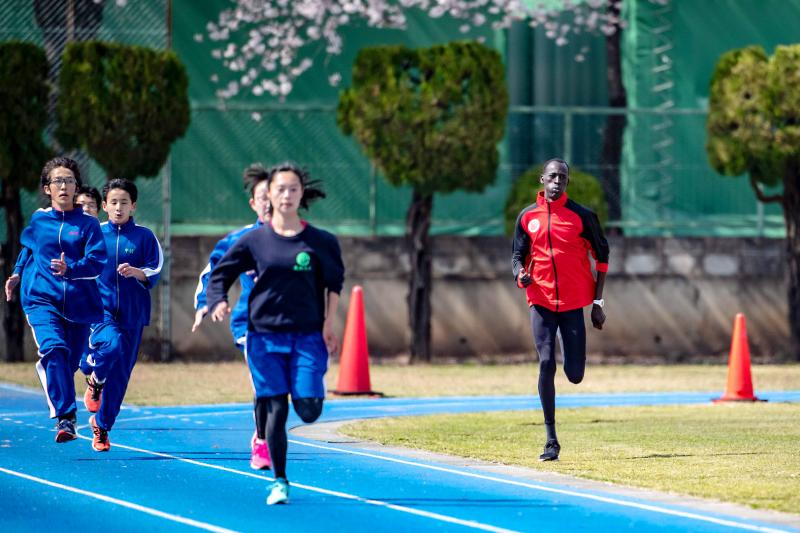
Photo: AFP
“The Tokyo Olympics have been postponed, but it’s not a problem,” team coach Joseph Rensio Tobia Omirok, 59, said. “I’m happy because I’m still training. In other countries, they have no training. They’re sitting in their house, but here we are OK. Training now is going OK.”
The decision to postpone the Games for a year until July 2021 came after athletes and sports associations heaped pressure on organizers and Olympic officials, pointing to scrapped qualifying events and restrictions on training.
Japan has so far avoided the sort of major outbreak seen in Europe and the US, and even a state of emergency declared on Tuesday only applies to some parts of the country. It does not include Gunma Prefecture, where Maebashi is located.
The city of 340,000 has pledged to continue helping the athletes by providing them with accommodation, meals and the use of a public track, along with an army of volunteer coaches and translators.
Maebashi decided to host the team — the coach, one female and two male Olympic sprinters, and one male Paralympic sprinter — as part of its efforts to promote peace through sports.
The athletes have visited local schools and community events to talk about their homeland, which won independence in 2011 and has been battling to recover from a civil war.
They regularly practice with local children and have learned to speak simple Japanese.
The athletes said that they have come to enjoy life in the city, abloom with cherry blossoms after a bitter winter, despite being more than 10,000km from home, where they had to practice on simple empty fields.
“Before I reached Japan, I didn’t know what kind of people the Japanese are,” said Abraham Majok Matet Guem, 20, who runs the 1,500m. “The love I got here ... is more than even what I expected, so I have not missed home so much because I am staying in a very peaceful environment with very loving people. So I was very surprised at that.”
The city has raised more than ¥14 million (US$128,600) from across Japan through a special taxation scheme and is continuing to raise funds to secure the ¥20 million needed to keep the team on through July.
Officials were quick to reassure the team after the Olympic delay was announced that they would be welcome to stay until at least July.
“We are eager to give them our continued support,” Maebashi City Government sports official Shinichi Hagiwara said.
The athletes’ fate after that is to be decided after the city consults with the South Sudanese National Olympic Committee, the Japanese government, the track team and others, Hagiwara said.
The athletes said that their warm reception left them hoping that they might one day be able to welcome their hosts to South Sudan.
“Right now, people are scared to go to South Sudan, but we believe that in the near future, it will be a very peaceful country and everyone will be free to travel there,” Guem said. “We will be happy to see people from Maebashi there also.”
Guem left his mother and seven siblings at home to train in the city for the Games and said that the delay was no more than a minor bump on his Olympic journey.
“My dream has always been that before I retire from athletics, I would become an Olympic medalist,” he said. “I will continue training and it is my hope to one day be a champion — I still have time.”

FIFA on Friday blamed the empty seats during the FIFA World Cup match between South Korea and the Czech Republic in Guadalajara, Mexico, on fans who watched from the concourses. There were many visible empty spots at the 45,664-capacity Guadalajara Stadium, with sections in the middle of the stands showing many unoccupied spaces and with other empty seats scattered around the venue. The announced attendance was 44,985 — including FIFA president Gianni Infantino. “Official attendance figures reflect the number of tickets scanned and spectators present within the stadium footprint, rather than visual assessments of seating occupancy at any given moment
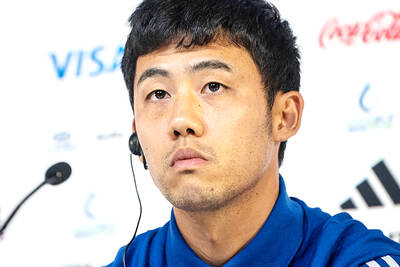
Japan captain Wataru Endo on Thursday was ruled out of the FIFA World Cup with injury and announced his international retirement, three days before his team’s opener against the Netherlands. The Liverpool midfielder pulled out of the tournament after failing to recover from a foot injury and was replaced in Japan’s squad by Shuto Machino. The 33-year-old Endo said on social media that he was “frustrated” at not being able to play, but backed his team to impress in Group F, where they face the Netherlands, Tunisia and Sweden. “There will definitely come a time in the future when Japan win the World

A rotting body was found on Friday in the trunk of a car parked near the stadium where Iran’s FIFA World Cup team is training in Mexico. The gruesome discovery came with games under way in the tournament, which is being jointly hosted by Mexico, the US and Canada. Reporters watched as police in Tijuana opened the trunk of the gray Toyota SUV, which had California plates, in the parking lot of a supermarket directly across from the Caliente Stadium, where Team Melli are training as they prepare for three games in the US. Specialists in white protective suits worked

About 100 people gathered at a bar in Taipei to watch the FIFA World Cup start in Mexico, despite the early hour of 3am yesterday. All seats had been reserved before the game started, said a clerk at the Brass Monkey, a bar in Taipei where customers can watch live sports broadcasts. The Group A clash between Mexico and South Africa drew supporters from multiple continents to the venue. For Misael Alanis, a Mexican student who has lived in Taiwan for two-and-a-half years, the atmosphere was just as important as the game itself. “There are a lot of Mexicans here and you can tell


 RSS
RSS