


A world famous legend recalling how German Luz Long crossed racial barriers to help American rival Jesse Owens qualify for the long jump final at the 1936 Olympics has been downplayed by Long’s son, Kai.
Kai Long said his father, whose actions helped Owens win the gold, prompting a furious Adolf Hitler to leave the stadium early, had simply acted within the old tradition of amateur sportsmanship.
“It was not a question of race, of being black and white,” said Kai Long, who attended the world athletics to watch the long jump final.
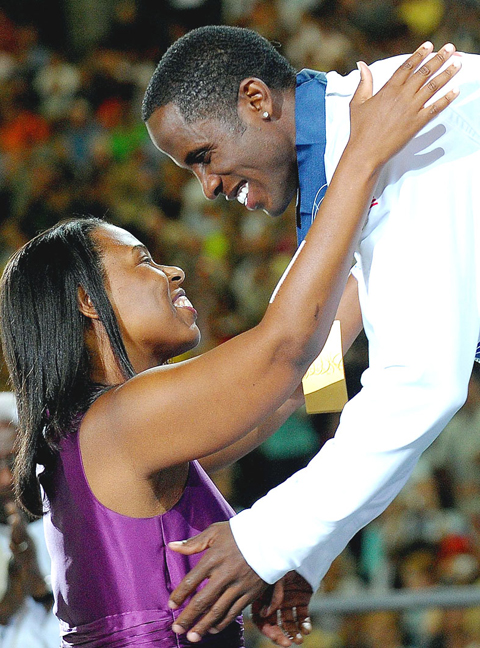
PHOTO: EPA
The 1936 Games, which the US came close to boycotting because of concerns over anti-Semitism, were marked by the performances of Owens. The son of a US slave, the “Black Pearl” won four gold medals from the 100m and 200m, the men’s relay and the long jump.
Luz Long was one of several athletes held up as a symbol of Hitler’s supposedly superior Aryan race but his actions appeared to demonstrate his dismissal of that notion, giving Owens advice that led to the American’s victory and the German settling for silver.
Owens said Luz Long went to him and advised that he jump from a spot several inches behind the line — advice that allowed the him to advance safely to the next round without risking another foul.
Owens won the gold, thus ridiculing Hitler’s claims of Aryan superiority, and went on to build a friendship with Luz Long, who died during World War II.
PURE SPORTSMEN
His son Kai insisted his father, who died of battle wounds in 1943 in Sicily, was not making a political statement to Hitler that black and white people were equals.
“It was the normal attitude of pure amateur sportsmen in those days,” he said. “It was absolutely normal to help each other so what he did was not deemed then to be extraordinary.”
Kai Long, who met Owens five times, did not deny that from that gesture something amazing had been born.
“This flame became bright, then brighter and even more bright and is still burning today,” Kai said.
If proof were needed that flame is still alive, the grandaughters of both Long and Owens, Julie Long and Marlene Dortch respectively, presented the medals for the long jump on Saturday.
Dortch, who said she never talked about the episode with her grandfather, drew on the example of Rosa Parks, “the mother of the modern day civil rights movement,” who refused to give up her seat to a white person on a bus in Montgomery, Alabama, in 1955.
“I would draw a comparison with Rosa Parks who did not deliberately sit down on the bus as a protest against racial discrimination but because she was tired and thought she deserved to have a seat,” Dortch said.
“I believe it is the same with Jesse Owens and Luz Long, who may not have intended to make a statement. However, I think it was very courageous of them to talk with each other and for Luz Long to help him,” she said. “It may not have been planned but you cannot deny it was inspirational.”
Long never had a chance to speak to his father about the moment because he was born in 1941.
‘HITLER WHO?’
Meanwhile, Dortch was surprised to be informed that she, her family and that of Long’s would be sitting where Hitler and his acolytes, such as propaganda minister Joseph Goebbels, had sat during those Games.
“I didn’t realize that,” Dortch said. “Well, it feels great to think that I will be sitting with my husband where Hitler once sat.”
“I think it is wonderful that Luz Long’s and Jesse Owens’ family will be sitting side by side and celebrating a great moment in sport’s history,” she said. “And regarding the other guy. Hitler who?”

Brice Turang and Pete Crow-Armstrong’s consecutive RBI singles proved to be the difference in the US’ 5-3 win over Canada in a World Baseball Classic (WBC) quarterfinal on Friday night in Houston. The US faces the Dominican Republic, which crushed South Korea 10-0 in seven innings in its quarter-final, in a semifinal Sunday in Miami for a spot in Tuesday’s championship. The Dominican team has won all five games in this WBC by a combined margin of 51-10. It appeared the US squad was headed toward a cozy victory when it built a 5-0 lead by the sixth inning. A first-inning RBI groundout

Wilyer Abreu watched the ball leave the park and tossed his bat high in the air. His Venezuela teammates streamed out of the dugout in celebration. The comeback was on and the win over the reigning World Baseball Classic (WBC) champion Japan was within reach. Japan, their 11-game WBC winning streak on the line, held a 5-4 lead in the sixth inning of Saturday’s thrilling quarter-final matchup when Abreu put his team ahead with the biggest swing of the game: a three-run shot off Hiromi Itoh that sent the loanDepot Park crowd into a passionate roar and helped seize Venezuela’s 8-5

A BREATHLESS BATTLE: France clinched the championship in a vicious back-and-forth match with England, denying Ireland the title by just a few points France won back-to-back Six Nations titles after beating England 48-46 on a last-second penalty-kick by Thomas Ramos in a thriller for the ages on Saturday. England scored their seventh try in the 77th minute and converted for 46-45. If the score held for a few more minutes, Ireland would have been crowned the champion. But France pressed yet again with 14 men, lost possession, regained it, and earned two simultaneous penalties after the fulltime siren. Captain Antoine Dupont debated with referee Nika Amashukeli where the penalty spots were. Ramos, who did not miss a goal-kick all night, finally lined up his seventh

Uni-President 7-Eleven Lions’ outfielder Chen Chieh-hsien, who fractured his left index finger earlier during the World Baseball Classic (WBC), is expected to be sidelined for four to six weeks. The Uni-Lions confirmed in a news statement on Friday that Chen had a distal fracture in his left index finger. The diagnosis followed X-ray and CT scans conducted at the Kaohsiung Chang Gung Memorial Hospital earlier that day. According to the club, the injury would require four to six weeks to heal. During this period, Chen must wear a protective splint but is permitted to engage in light, sport-specific training. The team plans to


 RSS
RSS