


A: Hey, the world’s major dictionaries just unveiled their words of the year for 2025.
B: Yup, the Cambridge Dictionary chose the word “parasocial,” which refers to a connection that someone feels between themselves and a famous person they don’t really know.
A: One-sided parasocial relationships with celebrities, influencers and even AI chatbots have clearly become more common.
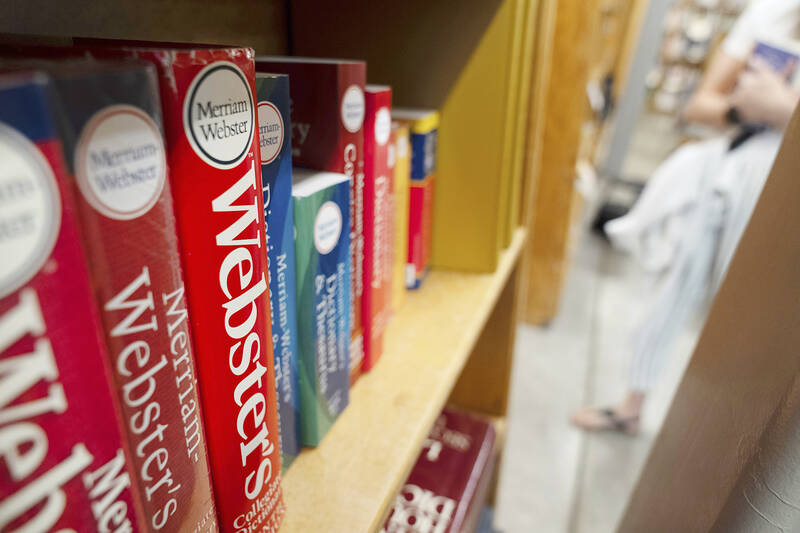
Photo: AP 照片:美聯社
B: The Oxford Dictionary picked “rage bait” — online content designed to elicit anger by being frustrating, provocative or offensive in order to increase traffic to Web sites or social media accounts.
A: The Collins Dictionary picked “vibe coding.” Let’s look up the word in the dictionary to find its meaning.
A: 世界各大字典近日分別公布了2025年代表字!
B: 劍橋字典的代表字為︰「parasocial」(擬社交),意思是人們自行想像與不認識的名人之社交關係。
A: 人們與名人、網紅、甚至AI聊天機器人的單向擬社交關係明顯在增加中。
B: 牛津字典的代表詞為︰「rage bait」(憤怒誘餌),意思是刻意設計用來激怒他人的網路內容,通常透過令人沮喪、挑釁或冒犯的方式呈現––以增加網頁或社群帳號流量。
A: 柯林斯字典的代表字為︰「vibe coding」(氛圍編程),我們來查字典找出它的意思。
(By Eddy Chang, Taipei Times/台北時報張迪)

In English, “name idioms” are part of what makes English fascinating. Let’s put a few examples under the microscope. Doubting Thomas This expression stems from the Bible. Thomas, one of Jesus’s disciples, refused to believe Jesus had been resurrected from the dead. He declared he wouldn’t accept it until he could see the nail marks in Jesus’s hands and touch his wounds himself. Today, this idiom refers to someone who won’t believe something without concrete evidence. For instance, if your friend’s expertise is reliable, but you’re still suspicious, you might be a “doubting Thomas.” Smart Aleck The origin of this phrase likely comes from

A: Hey, the world’s major dictionaries just unveiled their words of the year for 2025. B: Yup, the Cambridge Dictionary chose the word “parasocial,” which refers to a connection that someone feels between themselves and a famous person they don’t really know. A: One-sided parasocial relationships with celebrities, influencers and even AI chatbots have clearly become more common. B: The Oxford Dictionary picked “rage bait” — online content designed to elicit anger by being frustrating, provocative or offensive in order to increase traffic to Web sites or social media accounts. A: The Collins Dictionary picked “vibe coding.” Let’s

A: Apart from the world’s major dictionaries, the online Dictionary.com actually picked “67” as its word of the year. B: What does “67” even mean? A: Even the dictionary wasn’t exactly sure about its meaning. The slang term’s origin might be traced to US rapper Skrilla’s song Doot Doot (67). Aren’t Taiwanese media outlets choosing the Mandarin word for 2025? B: Yeah and after hearing the song Good-for-Nothing, adapted from some catchphrases of Legislator Wang Shih-chien, I’m going to vote for the character “tsung” (hasty) from the lyrics. A: Hopefully, in the new year, we’ll be calm as the

Sea star wasting disease (SSWD) is a strange and serious illness affecting sea stars, or starfish. This disease causes sea stars to develop painful lesions, lose their arms, and eventually turn into a gooey, melted mess. Since it was first observed in 2013, millions of sea stars along the Pacific coast of North America have died from this __1__. Although viruses were once considered a possible cause, researchers now believe that environmental stressors and microorganisms are primarily __2__ for sea star wasting disease. One of the main environmental triggers appears to be warmer ocean water. When the water heats


 RSS
RSS