


Chinese Nationalist Party (KMT) Chairwoman Cheng Li-wun (鄭麗文) departed today for a six-day visit to China, which might end with a meeting with Chinese President Xi Jinping (習近平).
Thirteen people are accompanying Cheng, including three KMT vice chairpersons, as well as former National Security Council secretary-general Su Chi (蘇起), who admitted making up the term “1992 consensus” in 2000.
The so-called “1992 consensus” refers to a tacit understanding between the KMT and the Chinese Communist Party (CCP) that both sides of the Strait acknowledge there is “one China,” with each side having its own interpretation of what “China” means.
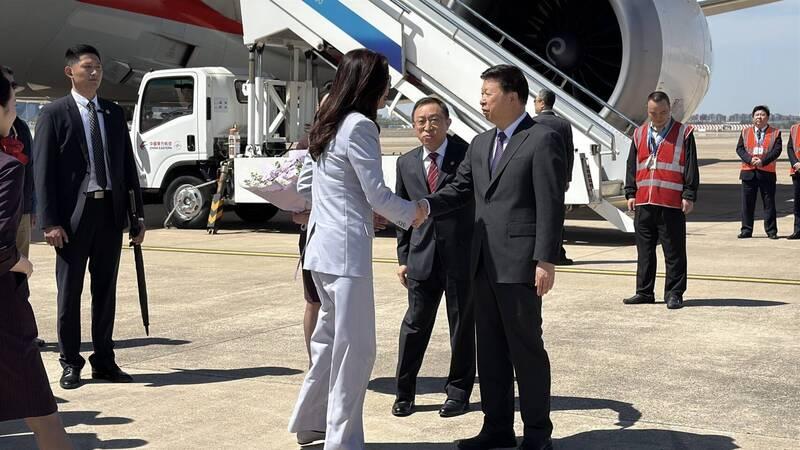
Photo: CNA
The KMT chairperson was invited to lead a KMT delegation on a visit to Jiangsu, Shanghai and Beijing from today to Sunday, but it has not been confirmed whether she is to meet Xi during the trip.
Cheng took a flight to Shanghai from Taipei International Airport (Songshan airport).
Although groups supporting and opposing Cheng's trip gathered at the airport, neither caught sight of her, as she reportedly used the special clearance channel rather than the departure hall.

Photo: Chang Chia-ming, Taipei Times
During a news conference in Taipei this morning before her departure, Cheng said that members of the Democratic Progressive Party (DPP) are full of doubts and fear toward China.
“I want to prove to them that peace in the Taiwan Strait is not that difficult,” she said.
If the KMT and the CCP could reconcile and work together for peace, “then why can’t the KMT and the DPP do the same?” she asked.
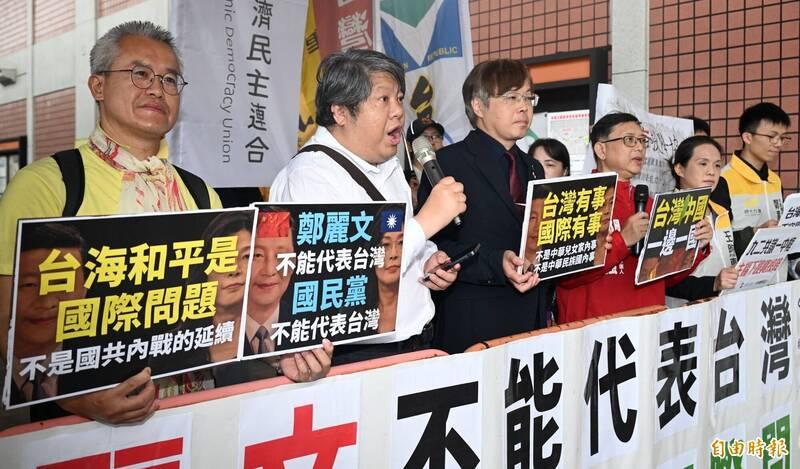
Photo: Liao Chen-huei, Taipei Times
The global environment is undeniably unstable, as conflicts spread and public anxiety rises, she said, adding that the Taiwan Strait has been labeled one of the world's most dangerous flashpoints.
As chairwoman, Cheng said she has the responsibility to not only protect Taiwan's 23 million people, but also maintain regional peace.
She said the purpose of her visit is to show the world that Taiwan is not the only side seeking peace, and that the Chinese leadership is also willing and determined to engage in peaceful dialogue to resolve differences.
Many people doubted whether her trip to China would materialize and could not believe she received a formal invitation from Xi, she said, adding that public reactions in Taiwan have been mixed, with some expressing anticipation, others unease and many remaining skeptical.
While she did not have the opportunity to meet with President William Lai (賴清德) since announcing the trip, Cheng said she believes he has been closely following developments.
“If you truly love Taiwan, you would seize every possible opportunity to prevent war,” she said. “Safeguarding peace is safeguarding Taiwan.”
She said she hopes that upon her return, the DPP and the KMT could reflect on their confrontations, move away from infighting and work quickly to resolve the current constitutional impasse.
Earlier today, Premier Cho Jung-tai (卓榮泰) told reporters he wished the KMT well in its party activities, but would closely monitor the trip.
During a legislative interpellation session, Cho added that any party representative or politically influential figure who makes public contact with the CCP should be subject to intense scrutiny, particularly from the public and the media.
Additional reporting by CNA

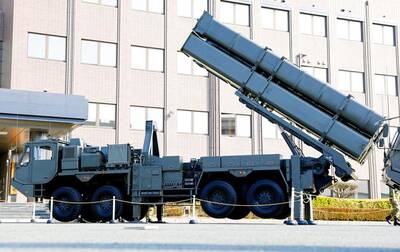
Japan has deployed long-range missiles in a southwestern region near China, the Japanese defense minister said yesterday, at a time when ties with Beijing are at their lowest in recent years. The missiles were installed in Kumamoto in the southern region of Kyushu, as Japan is attempting to shore up its military capacity as China steps up naval activity in the East China Sea. “Standoff defense capabilities enable us to counter the threat of enemy forces attempting to invade our country ... while ensuring the safety of our personnel,” Japanese Minister of Defense Shinjiro Koizumi said. “This is an extremely important initiative for

MORE POPULAR: Taiwan Pass sales increased by 59 percent during the first quarter compared with the same period last year, the Tourism Administration said The Tourism Administration yesterday said that it has streamlined the Taiwan Pass, with two versions available for purchase beginning today. The tourism agency has made the pass available to international tourists since 2024, allowing them to access the high-speed rail, Taiwan Railway Corp services, four MRT systems and four Taiwan Tourist Shuttles. Previously, five types of Taiwan Pass were available, but some tourists have said that the offerings were too complicated. The agency said only two types of Taiwan Pass would be available, starting from a three-day pass with the high-speed rail and a three-day pass with Taiwan Railway Corp. The former costs NT$2,800

NEW LOW: The council in 2024 based predictions on a pessimistic estimate for the nation’s total fertility rate of 0.84, but last year that rate was 0.69, 17 percent lower An expected National Development Council (NDC) report expects the nation’s population to drop below 12 million by 2065, with the old-age dependency ratio to top 100 percent sooner than 2070, sources said yesterday. The council is slated to release its latest population projections in August, using an ultra-low fertility model, the sources said. The previous report projected that Taiwan’s population would fall to 14.37 million by 2070, but based on a new estimate of the total fertility rate (TFR) — the average number of children born to a woman over her lifetime — the population is expected to reach 12 million by

COUNTERING HOSTILITY: The draft bill would require the US to increase diplomatic pressure on China and would impose sanctions on those who sabotage undersea cable networks US lawmakers on Thursday introduced a bipartisan bill to bolster the resilience of Taiwan’s submarine cables to counter China’s hostile activities. The proposal, titled the critical undersea infrastructure resilience initiative act, was cosponsored by Republican representatives Mike Lawler and Greg Stanton, and Democratic Representative Dave Min. US Senators John Curtis and Jacky Rosen also introduced a companion bill in the US Senate, which has passed markup at the chamber’s Committee on Foreign Relations. The House’s version of the bill would prioritize the deployment of sensors to detect disruptions or potential sabotage in real-time and enhance early warning capabilities through global intelligence sharing frameworks,


 RSS
RSS