


Chu Cheng-chi (朱政騏), a former legislative assistant who won a Democratic Progressive Party (DPP) primary for a Taipei city council seat, was indicted yesterday on charges of spying for China.
The Taipei District Prosecutors’ Office accused Chu of using his access to legislative offices while working as an aide to former legislator Ho Chih-wei (何志偉) and Taipei City Councilor Chung Pei-ling (鍾佩玲) to obtain and transmit confidential documents in August 2022.
Prosecutors said that he received 20,000 yuan (US$2,905) in return.
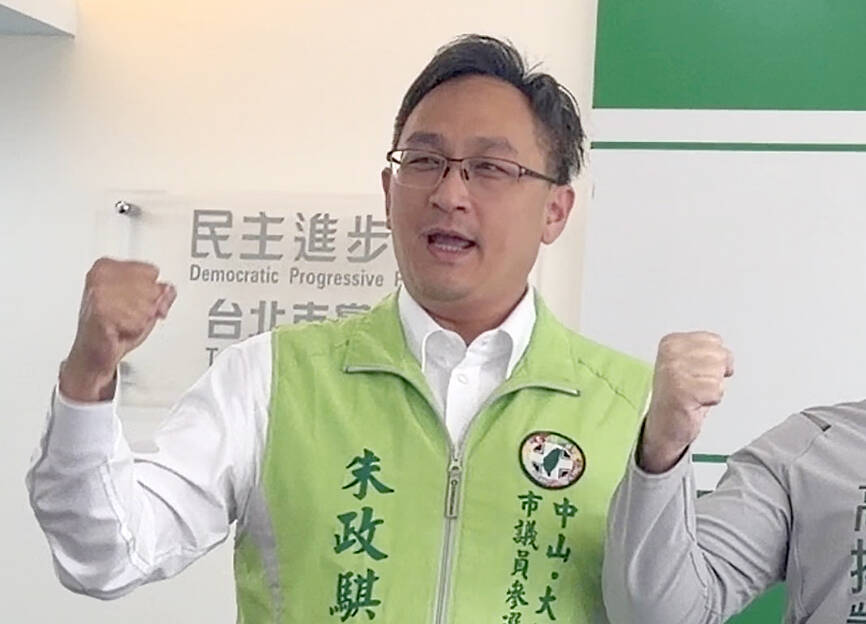
Photo: Tung Kuan-yi, Taipei Times
In July 2022, Chu received an iPhone 13 Pro from Hu Peng-nien (胡鵬年), a retired Executive Yuan official linked to a separate espionage case, and used it to communicate with contacts in China, prosecutors said.
On Aug. 23 and 24, 2022, he entered legislative offices in his role as an aide and accessed documents classified as “confidential,” and photographed and transmitted them to a Chinese contact surnamed Wang (王) in exchange for payment, they said.
Prosecutors indicted Chu over alleged contraventions of the National Security Act (國家安全法), and asked the courts to confiscate any illicit gains and sentence him to at least five years in prison.
The DPP’s Taipei City chapter convened an emergency meeting of its executive and review committees at noon yesterday, at which they expelled Chu from the party and denied his primary nomination.
A replacement candidate would be determined by the party’s central leadership, it said.
Chu yesterday denied wrongdoing, saying he had not leaked state secrets, harmed Taiwan’s interests or received illicit gains.
He said he had fully cooperated with investigators and would continue to do so, expressing confidence in a fair trial.
Taiwan People’s Party Legislator Jacky Chen (陳清龍) said that the DPP, known for championing its slogan of “resist China, defend Taiwan,” often uses “red-baiting” tactics to suppress political opponents.
“While it talks tough on China, its actions are seen as cozying up to Beijing,” Chen said.
President William Lai (賴清德), as DPP chairman, should conduct a thorough investigation within the party to determine “how many Chinese spies are still being sheltered” by the party, he said, referencing the cases of former Presidential Office consultant Wu Shang-yu (吳尚雨), former DPP staff member Chiu Shih-yuan (邱世元) and former Ministry of Foreign Affairs assistant Ho Jen-chieh (何仁傑), who were convicted in a first ruling last year for spying for China while working for the government.
“From the Presidential Office and the National Security Council to the Legislative Yuan, cases of Chinese espionage within the DPP keep emerging,” Chinese Nationalist Party (KMT) Legislator Hsu Yu-chen (許宇甄) said. “The DPP government has essentially become a nest of spies and its so-called ‘resist China, defend Taiwan’ stance is nothing more than a political scam.”
DPP Legislator Chen Kuan-ting (陳冠廷) said that regardless of a person’s status, any contact with hostile foreign forces or leaks of sensitive information pose a serious threat to national security.
The government should conduct a thorough review of background checks and access privileges, and require regular re-evaluations for sensitive personnel, while improving early-warning and protective measures to prevent similar incidents from happening again, he said.
The Chu case stems from a broader probe into an alleged Chinese espionage network involving businessman Cheng Ming-chia (鄭明嘉) and Hu. Both were indicted in January for allegedly recruiting military personnel and young political figures for China’s United Front Work Department, with prosecutors seeking a sentence of at least 10 years for Cheng.
Additional reporting by Ho Yu-hua, Chen Cheng-yu and Chen Chih-cheng

‘NO SECURITY RISK’: The Railway Bureau reassured the public that the technicians’ activities were limited to technical guidance and did not involve sensitive systems The Railway Bureau yesterday said it had invited eight Chinese technicians to assist with an airport MRT construction project. The bureau issued the confirmation after an Internet user said Chinese nationals had entered the construction zone of Taiwan Taoyuan International Airport’s Terminal 3 project. They asked why “individuals from an enemy state” were allowed access to such a major national infrastructure project, which raised serious concerns over Taiwan’s industrial safety, sensitive systems and information security. The bureau’s Northern Region Engineering Branch Office said subcontractor Taiwan Handle Industrial Co (台灣手把工業) of the Taoyuan airport MRT’s “Contract No. CU05 Project A14 Station Civil, MEP &

The National Chungshan Institute of Science and Technology yesterday showcased its locally developed variants of the Vision 60 robotic patrol dog, which it plans to deploy on the nation’s outlying territories in the South China Sea. The variants were produced under the Joint Lab project — created by the institute and domestic companies — and assembled with domestically produced motors, lenses and artificial intelligence (AI) systems alongside licensed tech from the US, Missile and Rocket Systems Research Division deputy director Jen Kuo-kang (任國光) told the media event at a military base in Taipei’s Dazhi (大直) area. Taiwan has built up its strengths

NOT IMMEDIATE: Taiwan has a chance to appeal the proposed 10 percent tariff before it starts, while other countries face a 12.5 percent tariff from the trade office Taiwan is among 60 economies determined by the US to have failed to impose or enforce a ban on the importation of goods produced with forced labor, according to a notice released on Tuesday by the Office of the US Trade Representative (USTR), which proposed imposing an additional 10 percent or more tariff on them. The USTR in a statement said that following an investigation, it had determined under Section 301 of the Trade Act of 1974 that the failure of the 60 economies to impose and effectively enforce a prohibition on the importation of goods produced with forced labor is

TIT-FOR-TAT: The US allegedly revoked the visa of a Chinese national working at Xinhua News Agency in the US in response to Beijing’s expulsion of Vivian Wang The Presidential Office yesterday condemned China for expelling a New York Times correspondent from Beijing following the newspaper’s interview with President William Lai (賴清德), saying the move highlighted Beijing’s suppression of press freedom and its threat to international news media. Taiwan has noted a series of recent incidents in which Beijing used similar tactics to “threaten and pressure international media outlets and journalists,” Presidential Office spokeswoman Karen Kuo (郭雅慧) said in a statement. “This concerns not only press freedom and freedom of expression, but also the safety of journalists, and Taiwan and relevant partners are paying close attention to the situation,” she


 RSS
RSS