


Taiwan yesterday called on Denmark to correct its designation of the nationality of Taiwanese residents as “China” or face retaliatory measures.
The Danish government in 2024 changed the nationality of Taiwanese citizens on their residence permits from “Taiwan” to “China.”
The decision goes against EU foreign policy and contravenes democratic and human rights principles, Ministry of Foreign Affairs (MOFA) spokesman Hsiao Kuang-wei (蕭光偉) said.
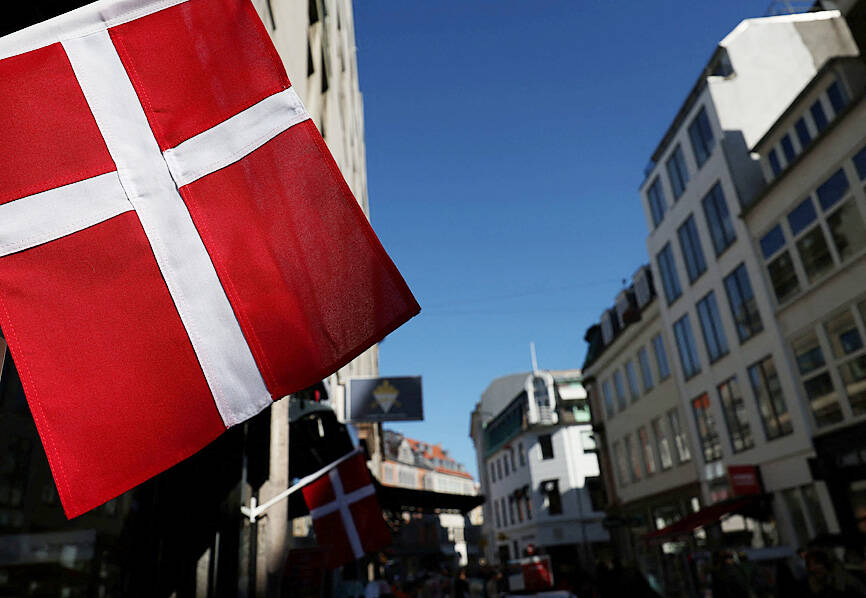
Photo: Reuters
Denmark should present a solution acceptable to Taiwan as soon as possible and correct the erroneous designation to preserve the longstanding friendship between the two nations, Hsiao said.
The issue could damage Denmark’s image and business reputation in Taiwan, harming the relationship between the two countries, as well as prospects for cooperation, he added.
Minister of Foreign Affairs Lin Chia-lung (林佳龍) last week said in the Legislative Yuan that the government was considering adjusting the privileges and immunities granted to staff at the Danish representative office in Taiwan — formally named the Trade Council of Denmark in Taipei — and garnered international partners’ support on the issue.
Denmark is the only country in the EU to list Taiwanese residents’ nationality as China, the Danish news platform Berlingske reported on Friday.
Taiwanese living in Denmark have protested to the Danish Agency for International Recruitment and Integration (SIRI) since the change was made in 2024, but no corrections have been made, the report said.
The change was due to errors in how Taiwanese had previously been designated, SIRI told Berlingske, adding that it was following the Danish Ministry of Immigration and Integration’s policy.
It declined to further comment on the issue.
The change aimed to standardize how to designate Taiwanese on official documents, the Danish Ministry of Immigration and Integration said in a statement on May 6 last year.
Its subordinate agencies previously had different ways of referring to Taiwanese’s nationality and place of birth, so it standardized the practice under the guidance of the Danish Ministry of Foreign Affairs, the statement said.
The standard stipulates that Taiwan or the Republic of China would not appear as nationality or citizenship designations, but Taiwan could be used as a place or regional name.
That means the place of birth of Taiwanese could be Taiwan, but their nationality would be recorded as China.
The Danish Ministry of Foreign Affairs has not changed its position on Taiwan and the practice is inconsistent between ministries and clearly contravenes EU policy, Representative to Denmark Robin Cheng (鄭榮俊) said.
While the EU also has a “one China” policy, it has clarified that the policy does not contradict interaction and cooperation with Taiwan, Cheng said.
The call comes after South Korea in its e-arrival system launched last month listed Taiwan as “China (Taiwan),” sparking protest from the government.
The ministry gave Seoul until Tuesday next week to correct the designation, or it would change South Korea’s listing on Taiwan’s online immigration entry system to “Korea (South),” Lin said on Sunday.
Sources familiar with the matter yesterday said that the Korean Mission in Taipei has expressed its willingness to propose a solution acceptable to Taiwan.

PROVOCATIVE: Chinese Deputy Ambassador to the UN Sun Lei accused Japan of sending military vessels to deliberately provoke tensions in the Taiwan Strait China denounced remarks by Japan and the EU about the South China Sea at a UN Security Council meeting on Monday, and accused Tokyo of provocative behavior in the Taiwan Strait and planning military expansion. Ayano Kunimitsu, a Japanese vice foreign minister, told the Council meeting on maritime security that Tokyo was seriously concerned about the situation in the East China and South China seas, and reiterated Japan’s opposition to any attempt to change the “status quo” by force, and obstruction of freedom of navigation and overflight. Stavros Lambrinidis, head of the EU delegation to the UN, also highlighted South China Sea

SILENCING CRITICS: In addition to blocking Taiwan, China aimed to prevent rights activists from speaking out against authoritarian states, a Cabinet department said The Ministry of Foreign Affairs (MOFA) yesterday condemned transnational repression by Beijing after RightsCon, a major digital human rights conference scheduled to be held in Zambia this week, was abruptly canceled due to Chinese pressure over Taiwanese participation. This year’s RightsCon, the world’s largest conference discussing issues “at the intersection of human rights and technology,” was scheduled to take place from tomorrow to Friday in Lusaka, and expected to draw 2,600 in-person attendees from 150 countries, along with 1,100 online participants. However, organizers were forced to cancel the event due to behind-the-scenes pressure from China, the ministry said, expressing its “strongest condemnation”
Taiwan Semiconductor Manufacturing Co (TSMC, 台積電), the world’s largest contract chipmaker, said it expects its 2-nanometer (2nm) chip capacity to grow at a compound annual rate of 70 percent from this year to 2028. The projection comes as five fabs begin volume production of 2-nanometer chips this year — two in Hsinchu and three in Kaohsiung — TSMC senior vice president and deputy cochief operating officer Cliff Hou (侯永清) said at the company’s annual technology symposium in Silicon Valley, California, last week. Output in the first year of 2-nanometer production, which began in the fourth quarter of last year, is expected to
Taiwan’s economy grew far faster than expected in the first quarter, as booming demand for artificial intelligence (AI) applications drove a surge in exports, spilling over into investment and consumption, the Directorate-General of Budget, Accounting and Statistics (DGBAS) said yesterday. GDP growth was 13.69 percent year-on-year during the January-to-March period, beating the DGBAS’ February forecast by 2.23 percentage points and marking the most robust growth in nearly four decades, DGBAS senior official Chiang Hsin-yi (江心怡) told a news conference in Taipei. The result was powered by exports, which remain the backbone of Taiwan’s economy, Chiang said. Outbound shipments jumped 51.12 percent year-on-year to


 RSS
RSS