


A restart plan for the Guosheng Nuclear Power Plant in New Taipei City’s Wanli District (萬里) and the Ma-anshan Nuclear Power Plant in Pingtung County’s Hengchun Township (恆春) would be submitted to the Nuclear Safety Commission by the end of the month, President William Lai (賴清德) said yesterday, reversing the government’s policy to abolish nuclear energy.
On May 17 last year, Taiwan shut down its last nuclear reactor and became the first non-nuclear nation in East Asia, fulfilling the Democratic Progressive Party (DPP) government’s pledge of a “nuclear-free homeland.”
Even without nuclear power, Taiwan can maintain a stable electricity supply until 2032, with daily reserve margins consistently above 10 percent, Lai said.
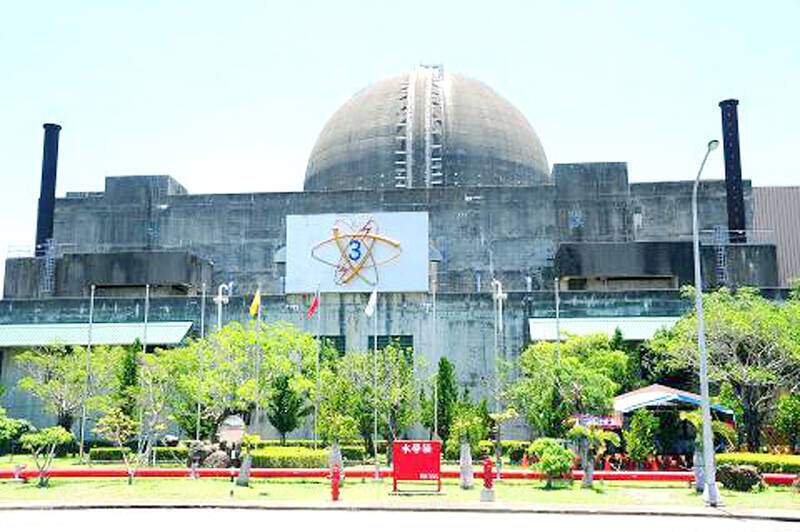
Photo: Tsai Tsung-hsien, Taipei Times
However, to comply with recent changes to the law, robust economic development, the international community’s need for low-carbon electricity and the power demands of the artificial intelligence era, the government is considering restarting nuclear power, he said during a gathering of business leaders hosted by the Entrepreneurs Club in Taichung.
Lai was referring to the Legislative Yuan’s amendments to the Nuclear Reactor Facilities Regulation Act (核子反應器設施管制法) last year.
The amendments provide a legislative basis for the continuation of nuclear power plant operations even after entering the decommissioning stage.
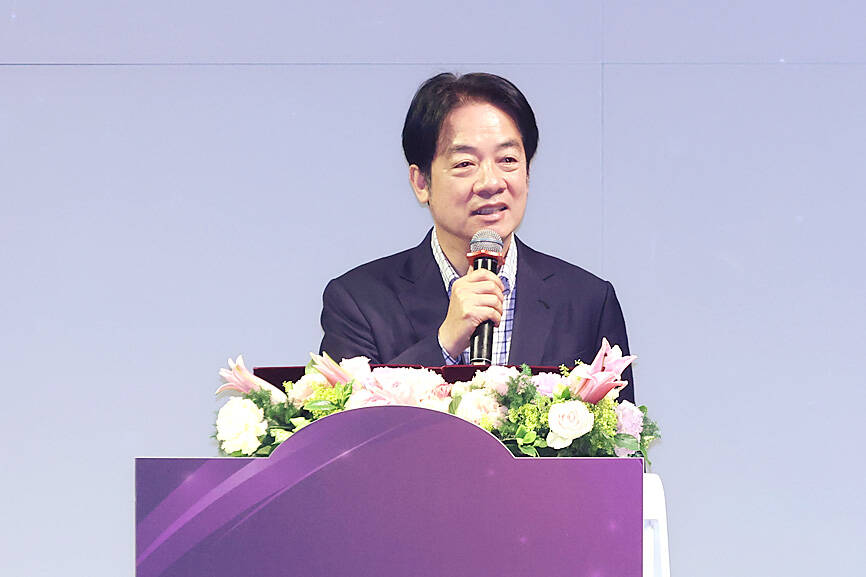
Photo: CNA
The Guosheng Nuclear Power Plant and the Ma-anshan Nuclear Power Plant were selected for the restart plan after Taiwan Power Co’s (Taipower, 台電) preliminary evaluations found the plants fit for reactivation, Lai said.
GE Aerospace and Westinghouse Electric would assist Taipower in conducting the safety audits to clear the way for the plants’ restart proposals, he added.
Lai reiterated that nuclear safety, nuclear waste disposal and public consensus are the three key factors the Nuclear Safety Commission would consider.
Sources said Taipower plans to submit the restart plan for the Ma-anshan Nuclear Power Plant to the Nuclear Safety Commission on Friday.
Taipower is carrying out preparatory work and implementing the plan, but the plant can only resume operations once the results are reviewed and licensed, they said.
How long the plant would operate after the restart would depend on the safety inspections, they said, adding that Taipower would first order a batch of new fuel rods, sufficient for at least 1.5 years of operation.
The company must procure these new fuel rods by the end of the year if it aims to restart the plant in 2028, they said.
Guosheng Nuclear Power Plant personnel should begin removing fuel rods from the reactor core by the end of the year, sources said.
The overall schedule is roughly one year behind the Ma-anshan Nuclear Power Plant, with a restart possible as early as 2029, they said.
In other news, Lai said Taiwan must be fully prepared, as it is unclear how long the conflict in the Middle East could last.
The nation’s legally required oil reserves cover about 90 days, and current reserves exceed 100 days, “so there is no problem,” Lai said.
As for natural gas, the legal storage requirement is 11 days, and Taiwan has enough for 12 to 14 days, he added.
Oil and gas supplies for next month are sufficient, and purchases from the US would arrive in June, he said.
Additional reporting by CNA
See STORIES on page 2

‘NO SECURITY RISK’: The Railway Bureau reassured the public that the technicians’ activities were limited to technical guidance and did not involve sensitive systems The Railway Bureau yesterday said it had invited eight Chinese technicians to assist with an airport MRT construction project. The bureau issued the confirmation after an Internet user said Chinese nationals had entered the construction zone of Taiwan Taoyuan International Airport’s Terminal 3 project. They asked why “individuals from an enemy state” were allowed access to such a major national infrastructure project, which raised serious concerns over Taiwan’s industrial safety, sensitive systems and information security. The bureau’s Northern Region Engineering Branch Office said subcontractor Taiwan Handle Industrial Co (台灣手把工業) of the Taoyuan airport MRT’s “Contract No. CU05 Project A14 Station Civil, MEP &

The National Chungshan Institute of Science and Technology yesterday showcased its locally developed variants of the Vision 60 robotic patrol dog, which it plans to deploy on the nation’s outlying territories in the South China Sea. The variants were produced under the Joint Lab project — created by the institute and domestic companies — and assembled with domestically produced motors, lenses and artificial intelligence (AI) systems alongside licensed tech from the US, Missile and Rocket Systems Research Division deputy director Jen Kuo-kang (任國光) told the media event at a military base in Taipei’s Dazhi (大直) area. Taiwan has built up its strengths

NOT IMMEDIATE: Taiwan has a chance to appeal the proposed 10 percent tariff before it starts, while other countries face a 12.5 percent tariff from the trade office Taiwan is among 60 economies determined by the US to have failed to impose or enforce a ban on the importation of goods produced with forced labor, according to a notice released on Tuesday by the Office of the US Trade Representative (USTR), which proposed imposing an additional 10 percent or more tariff on them. The USTR in a statement said that following an investigation, it had determined under Section 301 of the Trade Act of 1974 that the failure of the 60 economies to impose and effectively enforce a prohibition on the importation of goods produced with forced labor is

TIT-FOR-TAT: The US allegedly revoked the visa of a Chinese national working at Xinhua News Agency in the US in response to Beijing’s expulsion of Vivian Wang The Presidential Office yesterday condemned China for expelling a New York Times correspondent from Beijing following the newspaper’s interview with President William Lai (賴清德), saying the move highlighted Beijing’s suppression of press freedom and its threat to international news media. Taiwan has noted a series of recent incidents in which Beijing used similar tactics to “threaten and pressure international media outlets and journalists,” Presidential Office spokeswoman Karen Kuo (郭雅慧) said in a statement. “This concerns not only press freedom and freedom of expression, but also the safety of journalists, and Taiwan and relevant partners are paying close attention to the situation,” she


 RSS
RSS