


The Chinese Nationalist Party (KMT) caucus yesterday said it would propose a special defense budget bill totaling NT$350 billion (US$11.05 billion) to fund eight weapons sales announced by the US in December last year.
The caucus “fully supports” the eight systems listed in US foreign military sales announced on Dec. 17 last year, KMT caucus secretary-general Lin Pei-hsiang (林沛祥) told a news conference at the legislature in Taipei.
The sales include High Mobility Artillery Rocket Systems (HIMARS), Javelin missiles, Altius-700M and Altius-600 drones, TOW missiles, M109A7 self-propelled howitzers, C5ISR integrated technology systems, Harpoon missile follow-on support and helicopter parts at a combined cost of US$11.1 billion, Lin said.
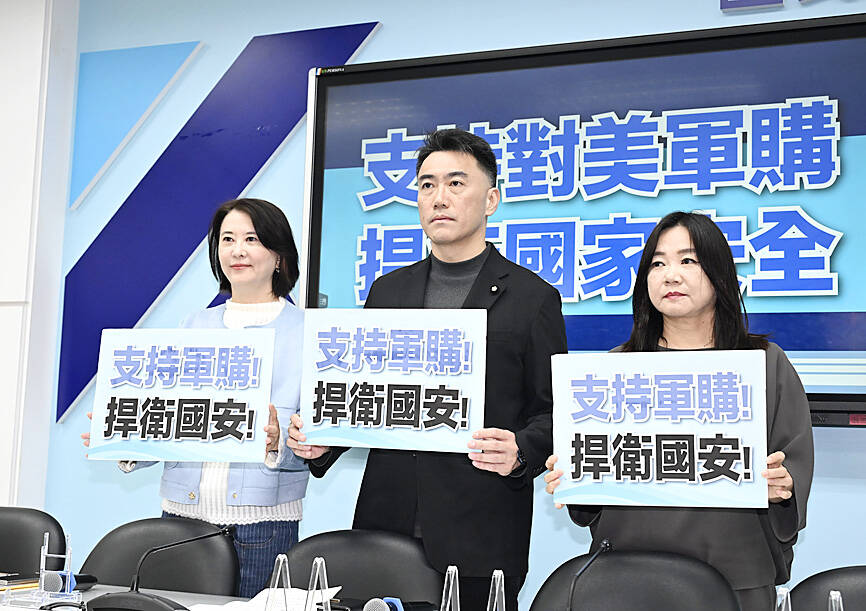
Photo: Lo Pei-de, Taipei Times
In contrast, the Cabinet’s special defense budget bill is NT$1.25 trillion and includes the eight systems, potential US arms sales that the US Congress has not been notified of and procurement plans involving domestic manufacturers such as the “T-Dome” multilayered air defense system and drones.
In the event of a follow-on foreign military sales package, the KMT’s proposal would mandate that the Ministry of National Defense draft a matching special budget bill and submit it to the legislature for review “promptly and without delay,” Lin said.
“We hope to take a phased approach to move arms procurement forward concretely and transparently, as opposed to a one-time authorization of a blank check,” he said.
The caucus was to formally sponsor the bill later yesterday, after final adjustments, he added.
The move came amid pressure from Washington over opposition parties blocking sales.
Senior KMT members, including Taichung Mayor Lu Shiow-yen (盧秀燕) and Legislative Speaker Han Kuo-yu (韓國瑜), have expressed concern that blocking the sales package could sour Taiwan-US relations.
The KMT and the Taiwan People’s Party (TPP) caucuses have blocked review of the Cabinet’s bill 10 times since November last year, saying it was “opaque,” and demanding that President William Lai (賴清德) brief lawmakers and face questions on the budget before review began.
Lin yesterday rejected accusations that the KMT had blocked the arms sales.
The KMT’s bill is meant to distinguish between foreign military sales — the costs of which are specified in letters of acceptance issued by the US — and direct commercial sales, which are often opaque and have sparked major corruption scandals, he said.
“The KMT has always supported US government-to-government arms sales,” the KMT said in a statement. “However, commercial procurement is where corruption and controversy most often occur. These two categories must never be bundled together to pressure the public and the legislature into approving them as a single package.”
Premier Cho Jung-tai (卓榮泰) criticized the idea that the budget should be compiled incrementally.
National defense requires holistic planning and cannot be built piecemeal, otherwise it would be impossible to plan the foundation and layout, Cho told reporters in Hualien County, using a house building metaphor.
The Cabinet’s proposal was meticulously put together based on the nation’s defense needs and overall fiscal planning, “making it a highly precise operation,” he said.
TPP caucus whip Jacky Chen (陳清龍) said that the party would insist on its own version of the bill, although all three versions would undergo substantive committee review today.
The TPP’s draft includes the weapons the US has announced it would sell to Taiwan, Chen said.
Its version also features a comprehensive oversight mechanism, stipulating that after the special budget is passed, the Executive Yuan must provide clear reports to the legislature regarding delivery schedules and financial impacts, he said.
KMT Chairwoman Cheng Li-wun (鄭麗文) asked why the central government proposed a NT$1.25 trillion budget when only NT$350 billion in US arms sales have been confirmed and why the funds were not incorporated into the regular annual defense budget.
Democratic Progressive Party spokesman Justin Wu (吳崢) said that the KMT had not reviewed “a single cent” of this year’s general budget.
A special budget was planned because the procurements are urgent and necessary, Wu said.
Additional reporting by AFP, Hua Meng-ching,Yu Tai-lang and Chen Cheng-yu

‘NO SECURITY RISK’: The Railway Bureau reassured the public that the technicians’ activities were limited to technical guidance and did not involve sensitive systems The Railway Bureau yesterday said it had invited eight Chinese technicians to assist with an airport MRT construction project. The bureau issued the confirmation after an Internet user said Chinese nationals had entered the construction zone of Taiwan Taoyuan International Airport’s Terminal 3 project. They asked why “individuals from an enemy state” were allowed access to such a major national infrastructure project, which raised serious concerns over Taiwan’s industrial safety, sensitive systems and information security. The bureau’s Northern Region Engineering Branch Office said subcontractor Taiwan Handle Industrial Co (台灣手把工業) of the Taoyuan airport MRT’s “Contract No. CU05 Project A14 Station Civil, MEP &

The National Chungshan Institute of Science and Technology yesterday showcased its locally developed variants of the Vision 60 robotic patrol dog, which it plans to deploy on the nation’s outlying territories in the South China Sea. The variants were produced under the Joint Lab project — created by the institute and domestic companies — and assembled with domestically produced motors, lenses and artificial intelligence (AI) systems alongside licensed tech from the US, Missile and Rocket Systems Research Division deputy director Jen Kuo-kang (任國光) told the media event at a military base in Taipei’s Dazhi (大直) area. Taiwan has built up its strengths
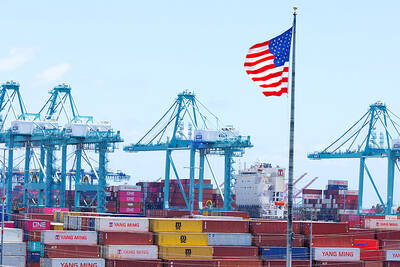
NOT IMMEDIATE: Taiwan has a chance to appeal the proposed 10 percent tariff before it starts, while other countries face a 12.5 percent tariff from the trade office Taiwan is among 60 economies determined by the US to have failed to impose or enforce a ban on the importation of goods produced with forced labor, according to a notice released on Tuesday by the Office of the US Trade Representative (USTR), which proposed imposing an additional 10 percent or more tariff on them. The USTR in a statement said that following an investigation, it had determined under Section 301 of the Trade Act of 1974 that the failure of the 60 economies to impose and effectively enforce a prohibition on the importation of goods produced with forced labor is
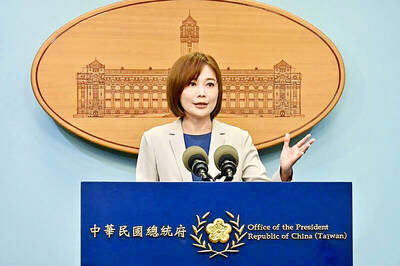
TIT-FOR-TAT: The US allegedly revoked the visa of a Chinese national working at Xinhua News Agency in the US in response to Beijing’s expulsion of Vivian Wang The Presidential Office yesterday condemned China for expelling a New York Times correspondent from Beijing following the newspaper’s interview with President William Lai (賴清德), saying the move highlighted Beijing’s suppression of press freedom and its threat to international news media. Taiwan has noted a series of recent incidents in which Beijing used similar tactics to “threaten and pressure international media outlets and journalists,” Presidential Office spokeswoman Karen Kuo (郭雅慧) said in a statement. “This concerns not only press freedom and freedom of expression, but also the safety of journalists, and Taiwan and relevant partners are paying close attention to the situation,” she


 RSS
RSS