


Japanese Prime Minister Sanae Takaichi’s ruling party approved plans to beef up the country’s intelligence capability, a party official said yesterday, as Takaichi pushes ahead with a defense overhaul.
Takaichi has vowed to make Japan “strong and prosperous” through key policy changes including in defense and intelligence.
The proposal, agreed by the intelligence strategy headquarters of the Liberal Democratic Party (LDP), includes establishing an upgraded intelligence bureau and bolstering “foreign intelligence collection capabilities,” an LDP official said.
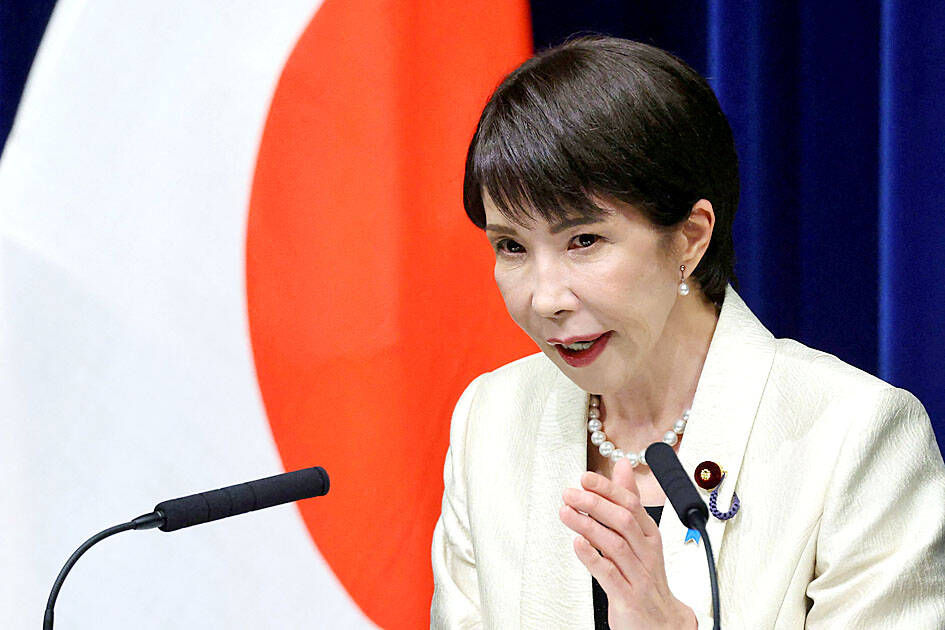
Photo: Reuters
It calls for a mandatory registration system for foreign agents — such as people and corporations lobbying within Japan on behalf of other governments — as part of counterintelligence measures.
The plan, which also includes a ban on the use of mobile phones in key government buildings, is expected to be submitted to Takaichi next week, the Asahi Shimbun and other local media reported.
“One of the central pillars of the major policy shift [under Takaichi] is a fundamental strengthening of intelligence,” LDP policy chief Takayuki Kobayashi said. “Simply creating an organization on paper is utterly meaningless; the question is how we can turn it into a truly living, functioning body.”
Separately, the LDP on Wednesday proposed changes to Japan’s stringent rules on exporting military equipment to enable exports of lethal weapons, local reports said.
Takaichi has also said that she plans to revise three key national security policy documents this year to reflect the changing security environment.
The prime minister has vowed that Japan would steadfastly protect its territory, waters and airspace.
Chinese Minister of Foreign Affairs Wang Yi (王毅) told the Munich Security Conference earlier this month that forces in Japan were seeking to “revive militarism.”
While Takaichi has said in parliament that she would not change the rules, local media have reported that the prime minister is considering allowing US nuclear weapons into Japanese territory — a revision to the country’s non-nuclear principles of not producing, possessing or permitting the introduction of such weapons into the country.

‘NO SECURITY RISK’: The Railway Bureau reassured the public that the technicians’ activities were limited to technical guidance and did not involve sensitive systems The Railway Bureau yesterday said it had invited eight Chinese technicians to assist with an airport MRT construction project. The bureau issued the confirmation after an Internet user said Chinese nationals had entered the construction zone of Taiwan Taoyuan International Airport’s Terminal 3 project. They asked why “individuals from an enemy state” were allowed access to such a major national infrastructure project, which raised serious concerns over Taiwan’s industrial safety, sensitive systems and information security. The bureau’s Northern Region Engineering Branch Office said subcontractor Taiwan Handle Industrial Co (台灣手把工業) of the Taoyuan airport MRT’s “Contract No. CU05 Project A14 Station Civil, MEP &

The National Chungshan Institute of Science and Technology yesterday showcased its locally developed variants of the Vision 60 robotic patrol dog, which it plans to deploy on the nation’s outlying territories in the South China Sea. The variants were produced under the Joint Lab project — created by the institute and domestic companies — and assembled with domestically produced motors, lenses and artificial intelligence (AI) systems alongside licensed tech from the US, Missile and Rocket Systems Research Division deputy director Jen Kuo-kang (任國光) told the media event at a military base in Taipei’s Dazhi (大直) area. Taiwan has built up its strengths

NOT IMMEDIATE: Taiwan has a chance to appeal the proposed 10 percent tariff before it starts, while other countries face a 12.5 percent tariff from the trade office Taiwan is among 60 economies determined by the US to have failed to impose or enforce a ban on the importation of goods produced with forced labor, according to a notice released on Tuesday by the Office of the US Trade Representative (USTR), which proposed imposing an additional 10 percent or more tariff on them. The USTR in a statement said that following an investigation, it had determined under Section 301 of the Trade Act of 1974 that the failure of the 60 economies to impose and effectively enforce a prohibition on the importation of goods produced with forced labor is
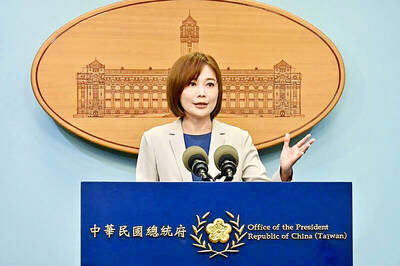
TIT-FOR-TAT: The US allegedly revoked the visa of a Chinese national working at Xinhua News Agency in the US in response to Beijing’s expulsion of Vivian Wang The Presidential Office yesterday condemned China for expelling a New York Times correspondent from Beijing following the newspaper’s interview with President William Lai (賴清德), saying the move highlighted Beijing’s suppression of press freedom and its threat to international news media. Taiwan has noted a series of recent incidents in which Beijing used similar tactics to “threaten and pressure international media outlets and journalists,” Presidential Office spokeswoman Karen Kuo (郭雅慧) said in a statement. “This concerns not only press freedom and freedom of expression, but also the safety of journalists, and Taiwan and relevant partners are paying close attention to the situation,” she


 RSS
RSS