


Taiwan Semiconductor Manufacturing Co’s (TSMC, 台積電) market capitalization swelled to US$2 trillion for the first time following a 4.25 percent rally in its American depositary receipts (ADR) overnight, putting the world’s biggest contract chipmaker sixth on the list of the world’s biggest companies by market capitalization, just behind Amazon.com Inc.
The site CompaniesMarketcap.com ranked TSMC ahead of Saudi Aramco and Meta Platforms Inc.
The Taiwanese company’s ADRs on Tuesday surged to US$385.75 on the New York Stock Exchange, as strong demand for artificial intelligence (AI) applications led to chip supply constraints and boost revenue growth to record-breaking levels. Each TSMC ADR represents 5 common shares.
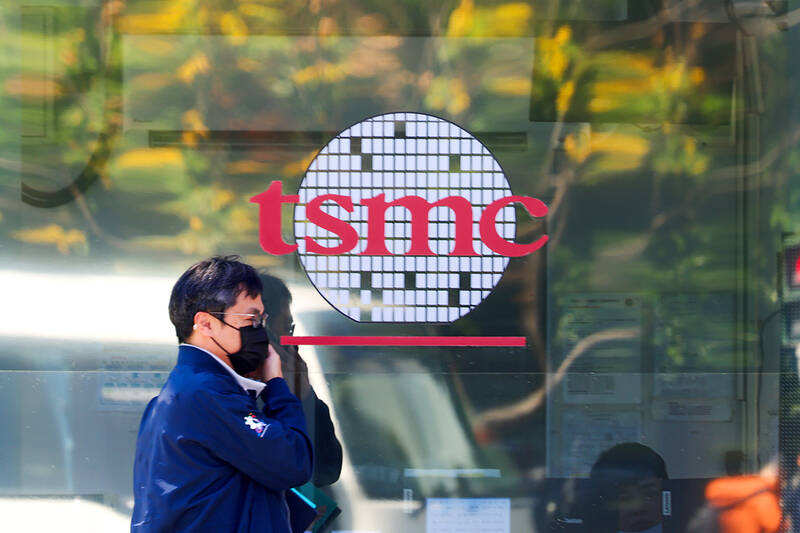
Photo: Ritchie B. Tongo, EPA
TSMC yesterday climbed 2.54 percent on the Taiwan Stock Exchange to close at a new high of NT$2,015.
Global funds on Tuesday snapped up Taiwanese stocks in their biggest one-day buying spree in two decades, signaling confidence that chipmakers would remain AI-boom beneficiaries, even as broader markets face growing fears of disruption.
Overseas investors bought a net US$2.77 billion of Taiwan equities, the most since December 2005, data compiled by Bloomberg showed.
The investment marked a sixth consecutive day of buying by foreign funds.
The surge comes as global equities wobbled following a report from little-known Citrini Research that warned of a dystopian-like wave of AI-driven disruption. While investors have been steering clear of sectors seen as vulnerable, they are doubling down on chipmakers viewed as the backbone of the AI buildout.
Taiwan’s logic-heavy market dominated by advanced semiconductor producers is seen as a relative safe haven in the AI “scare trade.”
“Taiwan is the home of the global AI supply chain,” Union Bancaire Privee managing director Vey-Sern Ling said. “Its companies and stock market will continue to benefit as long as investors believe that AI is disruptive and hence indispensable to our future.”
At the current pace, Taiwan is on track for about US$7 billion in foreign inflows this month, a contrast to the roughly similar amount that has been pulled from memorychip-focused South Korea over the same period.
The growing dominance of TSMC has underpinned the broader market, with the company accounting for about 45 percent of the TAIEX, about triple its weighting a decade earlier. The stock has surged about 30 percent this year, repeatedly notching fresh record highs.
The surge in equity inflows has also lent support to the New Taiwan dollar, although gains have been tempered by steady US dollar buying from local life insurers. The currency’s relative stability might also reduce the need for foreign investors to hedge their exposure.
Khoon Goh, head of Asia research at Australia & New Zealand Banking Group, said he does not expect a significant pickup in currency hedging alongside the stock inflows.
“Equity investors typically do not hedge, unlike fixed-income investors,” Goh said, adding that limited hedging activity should allow the inflows to continue supporting the NT dollar.

‘NO SECURITY RISK’: The Railway Bureau reassured the public that the technicians’ activities were limited to technical guidance and did not involve sensitive systems The Railway Bureau yesterday said it had invited eight Chinese technicians to assist with an airport MRT construction project. The bureau issued the confirmation after an Internet user said Chinese nationals had entered the construction zone of Taiwan Taoyuan International Airport’s Terminal 3 project. They asked why “individuals from an enemy state” were allowed access to such a major national infrastructure project, which raised serious concerns over Taiwan’s industrial safety, sensitive systems and information security. The bureau’s Northern Region Engineering Branch Office said subcontractor Taiwan Handle Industrial Co (台灣手把工業) of the Taoyuan airport MRT’s “Contract No. CU05 Project A14 Station Civil, MEP &

The National Chungshan Institute of Science and Technology yesterday showcased its locally developed variants of the Vision 60 robotic patrol dog, which it plans to deploy on the nation’s outlying territories in the South China Sea. The variants were produced under the Joint Lab project — created by the institute and domestic companies — and assembled with domestically produced motors, lenses and artificial intelligence (AI) systems alongside licensed tech from the US, Missile and Rocket Systems Research Division deputy director Jen Kuo-kang (任國光) told the media event at a military base in Taipei’s Dazhi (大直) area. Taiwan has built up its strengths

NOT IMMEDIATE: Taiwan has a chance to appeal the proposed 10 percent tariff before it starts, while other countries face a 12.5 percent tariff from the trade office Taiwan is among 60 economies determined by the US to have failed to impose or enforce a ban on the importation of goods produced with forced labor, according to a notice released on Tuesday by the Office of the US Trade Representative (USTR), which proposed imposing an additional 10 percent or more tariff on them. The USTR in a statement said that following an investigation, it had determined under Section 301 of the Trade Act of 1974 that the failure of the 60 economies to impose and effectively enforce a prohibition on the importation of goods produced with forced labor is

TIT-FOR-TAT: The US allegedly revoked the visa of a Chinese national working at Xinhua News Agency in the US in response to Beijing’s expulsion of Vivian Wang The Presidential Office yesterday condemned China for expelling a New York Times correspondent from Beijing following the newspaper’s interview with President William Lai (賴清德), saying the move highlighted Beijing’s suppression of press freedom and its threat to international news media. Taiwan has noted a series of recent incidents in which Beijing used similar tactics to “threaten and pressure international media outlets and journalists,” Presidential Office spokeswoman Karen Kuo (郭雅慧) said in a statement. “This concerns not only press freedom and freedom of expression, but also the safety of journalists, and Taiwan and relevant partners are paying close attention to the situation,” she


 RSS
RSS