


The government will move ahead with a long-planned project to elevate a stretch of railway between Yilan City and Yilan County’s Luodong Township (羅東), Premier Cho Jung-tai (卓榮泰) said yesterday.
Cho made the announcement during a Lunar New Year visit to the city’s Bisia Temple (碧霞宮), where he was handing out red envelopes as part of a Lunar New Year event.
“The Executive Yuan has, in principle, fully approved the Yilan-Luodong railway elevation project, allowing it to move forward,” he said.
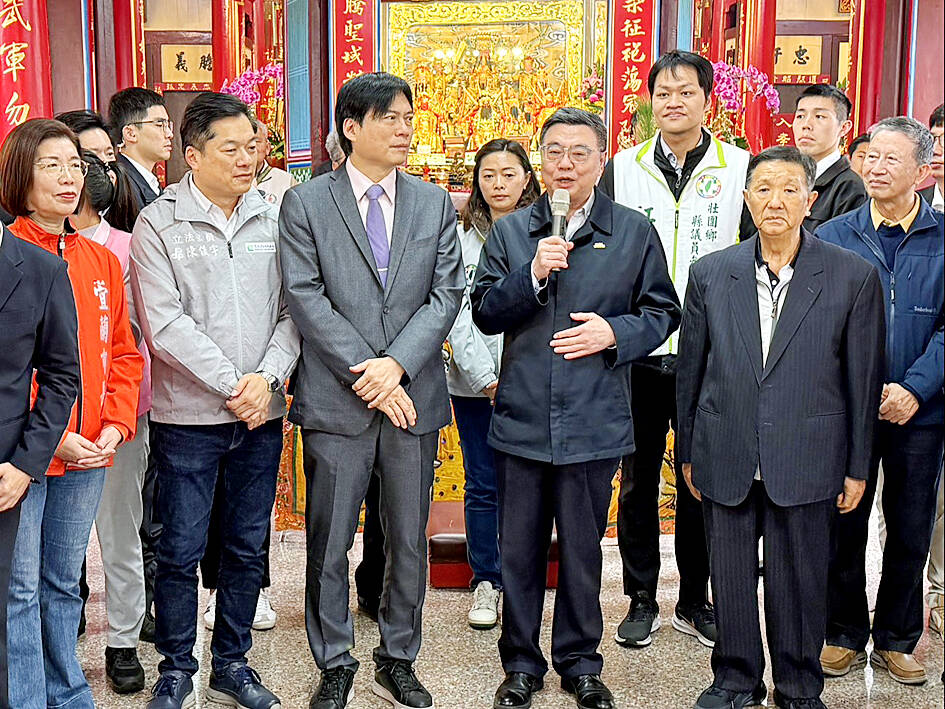
Photo: Wang Yi-hung, Taipei Times
The National Development Council in December last year approved the project, which was submitted to the Executive Yuan for final approval. Cho had pledged on Feb. 8 to make a final decision before the Lunar New Year holiday.
Cho yesterday said he visited Yilan with Democratic Progressive Party Legislator Chen Chun-yu (陳俊宇) and Executive Yuan political adviser Lin Kuo-chang (林國漳) to discuss the project and its significance for easing traffic congestion in the county.
The project would span about 16km, from the southern end of Sicheng Station (四城) to the Dongshan Drainage Bridge (冬山排水橋). Stations in Yilan, Erjie (二結), Jhongli (中里) and Luodong would be rebuilt as part of the elevation, and a new “County Government Center Station” would be added, he said.
The project would eliminate nine level crossings, four overpasses and four underpasses, at an estimated cost of NT$50.1 billion (US$1.6 billion).
Discussion of elevating Yilan’s railway dates back to 1993, when the now-defunct Taiwan Provincial Government proposed a study on railway grade separation.
After more than three decades of planning, the project has reached a major turning point, Cho said.
Following an on-site inspection, Cho said he was convinced the project should be accelerated, as removing level crossings and grade separations would significantly improve traffic flow.
Access to hospitals and other key facilities would also become more convenient, he said.
The Executive Yuan granted in-principle approval on Lunar New Year’s Eve, clearing preparatory work to proceed, he said.
However, while the Cabinet has endorsed the plan, it cannot advance without a budget approved by the Legislative Yuan, Cho added.
He said he has asked Chen to help secure passage of the funding bill.
Once the budget is approved, the government can finalize the funding schedule to ensure adequate resources for construction, with central and local authorities working together to complete the project, he said.
Minister Without Portfolio Derek Chen (陳金德), an Yilan native, on Tuesday last week said that elevating the railway would help reconnect divided parts of the county, ease bottlenecks caused by level crossings and promote integrated development along the Yilan-Luodong corridor.
The county government was originally required to contribute NT$10.5 billion in matching funds toward the project. To ease fiscal pressure, it sought special consultations with central authorities to reduce its share. In December last year, central ministries and the county government agreed to lower the local contribution to NT$5.7 billion.
The county government said it hopes to finalize the plan as soon as possible, targeting completion by 2035.
Additional reporting by Yu Ming-chin

‘NO SECURITY RISK’: The Railway Bureau reassured the public that the technicians’ activities were limited to technical guidance and did not involve sensitive systems The Railway Bureau yesterday said it had invited eight Chinese technicians to assist with an airport MRT construction project. The bureau issued the confirmation after an Internet user said Chinese nationals had entered the construction zone of Taiwan Taoyuan International Airport’s Terminal 3 project. They asked why “individuals from an enemy state” were allowed access to such a major national infrastructure project, which raised serious concerns over Taiwan’s industrial safety, sensitive systems and information security. The bureau’s Northern Region Engineering Branch Office said subcontractor Taiwan Handle Industrial Co (台灣手把工業) of the Taoyuan airport MRT’s “Contract No. CU05 Project A14 Station Civil, MEP &

The National Chungshan Institute of Science and Technology yesterday showcased its locally developed variants of the Vision 60 robotic patrol dog, which it plans to deploy on the nation’s outlying territories in the South China Sea. The variants were produced under the Joint Lab project — created by the institute and domestic companies — and assembled with domestically produced motors, lenses and artificial intelligence (AI) systems alongside licensed tech from the US, Missile and Rocket Systems Research Division deputy director Jen Kuo-kang (任國光) told the media event at a military base in Taipei’s Dazhi (大直) area. Taiwan has built up its strengths

NOT IMMEDIATE: Taiwan has a chance to appeal the proposed 10 percent tariff before it starts, while other countries face a 12.5 percent tariff from the trade office Taiwan is among 60 economies determined by the US to have failed to impose or enforce a ban on the importation of goods produced with forced labor, according to a notice released on Tuesday by the Office of the US Trade Representative (USTR), which proposed imposing an additional 10 percent or more tariff on them. The USTR in a statement said that following an investigation, it had determined under Section 301 of the Trade Act of 1974 that the failure of the 60 economies to impose and effectively enforce a prohibition on the importation of goods produced with forced labor is

TIT-FOR-TAT: The US allegedly revoked the visa of a Chinese national working at Xinhua News Agency in the US in response to Beijing’s expulsion of Vivian Wang The Presidential Office yesterday condemned China for expelling a New York Times correspondent from Beijing following the newspaper’s interview with President William Lai (賴清德), saying the move highlighted Beijing’s suppression of press freedom and its threat to international news media. Taiwan has noted a series of recent incidents in which Beijing used similar tactics to “threaten and pressure international media outlets and journalists,” Presidential Office spokeswoman Karen Kuo (郭雅慧) said in a statement. “This concerns not only press freedom and freedom of expression, but also the safety of journalists, and Taiwan and relevant partners are paying close attention to the situation,” she


 RSS
RSS