


Taiwan Semiconductor Manufacturing Co (TSMC, 台積電) plans to make advanced 3-nanometer chips in Japan, stepping up its semiconductor manufacturing roadmap in the country in a triumph for Japanese Prime Minister Sanae Takaichi’s technology ambitions.
TSMC is to adopt cutting-edge technology for its second wafer fab in Kumamoto, company chairman C.C. Wei (魏哲家) said yesterday.
That is an upgrade from an original blueprint to produce 7-nanometer chips by late next year, people familiar with the matter said.
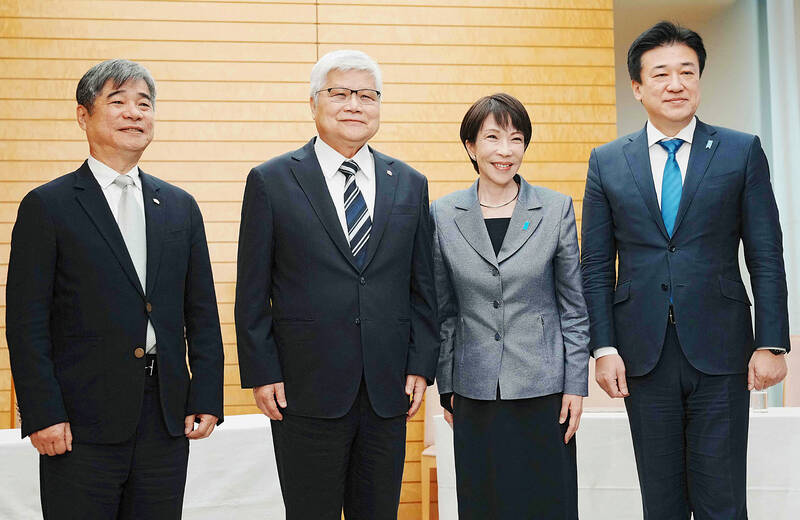
Photo: AFP
TSMC began mass production at its first plant in Japan’s Kumamoto in late 2024.
Its second fab, which is still under construction, was originally focused on manufacturing 6 to 12-nanometer chips, significantly less advanced than those announced yesterday.
The facility is scheduled to come online late next year.
To drive that expansion, TSMC plans to increase its overall investment in the Japanese plant to ¥2.6 trillion (US$17 billion), the Yomiuri Shimbun reported yesterday.
TSMC’s planned upgrade is likely to boost Takaichi’s goal to bolster domestic chipmaking.
Takaichi held up TSMC’s Kumamoto endeavor as a template for economic cooperation and said that a 3-nanometer fab shores up the global chip supply chain and Japan’s economic security.
“We want to strengthen our win-win partnership,” Takaichi said at the start of a meeting with Wei in Tokyo.
Wei in turn credited Tokyo for its endorsement and aid.
“Without your support this giga-fab project won’t be possible,” he told Takaichi, adding that he was a “firm supporter.”
He held up a copy of her book, Beautiful, Strong and Growing Nation: My Japan Economic Resilience Plan, and said: “You wrote a book five years ago, where you already talked about TSMC.”
The TSMC revelation coincides with a snap lower-house election this weekend that could reshape Japan’s political balance.
Takaichi — who has only been in the job for just more than three months — has set the election date for Sunday to capitalize on soaring public support to shore up her coalition government.
TSMC is accelerating a buildout around the world to meet a surge in demand for the high-end chips required to train and operate artificial intelligence (AI) services.
Taiwan also faces growing challenges when it comes to supplying resources, including land and electricity, while concerns persist about the concentration of advanced chip production in the nation.
Growing risk surrounding Taiwan likely contributed to the new plan, alongside faster-than-anticipated adoption of advanced technologies, Omdia analyst Akira Minamikawa said.
“This could lead to discussions about producing even more advanced nodes in Japan in the future,” he said.
Semiconductors made using 3-nanometer processes are used for AI robotics and data processing, Japanese Minister of Economy, Trade and Industry Ryosei Akazawa said, adding that Japan would work even closer with TSMC and deepen cooperation.
TSMC’s move to 3-nanometer chips is “fully aligned with the Takaichi administration’s strategy to advance the social implementation of AI in Japan,” he said.
While Taiwanese officials and TSMC have repeatedly pledged to keep its most-cutting-edge technology at home, the company intends to add capacity for more mature semiconductors overseas to alleviate resource constraints at home.
TSMC began mass production of 2-nanometer chips at its Kaohsiung factory last quarter.
“All TSMC’s decisions are based on customer needs, and their overseas expansion is not intended to replace Taiwan,” Executive Yuan spokeswoman Michelle Lee (李慧芝) said yesterday, citing Wei.
Additional reporting by CNA and AFP

‘NO SECURITY RISK’: The Railway Bureau reassured the public that the technicians’ activities were limited to technical guidance and did not involve sensitive systems The Railway Bureau yesterday said it had invited eight Chinese technicians to assist with an airport MRT construction project. The bureau issued the confirmation after an Internet user said Chinese nationals had entered the construction zone of Taiwan Taoyuan International Airport’s Terminal 3 project. They asked why “individuals from an enemy state” were allowed access to such a major national infrastructure project, which raised serious concerns over Taiwan’s industrial safety, sensitive systems and information security. The bureau’s Northern Region Engineering Branch Office said subcontractor Taiwan Handle Industrial Co (台灣手把工業) of the Taoyuan airport MRT’s “Contract No. CU05 Project A14 Station Civil, MEP &

The National Chungshan Institute of Science and Technology yesterday showcased its locally developed variants of the Vision 60 robotic patrol dog, which it plans to deploy on the nation’s outlying territories in the South China Sea. The variants were produced under the Joint Lab project — created by the institute and domestic companies — and assembled with domestically produced motors, lenses and artificial intelligence (AI) systems alongside licensed tech from the US, Missile and Rocket Systems Research Division deputy director Jen Kuo-kang (任國光) told the media event at a military base in Taipei’s Dazhi (大直) area. Taiwan has built up its strengths

NOT IMMEDIATE: Taiwan has a chance to appeal the proposed 10 percent tariff before it starts, while other countries face a 12.5 percent tariff from the trade office Taiwan is among 60 economies determined by the US to have failed to impose or enforce a ban on the importation of goods produced with forced labor, according to a notice released on Tuesday by the Office of the US Trade Representative (USTR), which proposed imposing an additional 10 percent or more tariff on them. The USTR in a statement said that following an investigation, it had determined under Section 301 of the Trade Act of 1974 that the failure of the 60 economies to impose and effectively enforce a prohibition on the importation of goods produced with forced labor is
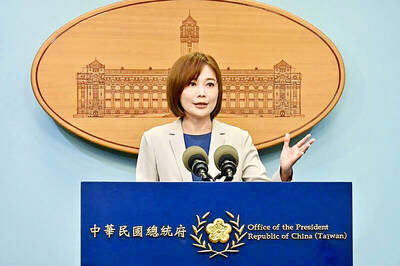
TIT-FOR-TAT: The US allegedly revoked the visa of a Chinese national working at Xinhua News Agency in the US in response to Beijing’s expulsion of Vivian Wang The Presidential Office yesterday condemned China for expelling a New York Times correspondent from Beijing following the newspaper’s interview with President William Lai (賴清德), saying the move highlighted Beijing’s suppression of press freedom and its threat to international news media. Taiwan has noted a series of recent incidents in which Beijing used similar tactics to “threaten and pressure international media outlets and journalists,” Presidential Office spokeswoman Karen Kuo (郭雅慧) said in a statement. “This concerns not only press freedom and freedom of expression, but also the safety of journalists, and Taiwan and relevant partners are paying close attention to the situation,” she


 RSS
RSS