

The Legislative Yuan sent the Taiwan People’s Party’s (TPP) defense bill to committee for review today, after continuing to block the Executive Yuan’s NT$1.25 trillion (US$39.52 billion) special defense budget.
The opposition again blocked the Executive Yuan’s eight-year special defense budget during the Procedure Committee’s meeting on Tuesday, preventing it from being added to the Legislative Yuan’s agenda for today’s meeting.
The Legislative Yuan was set to review amendments to the Housing Act (住宅法), Satellite Broadcasting Act (衛星廣播電視法) and the Act Governing the Settlement of Ill-gotten Properties by Political Parties and Their Affiliate Organizations (政黨及其附隨組織不當取得財產處理條例) when it convened this afternoon.
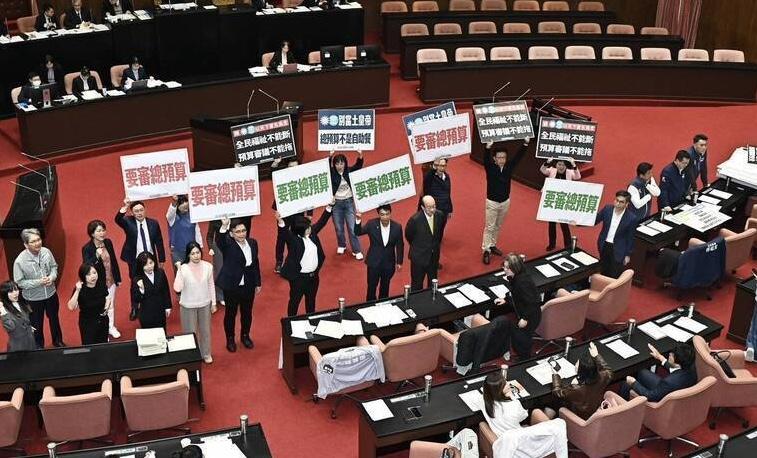
Photo: Tu Chien-jung, Taipei Times
The Democratic Progressive Party caucus proposed adding a review of the Executive Yuan’s special defense budget, but the opposition parties blocked it with their majority.
Under the opposition’s majority, the legislature then voted to send the TPP’s proposed “national security and asymmetric warfare procurement bill” to committee review.
The TPP’s proposal lists five items, including the High Mobility Artillery Rocket System (HIMARS), with total spending of NT$400 billion to be budgeted on an annual basis.
It allocates NT$126.7 billion for 60 M109A7 self-propelled howitzers along with 4,080 rounds of precision munitions, and NT$127.6 billion for 82 HIMARS multiple rocket missile systems.
It also covers anti-armor loitering munition systems, capped at NT$34.7 billion, 70 Javelin anti-armor missile launchers and 1,050 missiles, capped at NT$11.8 billion, and 24 TOW 2B anti-armor missile launchers and 1,545 missiles, capped at NT$11.1 billion.
Several preapproved US weapons sales present in the Cabinet's special budget are omitted, including US$1.01 billion for tactical mission network software, US$96 million for AH-1W helicopter parts and US$91.4 million for Harpoon missile support.
Funding for partnerships with the local arms industry, procurement of 200,000 drones, and the T-Dome multilayered air defense system are also absent.
The Executive Yuan’s version allocates NT$1.25 trillion to strengthen asymmetric warfare capabilities over eight years.
Repeatedly blocking the Executive Yuan’s special defense budget ignores the nation’s true needs, delaying national defense development and hindering joint operations, Executive Yuan spokesperson Michelle Lee (李慧芝) said.
The TPP’s proposed budget merely copies information made public by the Ministry of National Defense (MND) and cuts up the Executive Yuan’s version, Lee said.
It lacks strategic vision, military development planning, contradicts military procurement procedures and overlooks self-defense, she said.
It also threatens to obstruct arms purchases from the US and impact Taiwan’s sustainable combat capabilities, she added.
The MND previously said that the TPP’s proposal would only procure part of the necessary equipment and lacks supporting measures, which would make it hard to implement and may have serious long-term repercussions.
The Executive Yuan’s proposed budget was made through close communication with the US, Lee said, adding that it includes a comprehensive strategy and military development plan, aligns with procurement procedures and would enhance Taiwan’s self-defense capabilities.
As the TPP’s proposal lacks these elements, the Executive Yuan’s budget must be sent to committee review to truly build Taiwan’s national defense, she said.
The legislature has repeatedly blocked a review of the Cabinet's special defense budget since President William Lai (賴清德) announced it in November last year, with the opposition demanding that Lai first brief lawmakers and take questions on the proposal — a request Lai has rejected.

FRIDAY, SATURDAY: While Typhoon Champi might weaken, officials warned about large waves, while some transport services and tourist spots have been affected Typhoon Champi is forecast to have the greatest effect on Taiwan tomorrow and on Saturday, with a sea warning issued late last night and a land warning expected afternoon today, the Central Weather Administration (CWA) said yesterday. The storm’s projected track has shifted slightly westward and it could begin moving away from Taiwan toward Japan’s Kyushu island on Saturday, with the warnings potentially lifted as early as Saturday afternoon, CWA forecaster Chang Cheng-chuan (張承傳) said. As of yesterday afternoon, Champi was about 910km east-southeast of Oluanpi (鵝鑾鼻), Taiwan proper’s southernmost point, CWA data showed. Its maximum sustained winds had weakened slightly to
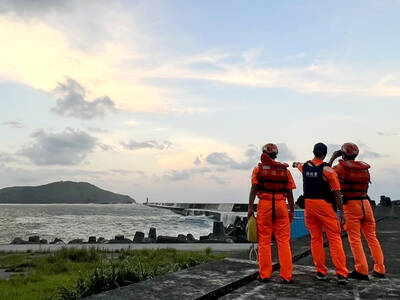
The Coast Guard Administration (CGA) yesterday urged China not to exploit typhoons to assert jurisdiction over the Taiwan Strait. The CGA issued the remarks after it found that China was shadowing eight Japan Coast Guard ships that sheltered in Taiwan proper’s western waters due to Typhoon Champi. Eight Japan Coast Guard (JCG) vessels sailed southward along the Taiwan Strait median line from 6am on Thursday, reaching waters southwest of Penghu County’s Cimei Island (七美島), outside Taiwan’s contiguous zone, which extends 24 nautical miles (44.4km) from the territorial sea baseline, it said. As the Japanese ships prepared for the typhoon, they were followed by
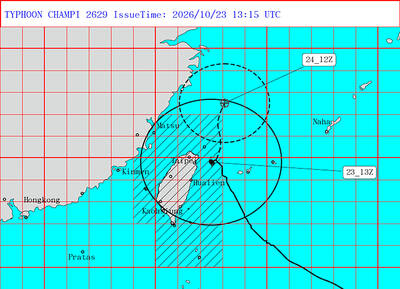
STAY CAUTIOUS: Rain is expected to begin easing this afternoon, but a CWA forecaster said that if the storm stalls or loops on its approach, heavy winds are likely Typhoon Champi, which caused widespread damage and injuries, and prompted road closures and evacuations across Taiwan yesterday, is expected to continue to bring heavy rain this morning, with up to 900mm of rain forecast for mountainous areas of New Taipei City, Taoyuan and Yilan County, the Central Weather Administration (CWA) said yesterday. At one point a super typhoon and one of the strongest storms in the Pacific this year, Champi was packing gusts of about 191kph near its center as of 8:30pm, the CWA said. Taipei, New Taipei City, Keelung, Taoyuan, Hsinchu city and county, Taichung; and Yilan, Miaoli, Changhua, Nantou, Yunlin
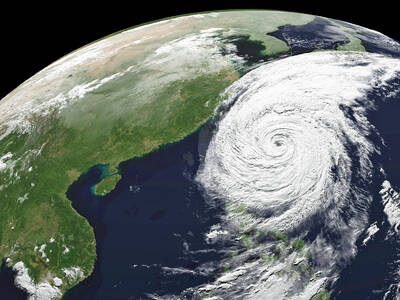
TOTAL COVERAGE: Champi’s outer band is expected to blanket the entire nation, with the center coming closest tonight or tomorrow before leaving tomorrow evening School and work across most of the nation has been canceled today, as Typhoon Champi is expected to skirt the northeast edge of Taiwan proper. As of 9pm, all municipalities except for Kinmen County had announced cancelations. Taitung County last night announced closures on Green Island (綠島) and Orchid Island (Lanyu, 蘭嶼), but did not announce for the rest of the county until 6am today. Stock market settlements scheduled for today would be postponed to the next business day, the Taiwan Stock Exchange said. The announcements came after the Central Weather Administration (CWA) yesterday expanded its land warning for Champi to 19 regions


 RSS
RSS