


US President Donald Trump on Monday threatened to hike tariffs on goods imported from South Korea to 25 percent, citing what he said was the failure of the country’s legislature to codify the trade deal the two nations reached last year.
Trump in a social media post said the new rate would apply to vehicles, lumber, pharmaceutical products and “all other Reciprocal TARIFFS.”
Under the existing agreement, the US president set a 15 percent levy on South Korean exports.
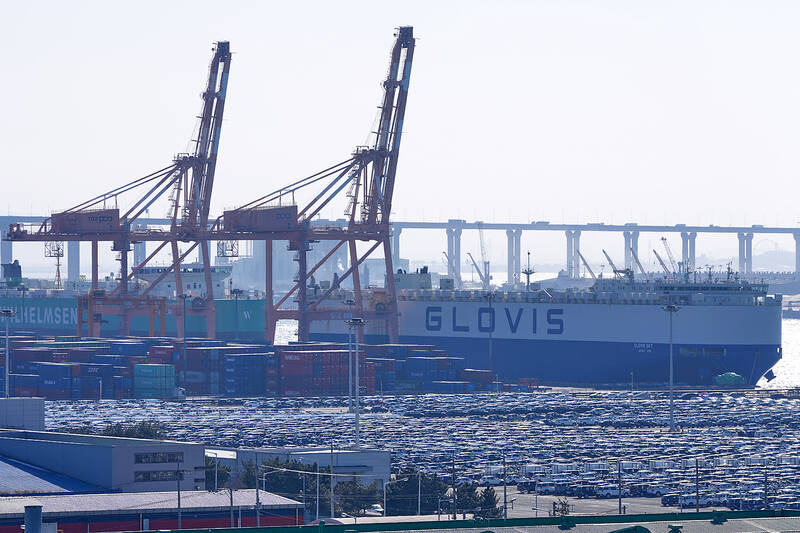
Photo: AP
“South Korea’s Legislature is not living up to its Deal with the United States,” Trump wrote. “In each of these Deals, we have acted swiftly to reduce our TARIFFS in line with the Transaction agreed to. We, of course, expect our Trading Partners to do the same.”
If implemented, the move could have wide-ranging effects on major South Korean companies, such as Hyundai Motor Co, which exported 1.1 million vehicles to the US in 2024.
Trump’s announcement marks his latest move to ratchet up trade tensions with allies. In the past few weeks, he has threatened to raise duties on Canadian products to 100 percent if Ottawa signed a trade deal with China and to slap new charges on European countries’ goods over his quest to seize control of Greenland.
Still, Trump’s tariff threats have often been scaled back or reversed. Data compiled by Bloomberg show that about 27 percent of such threats since late 2024 were fully executed, with the share that remained in place lower at about 20 percent.
South Korea has been lauded as a model ally by the US for raising its defense spending to 3.5 percent of GDP, but tensions remain over the pace at which Seoul provides investment to the US under its earlier trade deal, and regulations seen to be inhibiting US digital commerce firms.
There is also a lack of clarity over an agreement to help with US shipbuilding, the construction of nuclear submarines and the provision of nuclear fuel for submarines.
Following last year’s trade deal announcement, a domestic bill called the “special law on strategic investment with the US” was introduced to the South Korean parliament in late November last year, triggering a retroactive cut in US auto tariffs from 25 percent to 15 percent.
Once passed, it would give South Korea’s government the legal authority to manage and carry out the large-scale investments it pledged to the US under the trade deal, but it has not been put on the fast track for approval for now.
A Bloomberg report last week said Seoul would hold off this year on implementing its annual US investment pledge that was part of the trade deal framework amid concerns over capital outflows and currency volatility.
South Korean Minister of Finance Koo Yun-cheol subsequently said the government was not intentionally delaying the investment, but was still in the process of selecting projects and completing required procedures.
He said it would be difficult for the funds to be allocated in the first half of the year given the time needed to identify sites, finalize designs and carry out approvals.
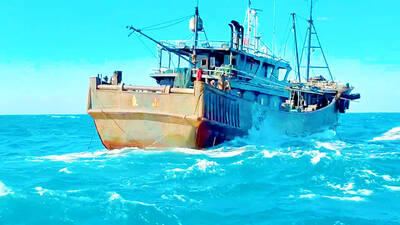
MAKING WAVES: China’s maritime militia could become a nontraditional threat in war, clogging up shipping lanes to prevent US or Japanese intervention, a report said About 1,900 Chinese ships flying flags of convenience and fishing vessels that participated in China’s military exercises around Taiwan last month and in January last year have been listed for monitoring, Coast Guard Administration (CGA) Deputy Director-General Hsieh Ching-chin (謝慶欽) said yesterday. Following amendments to the Commercial Port Act (商港法) and the Law of Ships (船舶法) last month, the CGA can designate possible berthing areas or deny ports of call for vessels suspected of loitering around areas where undersea cables can be accessed, Oceans Affairs Council Minister Kuan Bi-ling (管碧玲) said. The list of suspected ships, originally 300, had risen to about
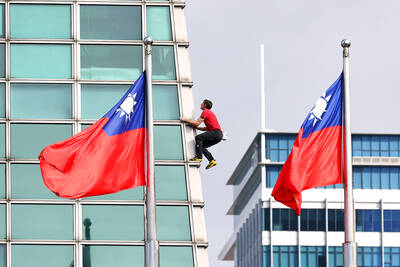
DAREDEVIL: Honnold said it had always been a dream of his to climb Taipei 101, while a Netflix producer said the skyscraper was ‘a real icon of this country’ US climber Alex Honnold yesterday took on Taiwan’s tallest building, becoming the first person to scale Taipei 101 without a rope, harness or safety net. Hundreds of spectators gathered at the base of the 101-story skyscraper to watch Honnold, 40, embark on his daredevil feat, which was also broadcast live on Netflix. Dressed in a red T-shirt and yellow custom-made climbing shoes, Honnold swiftly moved up the southeast face of the glass and steel building. At one point, he stepped onto a platform midway up to wave down at fans and onlookers who were taking photos. People watching from inside
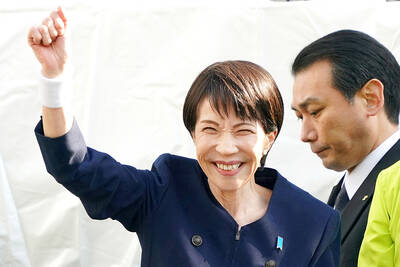
Japan’s strategic alliance with the US would collapse if Tokyo were to turn away from a conflict in Taiwan, Japanese Prime Minister Sanae Takaichi said yesterday, but distanced herself from previous comments that suggested a possible military response in such an event. Takaichi expressed her latest views on a nationally broadcast TV program late on Monday, where an opposition party leader criticized her for igniting tensions with China with the earlier remarks. Ties between Japan and China have sunk to the worst level in years after Takaichi said in November that a hypothetical Chinese attack on Taiwan could bring about a Japanese
The WHO ignored early COVID-19 warnings from Taiwan, US Deputy Secretary of Health and Human Services Jim O’Neill said on Friday, as part of justification for Washington withdrawing from the global health body. US Secretary of State Marco Rubio on Thursday said that the US was pulling out of the UN agency, as it failed to fulfill its responsibilities during the COVID-19 pandemic. The WHO “ignored early COVID warnings from Taiwan in 2019 by pretending Taiwan did not exist, O’Neill wrote on X on Friday, Taiwan time. “It ignored rigorous science and promoted lockdowns.” The US will “continue international coordination on infectious


 RSS
RSS