


Taiwan has surpassed South Korea as the country least willing to have children, with an annual crude birthrate of 4.62 per 1,000 people, Ministry of the Interior data showed yesterday.
The nation was previously ranked the second-lowest country in terms of total fertility rate, or the average number of children a woman has in her lifetime.
However, South Korea’s fertility rate began to recover from 2023, with total fertility rate rising from 0.72 and estimated to reach 0.82 to 0.85 by last year, and the crude birthrate projected at 6.7 per 1,000 people.

Photo: Tsai Shu-yuan, Taipei Times
Japan’s crude birthrate was projected to fall below six, but hold above five per 1,000 people last year.
In contrast, Taiwan’s crude birthrate plummeted from 5.76 per 1,000 people in 2024 to 4.62 last year, and its total fertility rate is likely to fall below 0.8.
Ministry data showed that only 107,812 babies were born in Taiwan last year, or a crude birthrate of 4.62 per 1,000 people.
That was 27,044 babies fewer than 2024, when there were 134,856 newborns and a crude birthrate of 5.76 per 1,000 people, and was a record low since the ministry began compiling statistics.
The number of newborns has declined for 10 consecutive years, from 208,440 in 2016 to 193,844 in 2017; 181,601 in 2018; 177,767 in 2019; 165,249 in 2020; 153,820 in 2021; 138,986 in 2022; 135,571 in 2023; 134,856 in 2024; and 107,812 last year, ministry data showed.
Taiwan has officially become a “super-aged society” under UN criteria, which defines it as one in which people aged 65 or older make up at least 20 percent of the population.
Countries where people aged 65 or older make up 14 percent or more of the population are defined as “aged” societies, while those with 7 percent or more are “aging” societies.
As of the end of last month, Taiwan’s population aged 65 or` older totaled 4,673,155, or 20.06 percent of the total population, the ministry said.
The total population was 23,299,132 as of the end of last month, down 101,088 from the same period in 2024, the second consecutive year of population decline, the data showed.
There were 200,268 deaths last month, 1,839 fewer than in December 2024, with a crude death rate of 8.58 per 1,000 people, it showed.
As of the end of last year, people aged 14 or younger totaled 2,681,890, or 11.51 percent of the population, while people aged 15 to 64 reached 15,944,087, or 68.43 percent, the figures showed.
As for marriages, 104,376 couples tied the knot last year, down 18,685 from 2024, the ministry said, adding that 52,101 couples divorced last year, 1,368 fewer than a year earlier.
Minister of Health and Welfare Shih Chung-liang (石崇良) said that half a year ago, the ministry already expected Taiwan would become a “super-aged society.”
In response to the rapidly aging population, the Ministry of Health and Welfare has plans in four key areas — health promotion, decentralized care, reform of the benefits system and integration of technology — adjusting medical and care systems to meet the challenges associated with a “super-aged society,” he said.
Additional reporting by Chiu Chih-jou

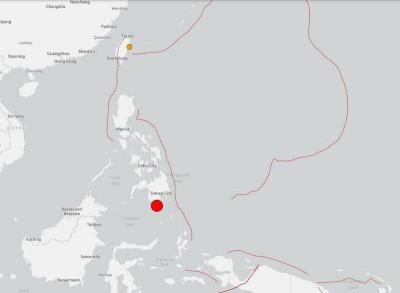
A magnitude 7.8 earthquake struck off the southern coast of Mindanao in the Philippines at 7:38am today, prompting the US Tsunami Warning System to issue an alert for neighboring countries, including Taiwan. The system issued a purple alert indicating a "tsunami threat." The potential threat zone includes Taiwan, the Philippines, Papua New Guinea, Yap and Palau. Philippine authorities were assessing the damage from the quake, with the office of civil defense seeking to verifying initial reports that 15 people had been killed and 129 injured in the region, mostly from falling debris. Arlene Hollero, disaster chief of Maasim town in the Philippines' Sarangani Province,

RESILIENCE: Taiwan plays a key role in semiconductors, energy, information infrastructure and advanced manufacturing, AIT Director Raymond Greene said Taiwan’s continued investment in deterrence and resilience remains vital, especially in uncrewed systems and other emerging technologies, American Institute in Taiwan (AIT) Director Raymond Greene said yesterday. Greene made the remarks at the annual National Strategic Summit on Supply Chain Resilience held by the Research Institute for Democracy, Society and Emerging Technology (DSET), a government-backed think tank. As Taiwan last year became the US’ fourth-largest trading partner and supply chain security is becoming more important, cooperation in emerging technologies continues to deepen between the two countries, he said. The US is committed to accelerating innovation, building key infrastructure, strengthening cooperation

The National Chungshan Institute of Science and Technology yesterday showcased its locally developed variants of the Vision 60 robotic patrol dog, which it plans to deploy on the nation’s outlying territories in the South China Sea. The variants were produced under the Joint Lab project — created by the institute and domestic companies — and assembled with domestically produced motors, lenses and artificial intelligence (AI) systems alongside licensed tech from the US, Missile and Rocket Systems Research Division deputy director Jen Kuo-kang (任國光) told the media event at a military base in Taipei’s Dazhi (大直) area. Taiwan has built up its strengths

‘GRAY ZONE’ PRESSURE: Beijing’s activities are intended to create the deceitful impression that China has jurisdiction over the area around Taiwan, the CGA said Taiwan’s rights over its territorial waters and exclusive economic zone must not be violated by any country, the Mainland Affairs Council said yesterday, adding that it will not accept any unprovoked actions. The council issued the remarks in response to the China Coast Guard conducting maritime enforcement drills near eastern Taiwan and claiming to fully exercise China’s maritime administrative law enforcement authority. The Coast Guard Administration (CGA) has been closely monitoring the situation and is taking concrete steps to defend the nation’s sovereignty and secure its waters, the council said. China has no sovereign rights over the waters off eastern


 RSS
RSS