


Premier Cho Jung-tai (卓榮泰) yesterday announced that the Cabinet would not countersign the amendments to the local revenue-sharing law passed by the Legislative Yuan last month.
Cho said the decision not to countersign the amendments to the Act Governing the Allocation of Government Revenues and Expenditures (財政收支劃分法) was made in accordance with the Constitution.
“The decision aims to safeguard our Constitution,” he said.
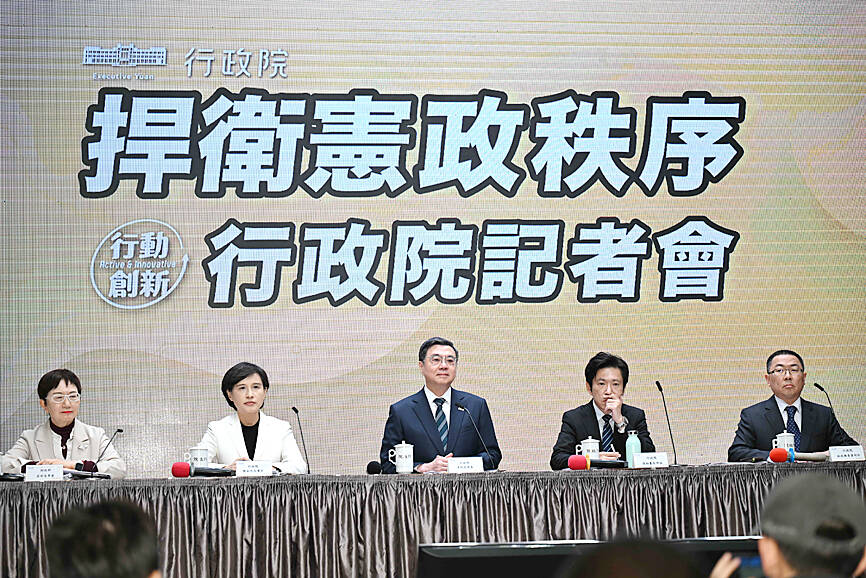
Photo: Chen Yi-kuan, Taipei Times
The Constitution stipulates the president shall, in accordance with law, promulgate laws and issue mandates with the countersignature of the head of the Executive Yuan, or with the countersignatures of both the head of the Executive Yuan and ministers or chairpersons of commissions concerned.
Although the decision marks the first time the Cabinet has ever refused to countersign legislation, the Democratic Progressive Party (DPP) government said that it is not in violation of the Constitution.
The announcement came after the 113-seat Legislative Yuan — in which the opposition Chinese Nationalist Party (KMT), the Taiwan People’s Party (TPP) and independent lawmakers aligned with the KMT hold a combined majority — on Dec. 5 rejected a Cabinet request to reconsider the approved amendments.

Photo courtesy of the Presidential Office via CNA
The amendments state that local governments would receive a larger share of central government revenue each year.
In its request for a reconsideration, the Executive Yuan said the amendments would strain the central government’s finances and force it to take on an additional NT$264.6 billion (US$8.43 billion) in debt next year, exceeding the annual borrowing cap of 15 percent of total expenditure.
The Cabinet last month asked the legislature to revisit the amendments, but the request was rejected by a vote of 59-50.
Cho yesterday said the opposition had forced the legislation through without proper consultation.
Cho said his decision to not countersign the amendments represents the executive's final means to correct what it considers legislative wrongdoing.
Cho argued that the Legislature had become an "autocratic political branch" by expanding its authority to secure more funding, undermining the constitutional system.
Cho stressed that his decision did not amount to authoritarianism or executive overreach. He noted that the Legislature retains a constitutional check, as it can still initiate a no-confidence vote against the premier if it disagrees with the Cabinet's actions.
He said that lawmakers could pass a no confidence motion to remove him if they wanted, as he would not countersign the legislation, paving the way for its enactment.
“As premier, if I am brought down by a legislature and political parties that trample on the Constitution and throw governance into chaos, that would be a democratic badge of honor for me,” he said.
If a no confidence motion were passed, Cho would have 10 days to submit his resignation to Lai, or he could ask the president to dissolve the legislature, which would lead to new elections within 60 days.
Later last night, the Presidential Office released a statement stating that President William Lai (賴清德) had issued a directive saying that the revisions could undermine fiscal sustainability.
The president wrote that the revisions would further weaken central finances, distort vertical and horizontal revenue allocations, hinder key policy implementation, and strain the government’s ability to safeguard national security and respond to natural disasters, Presidential Office spokesperson Karen Kuo (郭雅慧) said in the statement.
Earlier yesterday morning, Lai hosted a tea gathering with the heads of the Executive Yuan and Examination Yuan to discuss next year’s budget.
All ministries and agencies should implement legislation on a constitutionally sound basis to ensure the integrity of the constitutional system, Lai said after the meeting.
The Legislative Yuan passed amendments to the Constitutional Court Procedure Act (憲法訴訟法), effectively paralyzing the functioning of the court, he said.
Since then, the legislature has pushed through several bills with which the Executive Yuan and Examination Yuan disagree, including the revenue-allocation bill and halting pension cuts, he said.
The Constitutional Court, which currently only has eight sitting judges, has not been able to operate since January, when the legislature passed a bill requiring a quorum of 10 grand justices to participate in deliberations and nine to rule on the constitutionality of cases brought before it.
Additional reporting by Reuters and Chen Yu-fu
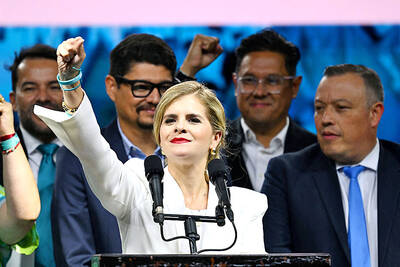
Right-wing political scientist Laura Fernandez on Sunday won Costa Rica’s presidential election by a landslide, after promising to crack down on rising violence linked to the cocaine trade. Fernandez’s nearest rival, economist Alvaro Ramos, conceded defeat as results showed the ruling party far exceeding the threshold of 40 percent needed to avoid a runoff. With 94 percent of polling stations counted, the political heir of outgoing Costa Rican President Rodrigo Chaves had captured 48.3 percent of the vote compared with Ramos’ 33.4 percent, the Supreme Electoral Tribunal said. As soon as the first results were announced, members of Fernandez’s Sovereign People’s Party
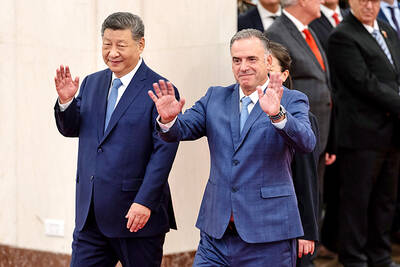
EMERGING FIELDS: The Chinese president said that the two countries would explore cooperation in green technology, the digital economy and artificial intelligence Chinese President Xi Jinping (習近平) yesterday called for an “equal and orderly multipolar world” in the face of “unilateral bullying,” in an apparent jab at the US. Xi was speaking during talks in Beijing with Uruguayan President Yamandu Orsi, the first South American leader to visit China since US special forces captured then-Venezuelan president Nicolas Maduro last month — an operation that Beijing condemned as a violation of sovereignty. Orsi follows a slew of leaders to have visited China seeking to boost ties with the world’s second-largest economy to hedge against US President Donald Trump’s increasingly unpredictable administration. “The international situation is fraught
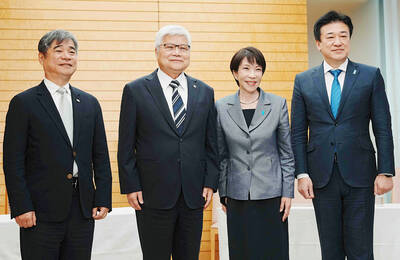
Taiwan Semiconductor Manufacturing Co (TSMC, 台積電) plans to make advanced 3-nanometer chips in Japan, stepping up its semiconductor manufacturing roadmap in the country in a triumph for Japanese Prime Minister Sanae Takaichi’s technology ambitions. TSMC is to adopt cutting-edge technology for its second wafer fab in Kumamoto, company chairman C.C. Wei (魏哲家) said yesterday. That is an upgrade from an original blueprint to produce 7-nanometer chips by late next year, people familiar with the matter said. TSMC began mass production at its first plant in Japan’s Kumamoto in late 2024. Its second fab, which is still under construction, was originally focused on

GROWING AMBITIONS: The scale and tempo of the operations show that the Strait has become the core theater for China to expand its security interests, the report said Chinese military aircraft incursions around Taiwan have surged nearly 15-fold over the past five years, according to a report released yesterday by the Democratic Progressive Party’s (DPP) Department of China Affairs. Sorties in the Taiwan Strait were previously irregular, totaling 380 in 2020, but have since evolved into routine operations, the report showed. “This demonstrates that the Taiwan Strait has become both the starting point and testing ground for Beijing’s expansionist ambitions,” it said. Driven by military expansionism, China is systematically pursuing actions aimed at altering the regional “status quo,” the department said, adding that Taiwan represents the most critical link in China’s


 RSS
RSS