


Chinese vessels are transmitting fake signals in Taiwan’s waters as a form of cognitive warfare, testing Taipei’s responses to various types of incursions, a report by the Institute for the Study of War said on Friday.
Several Chinese fishing vessels transmitted fake automatic identification system (AIS) signals in Taiwan’s waters last month, with one mimicking a Russian warship and another impersonating a Chinese law enforcement vessel, the report said.
Citing data from Starboard Maritime Intelligence, the report said that throughout August and last month, the Chinese fishing boat Minshiyu 06718 (閩獅漁06718) sailed through the Taiwan Strait while intermittently transmitting its own AIS and the AIS of a ship called Haixun 15012 (海巡15012).
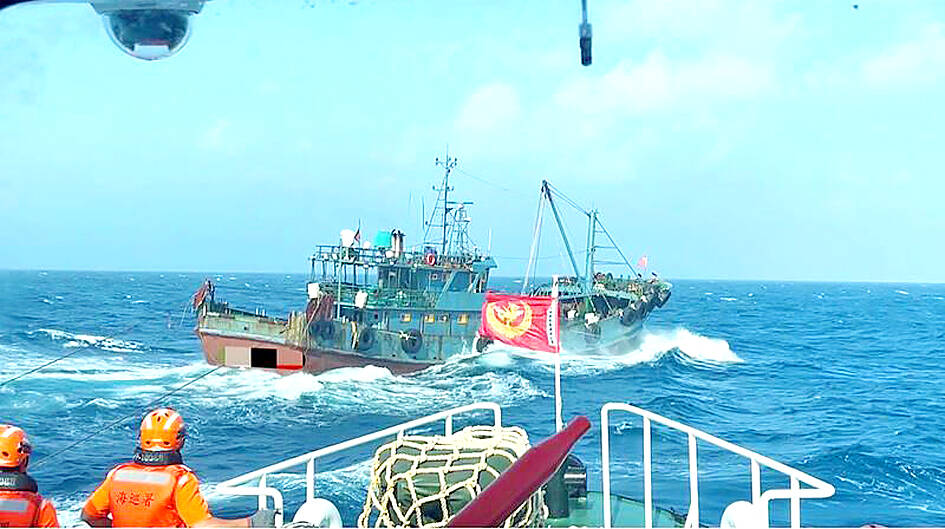
Photo courtesy of the Coast Guard Administration
Haixun ships are normally operated by the China Maritime Safety Administration (CMSA), a civilian law enforcement agency that has not been significantly involved in Chinese coercion against Taiwan, the report said.
This makes it likely that it was a fishing vessel posing as a CMSA vessel, rather than the other way around, it said.
On Sept. 17, another fishing boat, Minshiyu 07792 (閩獅漁07792), transmitted a fake signal of Russian Warship 532 in Taiwan’s northern exclusive economic zone, it said.
Several other Minshiyu vessels also transmitted fake AIS signals around the same time and area, with one posing as a tugboat and another as a different fishing boat, the report said.
China is experimenting with AIS spoofing to “pollute Taiwan’s information environment and test Taiwan’s responses to different kinds of perceived incursions,” it said.
That multiple fishing vessels with similar names transmitted different fake signals around the same time and place suggests a coordinated effort, it said.
These fishing boats likely belong to the Chinese maritime militia, which China often deploys to “carry out deniable ‘gray zone’ coercion, harassment and surveillance” in the Taiwan Strait and South China Sea, it said.
In addition, China Coast Guard vessels entered restricted waters around Kinmen County four times from Sept. 15 to 17.
While the overall frequency of three to four incursions per month has remained steady, the increasing concentration over short periods represents a new pattern, the report said.
In terms of airspace incursions, Chinese sorties into Taiwan’s air defense identification zone (ADIZ) have surpassed 300 per month for eight continuous months, more than double the monthly average before President William Lai (賴清德) took office in May last year.
China has “likely normalized a higher frequency of ADIZ incursions to degrade Taiwan’s threat awareness and response threshold, and to probe response protocols,” the report said.
Beijing’s increasingly routine incursions into Taiwan’s ADIZ have raised the bar for what constitutes a coercive act, “making it more difficult for Taiwan to detect and respond to a real threat effectively,” it said.
Maintaining readiness for these frequent incursions also places heavy demands on Taiwan’s resources and personnel, it added.
Additional reporting by CNA

‘NO SECURITY RISK’: The Railway Bureau reassured the public that the technicians’ activities were limited to technical guidance and did not involve sensitive systems The Railway Bureau yesterday said it had invited eight Chinese technicians to assist with an airport MRT construction project. The bureau issued the confirmation after an Internet user said Chinese nationals had entered the construction zone of Taiwan Taoyuan International Airport’s Terminal 3 project. They asked why “individuals from an enemy state” were allowed access to such a major national infrastructure project, which raised serious concerns over Taiwan’s industrial safety, sensitive systems and information security. The bureau’s Northern Region Engineering Branch Office said subcontractor Taiwan Handle Industrial Co (台灣手把工業) of the Taoyuan airport MRT’s “Contract No. CU05 Project A14 Station Civil, MEP &

The National Chungshan Institute of Science and Technology yesterday showcased its locally developed variants of the Vision 60 robotic patrol dog, which it plans to deploy on the nation’s outlying territories in the South China Sea. The variants were produced under the Joint Lab project — created by the institute and domestic companies — and assembled with domestically produced motors, lenses and artificial intelligence (AI) systems alongside licensed tech from the US, Missile and Rocket Systems Research Division deputy director Jen Kuo-kang (任國光) told the media event at a military base in Taipei’s Dazhi (大直) area. Taiwan has built up its strengths

RIGHT DIRECTION: Taiwan’s efforts to prevent forced labor include a proposal to ‘fully prohibit’ employers from withholding workers’ documents, an official said Taiwan is to establish a mechanism to restrict imports of goods linked to forced labor, the Executive Yuan said yesterday, after the US proposed imposing additional tariffs on Taiwanese goods over labor concerns. “The Ministry of Labor and the Ministry of Economic Affairs are to establish an interministerial review procedure,” Executive Yuan spokesperson Michelle Lee (李慧芝) said at a news briefing in Taipei. “The government is to use the Foreign Trade Act [貿易法] as the legal basis to restrict imports of goods produced with forced labor” and bring its supply chain governance more in line with international standards on human rights, resilience

NOT IMMEDIATE: Taiwan has a chance to appeal the proposed 10 percent tariff before it starts, while other countries face a 12.5 percent tariff from the trade office Taiwan is among 60 economies determined by the US to have failed to impose or enforce a ban on the importation of goods produced with forced labor, according to a notice released on Tuesday by the Office of the US Trade Representative (USTR), which proposed imposing an additional 10 percent or more tariff on them. The USTR in a statement said that following an investigation, it had determined under Section 301 of the Trade Act of 1974 that the failure of the 60 economies to impose and effectively enforce a prohibition on the importation of goods produced with forced labor is


 RSS
RSS