


Hamas militants yesterday handed over four captive female Israeli soldiers to the Red Cross in Gaza City after parading them in front of a crowd.
Israel was set to release 200 Palestinian prisoners or detainees later in the day as part of the fragile ceasefire in the Gaza Strip.
The four smiled broadly as they waved and gave the thumbs-up from a stage in Gaza City’s Palestine Square, with militants on either side of them and a crowd of thousands watching, before they were led off to waiting Red Cross vehicles. They were likely acting under duress.
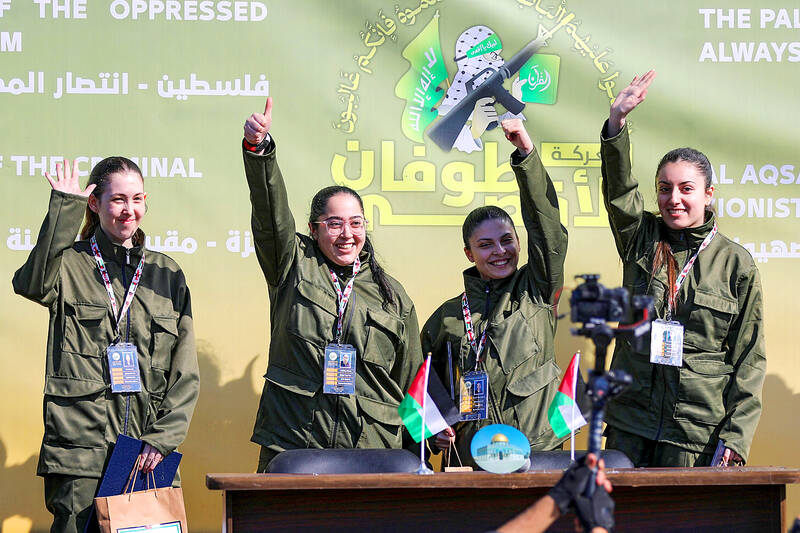
Photo: Reuters
As they were released, hundreds of people cheered in Tel Aviv’s Hostages Square where they were watching the drama unfold on a big screen television.
“I’m speechless,” said Aviv Bercovich, one of the onlookers. “I had goosebumps watching them. I just want the war to end.”
Israel confirmed that the hostages were with its forces not long after they were driven away from the handover in Gaza City by the Red Cross.
However, Israeli Prime Minister Benjamin Netanyahu’s office later said that Arbel Yehoud, a civilian hostage held by Hamas, was supposed to have been released yesterday.
It said Israel would not allow Palestinians to begin returning to northern Gaza until she is freed.
The crowds in Tel Aviv and also in Gaza City began gathering earlier in the day in anticipation of the second such exchange between Israel and Hamas since a ceasefire began in the Gaza Strip last weekend.
The excitement in Israel was palpable, with TV stations filled with live reports from smiling news anchors and reporters interviewing ecstatic friends and relatives of the hostages.
The truce is aimed at winding down the deadliest and most destructive war ever fought between Israel and the militant group. The fragile deal has so far held, quieting airstrikes and rockets and allowing for increased aid to flow into the tiny coastal territory.
When the ceasefire started on Sunday last week, three hostages held by the militants were released in exchange for 90 Palestinian prisoners, all women and children.
The four Israeli soldiers, Karina Ariev, 20, Daniella Gilboa, 20, Naama Levy, 20, and Liri Albag, 19, were captured in Hamas’ Oct. 7, 2023, attack that ignited the war.
In exchange, Israel was to release 200 prisoners, including 121 who were serving life sentences, according to a list released by Hamas. Of those, the list indicated that 70 would be expelled from Gaza and the West bank, but did not say where.
The more notorious militants being released include Mohammad Odeh, 52, and Wael Qassim, 54, both from east Jerusalem. They were accused of carrying out a series of deadly Hamas attacks against Israelis, including a bombing at a cafeteria at the Hebrew University of Jerusalem in 2002 that killed nine people, including five US citizens.
The four soldiers released were taken from Nahal Oz base near the border with Gaza when Palestinian militants overran it, killing more than 60 soldiers there.

NETWORK-MAPPING PROJECT: The database contains 170 detailed files of Taiwanese politicians and about 23 million records of household registration data in Taiwan China has developed a network-mapping project targeting political figures and parties in Taiwan to monitor public opinion during elections and to craft tailored influence campaigns aimed at dividing Taiwanese society, according to documents leaked by Chinese technology firm GoLaxy (中科天璣). The documents, collected by Taipei-based Doublethink Lab, showed a database was specifically created to gather detailed information on Taiwanese political figures, including their political affiliations, job histories, birthplaces, residences, education, religion and a brief biography about them. Several notable Taiwanese politicians are in the database, including President William Lai (賴清德), former president Tsai Ing-wen (蔡英文), Minister of Foreign Affairs Lin Chia-lung (林佳龍),

RECOGNITION: Former Fijian prime minister Mahendra Chaudhry said that Taiwan’s New Southbound Policy serves as a stabilizing force in the Indo-Pacific region Taiwan can lead the unification of the Chinese people, Nobel Peace Prize laureate and former Polish president Lech Walesa said in Taipei yesterday, adding that as the world order is changing, peaceful discussion would find good solutions, and that the use of force and coercion would always fail. Walesa made the remarks during his keynote address at a luncheon of the Yushan Forum in Taipei, titled “Indo-Pacific Partnership Prospects: Taiwan’s Values, Technology and Resilience,” organized by the Taiwan-Asia Exchange Foundation with the Ministry of Foreign Affairs. Walesa said that he had been at the forefront of a big peaceful revolution and “if
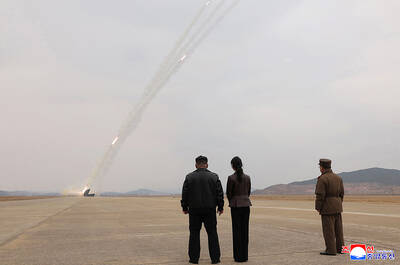
North Korea tested nuclear-capable rocket launchers, state media reported yesterday, a day after Seoul detected the launch of about 10 ballistic missiles. The test comes after South Korean and US forces launched their springtime military drills, due to run until Thursday. North Korean leader Kim Jong-un on Saturday oversaw the testing of the multiple rocket launcher system (MRLS), the Korean Central News Agency (KCNA) said. The test involved 12 600mm-caliber ultra-precision multiple rocket launchers and two artillery companies, it said. Kim said the drill gave Pyongyang’s enemies, within the 420km striking range, a sense of “uneasiness” and “a deep understanding

North Korea yesterday fired about 10 ballistic missiles to the sea toward Japan, the South Korean Joint Chiefs of Staff (JCS) said, days after Pyongyang warned of “terrible consequences” over ongoing South Korea-US military drills. Pyongyang recently dashed hopes of a diplomatic thaw with Seoul, Washington’s security ally, describing its latest peace efforts as a “clumsy, deceptive farce.” Seoul’s military detected “around 10 ballistic missiles launched from the Sunan area in North Korea toward the East Sea [Sea of Japan] at around 1:20pm,” JCS said in a statement, referring to South Korea’s name for the body of water. The missiles


 RSS
RSS