


Premier Cho Jung-tai (卓榮泰) yesterday said opposition party lawmakers had “sneak attacked” the Cabinet by sending a bill passed by the legislature just before the start of the Lunar New Year holiday.
The Cabinet has made a request for reconsideration through an impromptu meeting, Cho said.
The premier made the remarks in response to questions from reporters on statements made by members of opposition parties that he should resign if the Cabinet fails to reconsider amendments to the Public Officials Election and Recall Act (公職人員選舉罷免法).
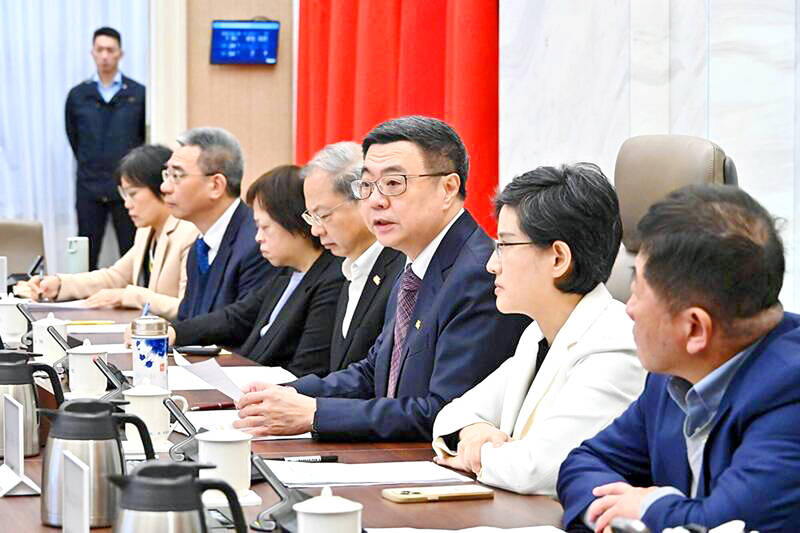
Photo courtesy of the Executive Yuan
The Cabinet on Friday night said it would ask the legislature to hold a revote on legislation that would tighten requirements for petitions to initiate a recall of an elected official.
The Legislative Yuan on Dec. 20 last year passed amendments to the act requiring petition signatories to submit a copy of their national identification. Although it passed the third reading last month, the legislature only on Friday sent the bill to the president.
The Cabinet during a provisional meeting asked lawmakers to reconsider the amendments, the third time the Cabinet has requested a revote in an attempt to overturn the bills.
The Executive Yuan said that the amendments were “difficult to implement” because they raised the thresholds for recall petitions, “exceedingly restricting” the public’s right to recall an elected official and “significantly increasing the burden” of local electoral authorities.
Cho also expressed dismay at the legislature sending the proposal at 4:47pm the day before the Lunar New Year holiday begins, calling it “naked political calculation.”
The legislature should not have done this as public workers were about to clock out and preparing to return home to spend the holiday with their families, he said.
While opposition lawmakers said he should be “struck out” as premier if the Cabinet’s request for reconsideration failed again following two prior unsuccessful attempts, Cho, in a baseball reference, said that he has been pitched “three balls.”
The Democratic Progressive Party yesterday said it supported the Cabinet’s efforts to seek judicial remedies “against the legislature’s mishandling” of the bills.
Opposition lawmakers should not abuse the power granted to them as a means to create political turmoil, it added.
Separately yesterday, Chinese Nationalist Party (KMT) Legislator Wang Hung-wei (王鴻薇) said Cho was “paranoid” in saying that the legislature “sneak attacked” the Cabinet.
Wang said that Cho blamed Legislative Speaker Han Kuo-yu (韓國瑜), but he should know better, as Han just returned to Taiwan from the US in the early hours of Friday.
Taiwan People’s Party Acting Chairman Huang Kuo-chang (黃國昌) called Cho incompetent, saying that Cho’s Cabinet could do nothing but file a request for the legislature’s reconsideration.
This is the third time that Cho’s Cabinet had filed a request for reconsideration, Huang said, urging Cho to resign as premier if the request is again rejected by the legislature.

The nation’s fastest supercomputer, Nano 4 (晶創26), is scheduled to be launched in the third quarter, and would be used to train large language models in finance and national defense sectors, the National Center for High-Performance Computing (NCHC) said. The supercomputer, which would operate at about 86.05 petaflops, is being tested at a new cloud computing center in the Southern Taiwan Science Park in Tainan. The exterior of the server cabinet features chip circuitry patterns overlaid with a map of Taiwan, highlighting the nation’s central position in the semiconductor industry. The center also houses Taiwania 2, Taiwania 3, Forerunner 1 and
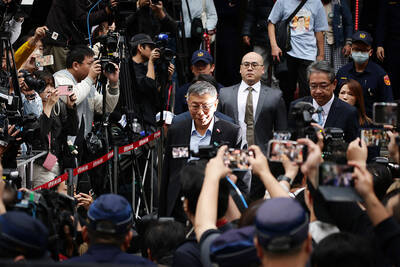
FIRST TRIAL: Ko’s lawyers sought reduced bail and other concessions, as did other defendants, but the bail judge denied their requests, citing the severity of the sentences Former Taipei mayor Ko Wen-je (柯文哲) was yesterday sentenced to 17 years in prison and had his civil rights suspended for six years over corruption, embezzlement and other charges. Taipei prosecutors in December last year asked the Taipei District Court for a combined 28-year, six-month sentence for the four cases against Ko, who founded the Taiwan People’s Party (TPP). The cases were linked to the Core Pacific City (京華城購物中心) redevelopment project and the mismanagement of political donations. Other defendants convicted on separate charges included Chinese Nationalist Party (KMT) Taipei City Councilor Angela Ying (應曉薇), who was handed a 15-year, six-month sentence; Core Pacific
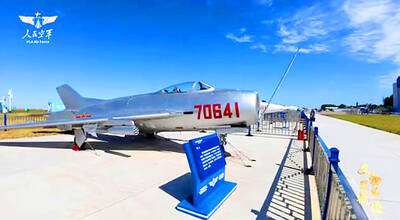
J-6 REMODEL: The converted drones are part of Beijing’s expanding mix of airpower weapons, including bombers with stand-off missiles and UAV swarms, the report said China has stationed obsolete supersonic fighters converted to attack drones at six air bases close to the Taiwan Strait, a report published this month by the Arlington, Virginia-based Mitchell Institute for Aerospace Studies said. Satellite imagery of the airfields from the institute’s “China Airpower Tracker” shows what appear to be lines of stubby, swept-winged aircraft matching the shape of J-6 fighters that first flew with the Chinese People’s Liberation Army (PLA) Air Force in the 1960s. Since their conversion to drones, the aircraft have been identified at five bases in China’s Fujian Province and one in Guangdong Province, the report said. J.

China used fake LinkedIn profiles to harvest sensitive data from NATO and EU institutions by soliciting information from staff, a European security source said on Friday. The operation, allegedly orchestrated by the Chinese Ministry of State Security, targeted dozens of employees at the military alliance or EU organizations through fictitious accounts, the source said, confirming reports in French and Belgian media. Posing as recruiters on the online professional networking platform, Chinese spies would initially request paid reports before later soliciting non-public or even classified information. One particularly active fake profile used the name “Kevin Zhang,” claiming to be the head


 RSS
RSS