


Forty-four people sustained minor injuries and several houses in Tainan and Chiayi County were damaged or collapsed after a magnitude 6.4 earthquake on the Richter scale struck southeast of Chiayi at 12:17am, the National Fire Agency said yesterday as of 5:30pm.
The earthquake’s hypocenter was 37.9km southeast of the Chaiyi County Hall in Dapu Township (大埔) at a depth of 9.7km, data from the Central Weather Administration (CWA) showed.
The quake shook the ground for about 43 seconds, it added.
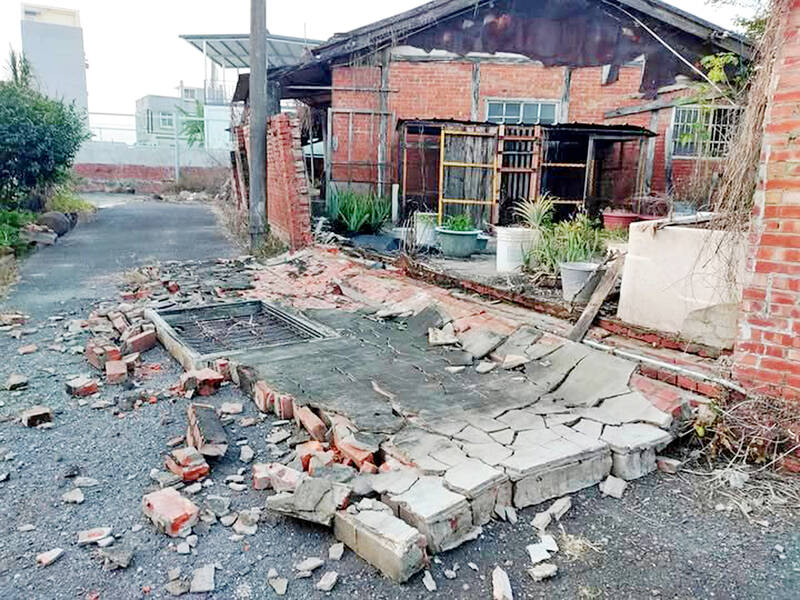
Photo: CNA
As of 5pm yesterday, 61 aftershocks had been recorded, including two quakes between magnitudes 5 and 6, 16 between magnitudes 4 and 5, and 43 smaller than magnitude 4, CWA data showed.
Most of the aftershocks occurred in Dapu and Tainan’s Nansi District (楠西).
The epicenter was in a geologically fractured zone close to the mountainous areas, CWA seismological center deputy director Wu Chien-fu (吳健富) told a news conference in Taipei, adding that it was the first time that a quake of at least magnitude 6.4 was recorded in the area within 30km of the epicenter since 1976.
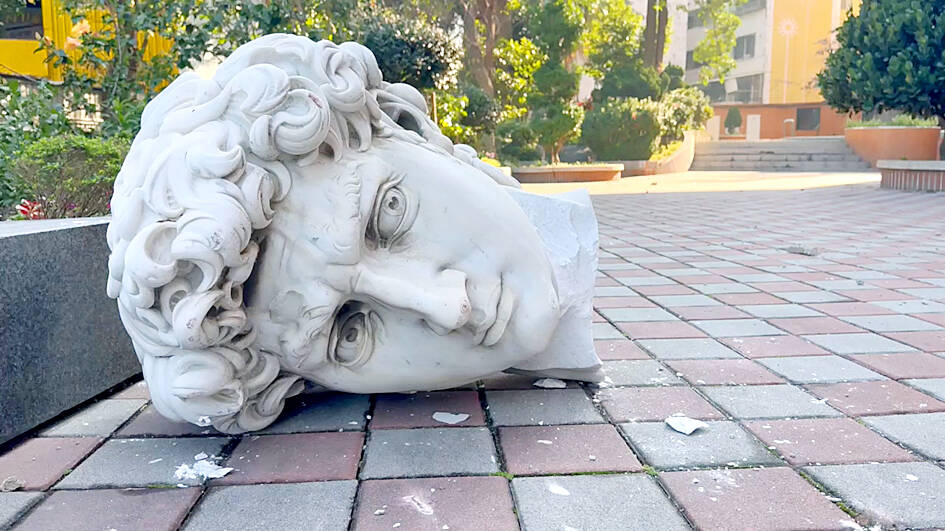
Photo: Chang Tsung-chiu, Taipei Times
The earthquake was not caused by the Meishan Fault (梅山斷層), as the epicenter was about 50km from it, Wu said, adding that more research is needed to study the relations with three other faults near the epicenter.
Aftershocks measuring magnitude 5 or higher could occur in southern Taiwan in the next three days, Wu said.
Taiwan Semiconductor Manufacturing Corp (台積電) issued a statement yesterday morning saying that workers at some of its factories in central and southern Taiwan were evacuated as soon as the earthquake struck.
As of 1am yesterday, it had completed a survey of its facilities and confirmed that no personnel were injured, it said, adding that production has resumed after ascertaining that none of its buildings were damaged.
Construction at the sites for new factories also resumed yesterday morning following a post-quake inspection, the company said.
Most injuries and housing damage were reported in Tainan and Chiayi, the fire agency said.
Houses in Tainan’s Yuchin (玉井) and Nansi districts were severely damaged, including a six-story building in Yuchin, the Tainan City Government said yesterday, adding that 28 people from the two districts stayed in temporary shelters after the earthquake.
Footage posted on Mirror Media showed firefighters in Tainan rescuing a slightly injured couple, their one-month-old child and their dog from a collapsed home in Nansi.
Nansi Elementary School, which is near the epicenter, also reported severe damage to its classrooms, auditorium and walls around the campus.
Tainan Mayor Huang Wei-che (黃偉哲) said that civil and structural engineers would submit a list of dangerous buildings this morning.
Residents who were evacuated from the six-story building, which has three broken pillars, were allowed to enter the building to retrieve important personal belongings after the building was temporarily supported by an H-beam, Huang said.
People whose lives have been disrupted by the earthquake would be given a solatium to help them get through the Lunar New Year holiday next week, he said.
The National Taxation Administration of Southern Area said it would assist taxpayers affected by the earthquake when they file for relief from income tax, housing tax, land value tax and six other tax items.

Right-wing political scientist Laura Fernandez on Sunday won Costa Rica’s presidential election by a landslide, after promising to crack down on rising violence linked to the cocaine trade. Fernandez’s nearest rival, economist Alvaro Ramos, conceded defeat as results showed the ruling party far exceeding the threshold of 40 percent needed to avoid a runoff. With 94 percent of polling stations counted, the political heir of outgoing Costa Rican President Rodrigo Chaves had captured 48.3 percent of the vote compared with Ramos’ 33.4 percent, the Supreme Electoral Tribunal said. As soon as the first results were announced, members of Fernandez’s Sovereign People’s Party
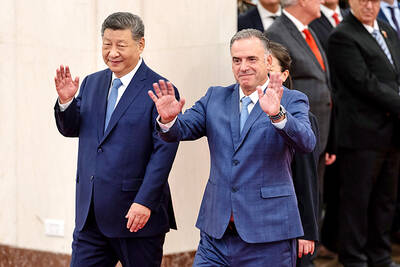
EMERGING FIELDS: The Chinese president said that the two countries would explore cooperation in green technology, the digital economy and artificial intelligence Chinese President Xi Jinping (習近平) yesterday called for an “equal and orderly multipolar world” in the face of “unilateral bullying,” in an apparent jab at the US. Xi was speaking during talks in Beijing with Uruguayan President Yamandu Orsi, the first South American leader to visit China since US special forces captured then-Venezuelan president Nicolas Maduro last month — an operation that Beijing condemned as a violation of sovereignty. Orsi follows a slew of leaders to have visited China seeking to boost ties with the world’s second-largest economy to hedge against US President Donald Trump’s increasingly unpredictable administration. “The international situation is fraught
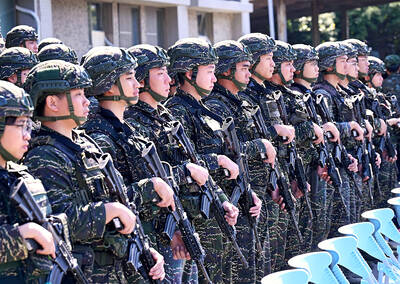
MORE RESPONSIBILITY: Draftees would be expected to fight alongside professional soldiers, likely requiring the transformation of some training brigades into combat units The armed forces are to start incorporating new conscripts into combined arms brigades this year to enhance combat readiness, the Executive Yuan’s latest policy report said. The new policy would affect Taiwanese men entering the military for their compulsory service, which was extended to one year under reforms by then-president Tsai Ing-wen (蔡英文) in 2022. The conscripts would be trained to operate machine guns, uncrewed aerial vehicles, anti-tank guided missile launchers and Stinger air defense systems, the report said, adding that the basic training would be lengthened to eight weeks. After basic training, conscripts would be sorted into infantry battalions that would take

GROWING AMBITIONS: The scale and tempo of the operations show that the Strait has become the core theater for China to expand its security interests, the report said Chinese military aircraft incursions around Taiwan have surged nearly 15-fold over the past five years, according to a report released yesterday by the Democratic Progressive Party’s (DPP) Department of China Affairs. Sorties in the Taiwan Strait were previously irregular, totaling 380 in 2020, but have since evolved into routine operations, the report showed. “This demonstrates that the Taiwan Strait has become both the starting point and testing ground for Beijing’s expansionist ambitions,” it said. Driven by military expansionism, China is systematically pursuing actions aimed at altering the regional “status quo,” the department said, adding that Taiwan represents the most critical link in China’s


 RSS
RSS