


Taiwan is open to healthy interactions with China, but Beijing should not engage in “united front” campaigns, a Cabinet official said yesterday following a report that China is paying influencers to produce content it approves of.
YouTuber Potter King (波特王) said that the Chinese government has been paying Taiwanese content creators to travel to China and produce videos favorable to Beijing.
Cabinet spokesman Chen Shih-kai (陳世凱) said that the government welcomes healthy and sustainable interactions between the two sides of the Taiwan Strait, but China should not use “united front” tactics in the culture and entertainment sphere to target young Taiwanese.
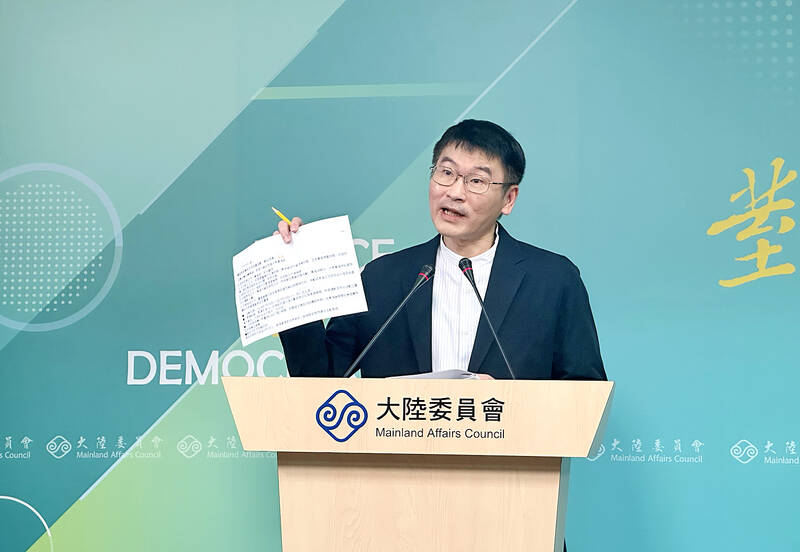
Photo: Lin Che-yuan, Taipei Times
Potter King said that numerous insiders had told him that the Chinese government is paying a lot of money to sponsor YouTubers and other content creators to produce social media videos.
“Starting next month, people will start seeing videos of Taiwanese YouTubers and other content creators traveling to attractions and historic sites in China, and sharing positive views of their experiences to promote China to young Taiwanese,” he said. “About 10 production teams of some well-known YouTubers are participating in the campaign.”
“From what I know, their travel, food, accommodation and other expenses are being paid for by the Chinese side,” he said. “They were invited under an official tourism program arranged by a Chinese state-funded organization that focuses on organizing cross-strait cultural exchanges for young people.”
Potter King’s descriptions came after Chinese celebrity Hu Ge (胡歌) visited at the same time as a delegation from Shanghai and held a “youth dialogue” event in Taipei.
Chen was asked about the visit of Hu, 41, a film and television actor who arrived on the same flight as a delegation of Shanghai officials.
The delegation was in Taiwan to meet with the Taipei City Government to plan the Twin City Forum.
Hu and the delegation arrived at Taipei International Airport (Songshan airport) on Wednesday.
Hu hosted the youth event at Taipei’s Songshan Cultural and Creative Park (松山文創園區) before returning to China on a flight early yesterday.
The short stay was reportedly to keep Hu’s visit a low-key affair and not to create a political fuss.
However, Hu was greeted at the airport by fans and was photographed walking through the airport alongside Zhong Xiaomin (鍾曉敏), the head of Shanghai’s Taiwan Affairs Office.
Democratic Progressive Party Taipei City Councilor Hsu Shu-hua (許淑華) said that the Taipei City Government was complicit in arranging Hu’s “united front” event, which was meant to “influence young Taiwanese.”
Hsu asked who provided the money to arrange the visit and whether any laws had been broken.
Taipei City Government spokesman Yin Wei (殷瑋) denied that it had invited Hu.
City officials were focused on preparations for the forum, Yin said.
The list of people in the delegation did not include Hu, Yin said, adding that Zhong and other Shanghai officials were the only members named.
“We did not know Hu Ge was on the same flight as the Shanghai delegation,” Yin said.
“Hu was in Taiwan on a cultural exchange and we hope people would view his visit in a positive light,” he added.
Mainland Affairs Council Deputy Minister Liang Wen-chieh (梁文傑) said that Hu had applied with it to visit Taiwan.
“We gave approval, as his application was based on only one activity, the dialogue session with students,” Liang said.
“He was not authorized to participate in any other programs during his time in Taiwan,” he added.

Right-wing political scientist Laura Fernandez on Sunday won Costa Rica’s presidential election by a landslide, after promising to crack down on rising violence linked to the cocaine trade. Fernandez’s nearest rival, economist Alvaro Ramos, conceded defeat as results showed the ruling party far exceeding the threshold of 40 percent needed to avoid a runoff. With 94 percent of polling stations counted, the political heir of outgoing Costa Rican President Rodrigo Chaves had captured 48.3 percent of the vote compared with Ramos’ 33.4 percent, the Supreme Electoral Tribunal said. As soon as the first results were announced, members of Fernandez’s Sovereign People’s Party
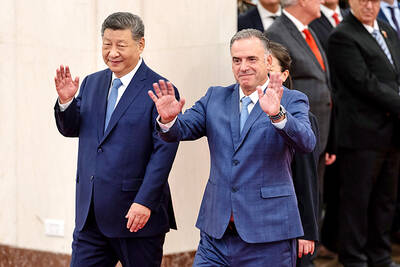
EMERGING FIELDS: The Chinese president said that the two countries would explore cooperation in green technology, the digital economy and artificial intelligence Chinese President Xi Jinping (習近平) yesterday called for an “equal and orderly multipolar world” in the face of “unilateral bullying,” in an apparent jab at the US. Xi was speaking during talks in Beijing with Uruguayan President Yamandu Orsi, the first South American leader to visit China since US special forces captured then-Venezuelan president Nicolas Maduro last month — an operation that Beijing condemned as a violation of sovereignty. Orsi follows a slew of leaders to have visited China seeking to boost ties with the world’s second-largest economy to hedge against US President Donald Trump’s increasingly unpredictable administration. “The international situation is fraught

GROWING AMBITIONS: The scale and tempo of the operations show that the Strait has become the core theater for China to expand its security interests, the report said Chinese military aircraft incursions around Taiwan have surged nearly 15-fold over the past five years, according to a report released yesterday by the Democratic Progressive Party’s (DPP) Department of China Affairs. Sorties in the Taiwan Strait were previously irregular, totaling 380 in 2020, but have since evolved into routine operations, the report showed. “This demonstrates that the Taiwan Strait has become both the starting point and testing ground for Beijing’s expansionist ambitions,” it said. Driven by military expansionism, China is systematically pursuing actions aimed at altering the regional “status quo,” the department said, adding that Taiwan represents the most critical link in China’s
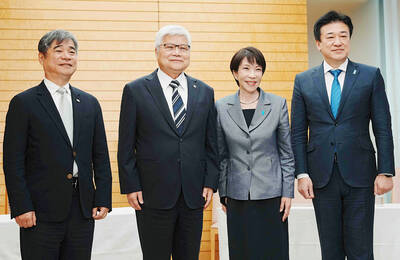
Taiwan Semiconductor Manufacturing Co (TSMC, 台積電) plans to make advanced 3-nanometer chips in Japan, stepping up its semiconductor manufacturing roadmap in the country in a triumph for Japanese Prime Minister Sanae Takaichi’s technology ambitions. TSMC is to adopt cutting-edge technology for its second wafer fab in Kumamoto, company chairman C.C. Wei (魏哲家) said yesterday. That is an upgrade from an original blueprint to produce 7-nanometer chips by late next year, people familiar with the matter said. TSMC began mass production at its first plant in Japan’s Kumamoto in late 2024. Its second fab, which is still under construction, was originally focused on


 RSS
RSS