


China has been bribing UN officials to obtain “special benefits” and to block funding from countries that have diplomatic ties with Taiwan, a former UN employee told the British House of Commons on Tuesday.
At a House of Commons Foreign Affairs Committee hearing into “international relations within the multilateral system,” former Office of the UN High Commissioner for Human Rights (OHCHR) employee Emma Reilly said in a written statement that “Beijing paid bribes to the two successive Presidents of the [UN] General Assembly” during the two-year negotiation of the Sustainable Development Goals.
Another way China exercises influence within the UN Secretariat is through the “secret conditionality” of its donations to the governing body, Reilly wrote.

Photo: Screen grab from parliamentlive.tv’s Web site
The People’s Republic of China (PRC) “imposes a secret conditionality across UN agencies that the monies so provided may not be spent in states with diplomatic relations with Taiwan,” she said.
“Essentially, the PRC instumentalises the UN to increase pressure on” small island developing states and least developed countries, “which account for a majority of states that still have formal diplomatic relations with Taiwan, to transfer their allegiance to the PRC,” she said.
The “Chief of the Human Rights Council Branch in OHCHR, a French national, was secretly providing the PRC with advance information on which human rights activists planned to attend the Human Rights Council,” Reilly wrote.
That information included British citizens and residents, she added.
The families of non-governmental organization (NGO) delegates were visited by Chinese police and “forced to phone them to tell them to stop their advocacy, arbitrarily arrested, placed under house arrest for the period of the meeting, disappeared, sentenced to long prison terms without cause, tortured, or, as regards Uyghurs, put in concentration camps,” she said.
Some individuals had died in detention, and “in at least one case, the Chinese government issued an Interpol red notice against an NGO delegate,” she said.
Regarding the COVID-19 pandemic, Reilly said that WHO and UN Environment Programme reports on the origins of COVID-19 “were edited to reduce references to the possibility of a laboratory leak.”
She also included in her “written evidence” a British Foreign, Commonwealth and Development Office report that said that China is working to “shape the multilateral system to align more with a state-centric, authoritarian world view.”
Tuesday’s inquiry aimed to follow up on a 2021 report by the committee, which concluded that autocratic states were attempting to aggressively co-opt strategically important multilateral organizations and to fundamentally redefine their founding principles.
In Taipei, the Ministry of Foreign Affairs yesterday thanked Reilly for speaking out.
“Thank you, @EmmaReillyTweet, for speaking out on how the #PRC corrupts the @UN& the rules-based order. #Taiwan is a known victim of #China’s wrongdoing, but in reality the whole world suffers. We need this brought up in the #G7, #EU & other bodies to counter this evil empire,” it wrote on X.

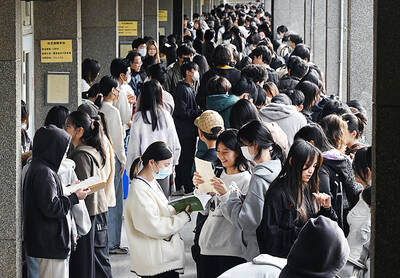
A global survey showed that 60 percent of Taiwanese had attained higher education, second only to Canada, the Ministry of the Interior said. Taiwan easily surpassed the global average of 43 percent and ranked ahead of major economies, including Japan, South Korea and the US, data from the Organisation for Economic Co-operation and Development (OECD) for 2024 showed. Taiwan has a high literacy rate, data released by the ministry showed. As of the end of last year, Taiwan had 20.617 million people aged 15 or older, accounting for 88.5 percent of the total population, with a literacy rate of 99.4 percent, the data

NEW LOW: The council in 2024 based predictions on a pessimistic estimate for the nation’s total fertility rate of 0.84, but last year that rate was 0.69, 17 percent lower An expected National Development Council (NDC) report expects the nation’s population to drop below 12 million by 2065, with the old-age dependency ratio to top 100 percent sooner than 2070, sources said yesterday. The council is slated to release its latest population projections in August, using an ultra-low fertility model, the sources said. The previous report projected that Taiwan’s population would fall to 14.37 million by 2070, but based on a new estimate of the total fertility rate (TFR) — the average number of children born to a woman over her lifetime — the population is expected to reach 12 million by
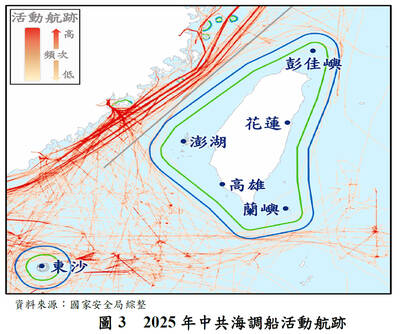
INTENSIFYING THREATS: Beijing’s tactics include massive attacks on the government service network, aircraft and naval vessel incursions and damaging undersea cables China is prepared to interfere in November’s nine-in-one local elections by launching massive attacks on the Taiwanese government’s service network (GSN), a report published by the National Security Bureau showed. The report was submitted to the Legislative Yuan ahead of the bureau’s scheduled briefing at the Foreign Affairs and National Defense Committee tomorrow. The national security team has identified about 13,000 suspicious Internet accounts and 860,000 disputed messages, the bureau said of China’s cognitive warfare against Taiwan. The disputed messages focus on major foreign affairs, national defense and economic issues, which were produced using generative artificial intelligence (AI) and distributed through Chinese

COUNTERING HOSTILITY: The draft bill would require the US to increase diplomatic pressure on China and would impose sanctions on those who sabotage undersea cable networks US lawmakers on Thursday introduced a bipartisan bill to bolster the resilience of Taiwan’s submarine cables to counter China’s hostile activities. The proposal, titled the critical undersea infrastructure resilience initiative act, was cosponsored by Republican representatives Mike Lawler and Greg Stanton, and Democratic Representative Dave Min. US Senators John Curtis and Jacky Rosen also introduced a companion bill in the US Senate, which has passed markup at the chamber’s Committee on Foreign Relations. The House’s version of the bill would prioritize the deployment of sensors to detect disruptions or potential sabotage in real-time and enhance early warning capabilities through global intelligence sharing frameworks,


 RSS
RSS