


A senior Ukrainian official has denied Russian accusations that his nation’s army launched exploding drones at Europe’s largest nuclear power plant, which the Kremlin’s forces have been occupying and running in southern Ukraine since shortly after the war began more than two years ago.
Ukrainian Ministry of Defense Main Intelligence Directorate spokesman Andrii Yusov said there had been no attack, adding that Russian forces routinely fabricate strikes on the Zaporizhzhia nuclear power plant.
However, the strikes on this occasion were confirmed by UN’s atomic watchdog agency, although it did not attribute responsibility for the attack to either side.
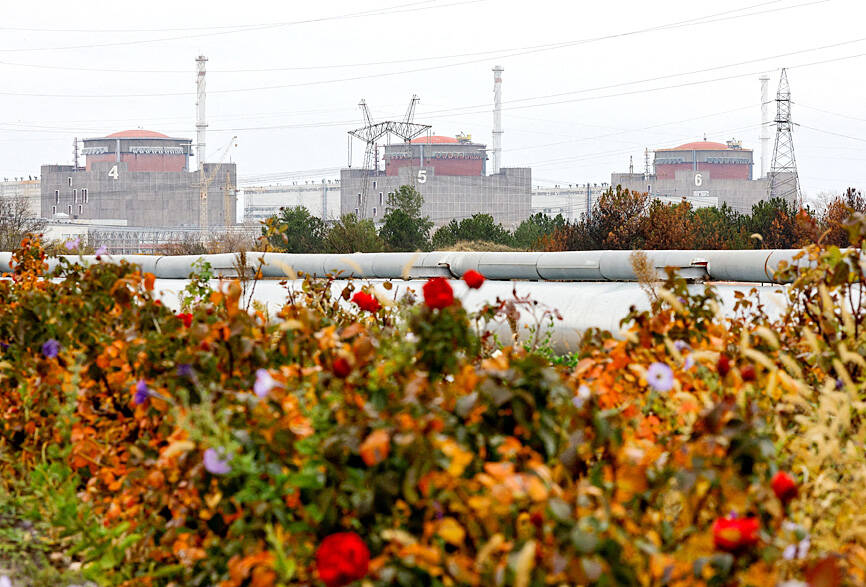
Photo: Reuters
The plant has repeatedly been caught in the crossfire since Russia launched its full-scale invasion of Ukraine in February 2022 and seized the facility shortly afterward.
The International Atomic Energy Agency (IAEA) has frequently expressed alarm about the facility amid fears of a potential nuclear catastrophe.
The plant’s six reactors have been shut down for months, but it still needs power and qualified staff to operate crucial cooling systems and other safety features.
The IAEA on Sunday confirmed drone strikes on one of the plant’s six reactors, causing one casualty.
The IAEA team did not observe structural damage to the “systems, structures and components” important to the nuclear safety of the plant, it said.
The team reported superficial scorching to the top of a reactor dome.
The damage “has not compromised nuclear safety, but this is a serious incident [with the] potential to undermine [the] integrity of the reactor’s containment system,” the IAEA wrote on social media.
IAEA Director-General Rafael Mariano Grossi said the main reactor containment structures took at least three direct hits.
“This cannot happen,” he wrote.
Zaporizhzhia is one of four regions that Russia illegally annexed in September 2022.
The Institute for the Study of War, a think tank based in Washington, said Russian authorities are seeking “to use Russia’s physical control over the [plant] to force international organizations, including the IAEA, to meet with Russian occupation officials to legitimize Russia’s occupation of the [plant] and by extension Russia’s occupation of sovereign Ukrainian land.”

Right-wing political scientist Laura Fernandez on Sunday won Costa Rica’s presidential election by a landslide, after promising to crack down on rising violence linked to the cocaine trade. Fernandez’s nearest rival, economist Alvaro Ramos, conceded defeat as results showed the ruling party far exceeding the threshold of 40 percent needed to avoid a runoff. With 94 percent of polling stations counted, the political heir of outgoing Costa Rican President Rodrigo Chaves had captured 48.3 percent of the vote compared with Ramos’ 33.4 percent, the Supreme Electoral Tribunal said. As soon as the first results were announced, members of Fernandez’s Sovereign People’s Party
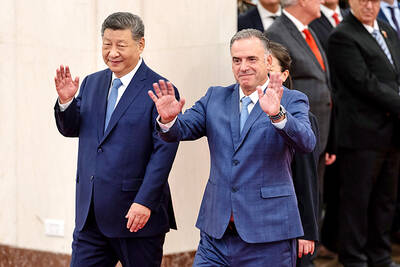
EMERGING FIELDS: The Chinese president said that the two countries would explore cooperation in green technology, the digital economy and artificial intelligence Chinese President Xi Jinping (習近平) yesterday called for an “equal and orderly multipolar world” in the face of “unilateral bullying,” in an apparent jab at the US. Xi was speaking during talks in Beijing with Uruguayan President Yamandu Orsi, the first South American leader to visit China since US special forces captured then-Venezuelan president Nicolas Maduro last month — an operation that Beijing condemned as a violation of sovereignty. Orsi follows a slew of leaders to have visited China seeking to boost ties with the world’s second-largest economy to hedge against US President Donald Trump’s increasingly unpredictable administration. “The international situation is fraught
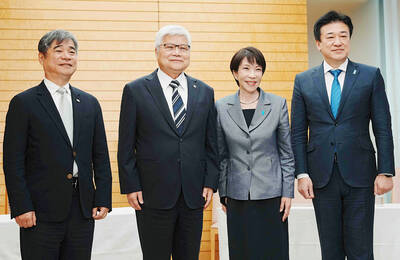
Taiwan Semiconductor Manufacturing Co (TSMC, 台積電) plans to make advanced 3-nanometer chips in Japan, stepping up its semiconductor manufacturing roadmap in the country in a triumph for Japanese Prime Minister Sanae Takaichi’s technology ambitions. TSMC is to adopt cutting-edge technology for its second wafer fab in Kumamoto, company chairman C.C. Wei (魏哲家) said yesterday. That is an upgrade from an original blueprint to produce 7-nanometer chips by late next year, people familiar with the matter said. TSMC began mass production at its first plant in Japan’s Kumamoto in late 2024. Its second fab, which is still under construction, was originally focused on
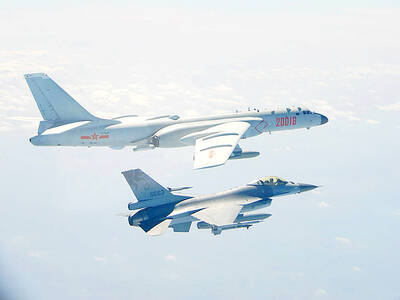
GROWING AMBITIONS: The scale and tempo of the operations show that the Strait has become the core theater for China to expand its security interests, the report said Chinese military aircraft incursions around Taiwan have surged nearly 15-fold over the past five years, according to a report released yesterday by the Democratic Progressive Party’s (DPP) Department of China Affairs. Sorties in the Taiwan Strait were previously irregular, totaling 380 in 2020, but have since evolved into routine operations, the report showed. “This demonstrates that the Taiwan Strait has become both the starting point and testing ground for Beijing’s expansionist ambitions,” it said. Driven by military expansionism, China is systematically pursuing actions aimed at altering the regional “status quo,” the department said, adding that Taiwan represents the most critical link in China’s


 RSS
RSS