


Chinese and Philippine coast guard vessels yesterday collided in the disputed South China Sea and four Filipino crewmembers were injured in high-seas confrontations.
The China Coast Guard ships and accompanying vessels blocked the Philippine Coast Guard and supply vessels off the disputed Second Thomas Shoal (Renai Shoal, 仁愛暗沙) and executed dangerous maneuvers that caused two minor collisions between the Chinese ships and two of the Philippine vessels, Philippine officials said.
The BRP Sindangan of the Philippine Coast Guard had minor structural damage from the collision that happened shortly after dawn. Over an hour later, another Chinese coast guard ship first blocked then collided with a supply boat the Philippine coast guard was escorting, the Philippine officials said.
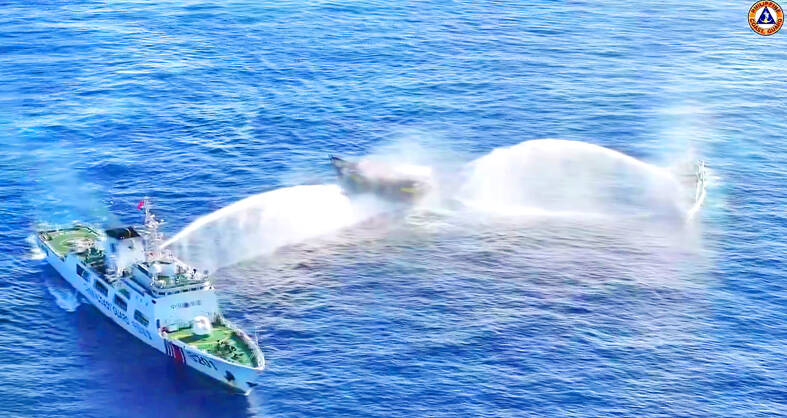
Photo: AFP / Philippine Coast Guard
The supply boat, crewed by Filipino navy personnel, was later hit by water cannon blasts from two Chinese coast guard ships. Its windshield shattered, injuring at least four Filipino crewmembers, a statement from the Philippine government task force dealing with territorial disputes said.
The actions by the Chinese was “another attempt to illegally impede or obstruct a routine resupply and rotation mission,” the task force said.
“China’s latest unprovoked acts of coercion and dangerous maneuvers” against Philippine ships en route to deliver supplies and fresh troops to the Philippine-occupied shoal “put the lives of our people at risk and caused actual injury to Filipinos,” it said.
The Philippine Department of Foreign Affairs summoned China’s deputy ambassador to convey a protest against the China Coast Guard’s actions, which it said were unacceptable.
“The Philippines demands that Chinese vessels leave the vicinity of Ayungin Shoal immediately,” the department said in a statement, using the Philippine name for the contested shoal.
A small Philippine marine and navy contingent has kept watch onboard a rusting warship, the BRP Sierra Madre, which has been marooned since the late 1990s in the shallows of the Second Thomas Shoal.
China also claims the shoal lying off the western Philippines and has surrounded the atoll with coast guard, navy and other ships to press its claims and prevent Filipino forces from delivering construction materials to fortify the Sierra Madre in a decades-long standoff.
The shoal was the site of several tense skirmishes between Chinese and Philippine coast guard ships last year.
The Chinese coast guard said in a statement that “it took control measures in accordance with the law against Philippine ships that illegally intruded into the waters adjacent to Renai Reef,” the name Beijing uses for Second Thomas Shoal.
A Chinese coast guard spokesperson said a Philippine ship deliberately rammed a Chinese coast guard vessel, causing a minor scratch.
Washington strongly condemned the Chinese coast guard’s actions and US Ambassador to the Philippines MaryKay Carlson said that the US stands with the Philippines and proponents of international law.
Australia and Japan separately expressed their concern over China’s actions.

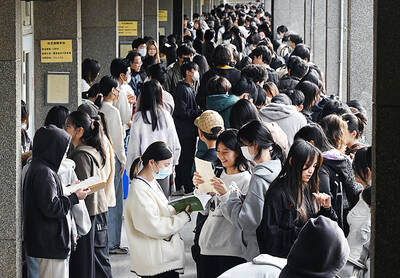
A global survey showed that 60 percent of Taiwanese had attained higher education, second only to Canada, the Ministry of the Interior said. Taiwan easily surpassed the global average of 43 percent and ranked ahead of major economies, including Japan, South Korea and the US, data from the Organisation for Economic Co-operation and Development (OECD) for 2024 showed. Taiwan has a high literacy rate, data released by the ministry showed. As of the end of last year, Taiwan had 20.617 million people aged 15 or older, accounting for 88.5 percent of the total population, with a literacy rate of 99.4 percent, the data

NEW LOW: The council in 2024 based predictions on a pessimistic estimate for the nation’s total fertility rate of 0.84, but last year that rate was 0.69, 17 percent lower An expected National Development Council (NDC) report expects the nation’s population to drop below 12 million by 2065, with the old-age dependency ratio to top 100 percent sooner than 2070, sources said yesterday. The council is slated to release its latest population projections in August, using an ultra-low fertility model, the sources said. The previous report projected that Taiwan’s population would fall to 14.37 million by 2070, but based on a new estimate of the total fertility rate (TFR) — the average number of children born to a woman over her lifetime — the population is expected to reach 12 million by
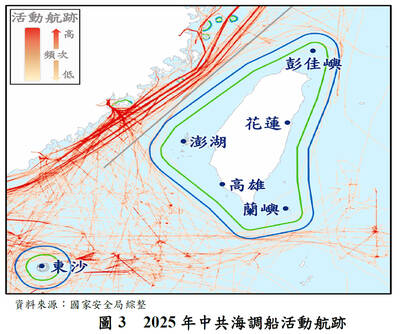
INTENSIFYING THREATS: Beijing’s tactics include massive attacks on the government service network, aircraft and naval vessel incursions and damaging undersea cables China is prepared to interfere in November’s nine-in-one local elections by launching massive attacks on the Taiwanese government’s service network (GSN), a report published by the National Security Bureau showed. The report was submitted to the Legislative Yuan ahead of the bureau’s scheduled briefing at the Foreign Affairs and National Defense Committee tomorrow. The national security team has identified about 13,000 suspicious Internet accounts and 860,000 disputed messages, the bureau said of China’s cognitive warfare against Taiwan. The disputed messages focus on major foreign affairs, national defense and economic issues, which were produced using generative artificial intelligence (AI) and distributed through Chinese

COUNTERING HOSTILITY: The draft bill would require the US to increase diplomatic pressure on China and would impose sanctions on those who sabotage undersea cable networks US lawmakers on Thursday introduced a bipartisan bill to bolster the resilience of Taiwan’s submarine cables to counter China’s hostile activities. The proposal, titled the critical undersea infrastructure resilience initiative act, was cosponsored by Republican representatives Mike Lawler and Greg Stanton, and Democratic Representative Dave Min. US Senators John Curtis and Jacky Rosen also introduced a companion bill in the US Senate, which has passed markup at the chamber’s Committee on Foreign Relations. The House’s version of the bill would prioritize the deployment of sensors to detect disruptions or potential sabotage in real-time and enhance early warning capabilities through global intelligence sharing frameworks,


 RSS
RSS