

Heavy gunfire on Thursday paralyzed Haiti’s capital and at least four police officers were slain as a gang leader announced that he would try to capture the country’s police chief and government ministers.
The move came during the absence of Haitian Prime Minister Ariel Henry, who is in Kenya trying to finalize details for the deployment of a foreign armed force to Haiti to help combat gangs.
Gunmen shot at Haiti’s main international airport and other targets, including police stations.
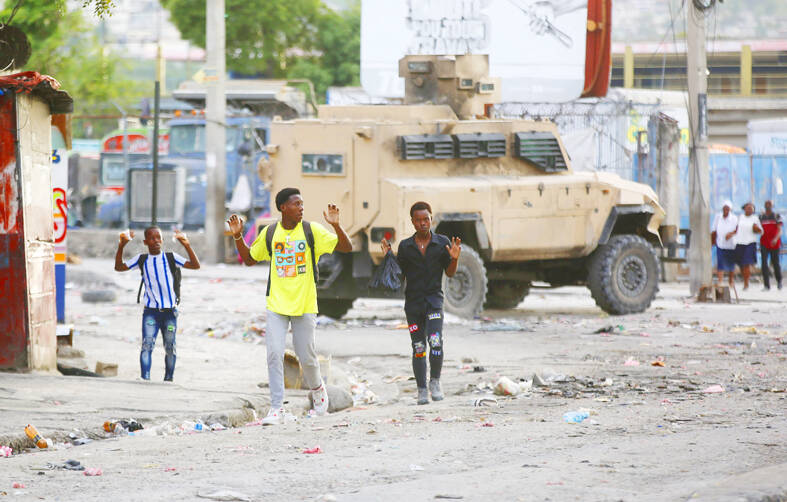
Photo: AP
At least four police officers, including two women, were killed in an attack on a station near the community of Canaan, a police union said.
The violence forced the airport, businesses, government agencies and schools to close as parents and young children fled through the streets. At least one airline, Sunrise Airways, suspended all flights.
Jimmy Cherizier, known as “Barbecue” and leader of the gang federation G9 Family and Allies, was seen in a recorded video announcing that the aim was to tie up the police chief and government ministers, and prevent Henry from returning to Haiti.
“With our guns and with the Haitian people, we will free the country,” Cherizier said.
A spokesman for the prime minister’s office could not be immediately reached for comment.
The head of Haiti’s National Police, Frantz Elbe, and police spokesman Garry Desrosiers did not return messages for comment.
Armored vehicles patrolled empty streets in downtown Port-au-Prince, while others were stationed near gang-controlled slums.
Residents in some neighborhoods, including Canape Vert and Turgeau, set up roadblocks to prevent gangs from entering as men who were not wearing uniforms stood by with machine guns.
Pierre Alex Boucher, a math teacher who lives in downtown Port-au-Prince, said he heard heavy gunfire before dawn.
Several hours later, as the gunfire continued, he stood on his roof and said he saw police in an armored vehicle fighting gang members before abruptly leaving.
The shooting then worsened, and when he saw what he said were teenagers with machine guns, he fled his home, feeling that his life was in danger.
“The area is completely invaded by gangs,” Boucher said of his neighborhood. “A lot of people couldn’t make it out, and some locked themselves inside their homes.”
He said he spoke with friends who saw people who had been shot to death.
“The country has to revolt against the gangs,” he said. “No one is safe.”
It was not clear whether Cherizier had the backing of other major gangs, which are estimated to control up to 80 percent of Haiti’s capital.
Diego Da Rin, with the International Crisis Group, said that Cherizier in his speech referred to a coalition called Viv Ansanm, which means “living together” in Haitian Creole.
It remains to be seen whether Cherizier truly has the support of other gang leaders, Da Rin said.
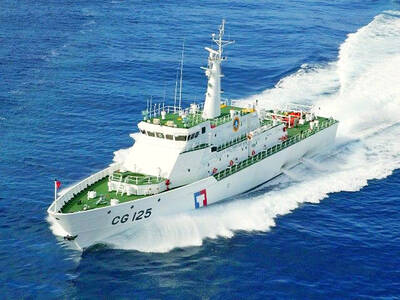
GEOPOLITICAL SIGNIFICANCE: The CGA’s nonmilitary role makes it a tool to avert diplomatic issues, an official said, while confirming the donation of a ship to Manila Coast Guard Administration (CGA) ships are scheduled to sail to the Philippines bearing the words “Taiwan Coast Guard” in a high-profile visit in October next year, the first such visit by a Taiwanese maritime law enforcement vessel to the Southeast Asian nation, the agency said yesterday. The CGA also confirmed that it had donated one of its decommissioned patrol vessels to the Philippines in a rare transfer of a retired ship to a nondiplomatic ally. The Republic of China (ROC) Navy last made such a visit in 1974, shortly before the Philippines switched diplomatic recognition to the People’s Republic of China in

‘GLOBAL WARNING’: The infiltration is not just a local problem, as Beijing has been deploying the same tactics worldwide against Western democracies, a report said Between 50,000 and 100,000 Chinese spies are operating in Taiwan, far more than the National Security Bureau’s previous estimate of 5,000, German journalist and author Jurgen Kremb said on Monday. Kremb presented his research, titled “The War of Spies: How China’s Intelligence Services Are Infiltrating Taiwan — and What Europe Must Learn from It,” at a joint event held by the Taiwan offices of the Friedrich Naumann Foundation and the European Values Center for Security Policy. The report was published in June in the Ministry of Justice Investigation Bureau’s Prospect & Exploration Monthly (展望與探索月刊). By spies, he said he was referring to informants,

PRICE STABILIZATION: The Ministry of Economic Affairs has urged the legislature to support the Cabinet’s supplementary budget for state-owned energy companies State-owned oil supplier CPC Corp, Taiwan (CPC, 台灣中油) on Saturday announced that it would raise domestic gasoline prices by NT$0.7 (US$0.02) per liter and diesel prices by NT$0.6 per liter this week after international crude oil prices rose above US$100 per barrel last week. Formosa Petrochemical Corp (台塑石化) yesterday said that it matched CPC’s price adjustments for this week. The decisions end a six-week period during which CPC and Formosa kept fuel prices in Taiwan unchanged. Retail gasoline prices this week would rise to NT$31.2, NT$32.7 and NT$34.7 per liter for 92, 95 and 98-octane unleaded gasoline respectively at CPC
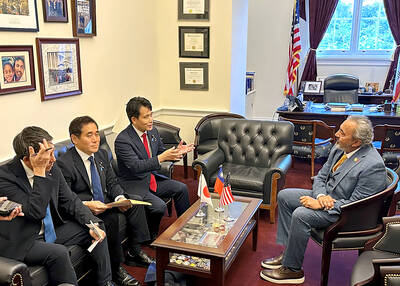
WASHINGTON MEETING: Japan’s Hirofumi Takinami said participants rejected the idea that the US should limit its defensive perimeter to the Second Island Chain US and Japanese lawmakers agree that the US must defend the First Island Chain, including Taiwan, and should not fall back to the Second Island Chain, while “a Taiwan contingency is a Japan contingency and therefore a US-Japan alliance contingency,” media reported after a meeting between officials of the two nations in Washington on Tuesday. A delegation of Japanese lawmakers from the Liberal Democratic Party met with US Senator Thom Tillis, co-chair of the Senate Taiwan Caucus, and US Representative Ami Bera, co-chair of the US Congressional Taiwan caucus, to discuss issues concerning East Asia and the Taiwan Strait. The Japanese and


 RSS
RSS