


US President Joe Biden said he thought there should be a humanitarian “pause” in the Israel-Hamas war, after his campaign speech on Wednesday evening was interrupted by a protester.
“I think we need a pause,” Biden said.
The call was a subtle departure for Biden and top aides, who throughout the Middle East crisis have been steadfast in stating they would not dictate how Israel operates militarily in response to Hamas’ Oct. 7 attacks.

Photo: AP
Yet Biden has faced growing pressure from human rights groups, fellow world leaders and other Democratic Party members, who say that Israel’s bombardment of Gaza is collective punishment and that a ceasefire is needed.
Biden commented that he was exerting pressure on Israeli Prime Minister Benjamin Netanyahu to give Palestinians a brief reprieve from the relentless military operation that has left Gaza mired in a roiling humanitarian crisis.
The White House has yet to call for a ceasefire.
Hundreds of foreign nationals and dozens of seriously injured Palestinians were allowed to leave Gaza after more than three weeks under siege.
The first people to leave Gaza crossed into Egypt.
Israeli Ambassador to the US Michael Herzog on Wednesday told The Hill on NewsNation that “we don’t need urging” in response to calls for more aid.
“We are ramping up humanitarian supplies into Gaza in those areas which are away from Hamas in the southern part of Gaza. The number of truckloads doubles and is going to pick up more and more,” he said.
Biden was speaking to supporters in Minneapolis Wednesday evening about his run for president in 2020 when a woman stood up and yelled: “Mr. President, if you care about Jewish people, as a rabbi, I need you to call for a ceasefire.”
His presence drew more than 1,000 nearby demonstrators. They carried Palestinian flags and signs that read “Stop Bombing Children,” “Free Palestine” and “Ceasefire now.”
In other news, just weeks after a frenzied trip to the Middle East, US Secretary of State Antony Blinken is returning to the region with a somewhat more nuanced message than he offered in the immediate aftermath of Hamas’ bloody Oct. 7 attack on Israel and Israel’s military response.
As he did last month, Blinken would stress US support for Israel and try to prevent a wider Middle Eastern war as he visits Israel and Jordan starting today.
However, Blinken’s agenda this time is more complex as the conflict intensifies and the Biden administration grapples with competing domestic and international interests and anger.
Meanwhile, Israel hit Gaza’s largest refugee camp with renewed air strikes on Wednesday, prompting UN rights officials to warn that targeting densely populated residential areas “could amount to war crimes.”
Bombs struck the Jabalia camp for a second time in two days, pulverizing buildings and, according to the Hamas-run health ministry, killing dozens of people.
The UN decried Israel’s most recent bombings, joining a chorus of international condemnation from as far afield as Bolivia, which severed diplomatic ties in protest.
Additional reporting by AFP

NETWORK-MAPPING PROJECT: The database contains 170 detailed files of Taiwanese politicians and about 23 million records of household registration data in Taiwan China has developed a network-mapping project targeting political figures and parties in Taiwan to monitor public opinion during elections and to craft tailored influence campaigns aimed at dividing Taiwanese society, according to documents leaked by Chinese technology firm GoLaxy (中科天璣). The documents, collected by Taipei-based Doublethink Lab, showed a database was specifically created to gather detailed information on Taiwanese political figures, including their political affiliations, job histories, birthplaces, residences, education, religion and a brief biography about them. Several notable Taiwanese politicians are in the database, including President William Lai (賴清德), former president Tsai Ing-wen (蔡英文), Minister of Foreign Affairs Lin Chia-lung (林佳龍),

RECOGNITION: Former Fijian prime minister Mahendra Chaudhry said that Taiwan’s New Southbound Policy serves as a stabilizing force in the Indo-Pacific region Taiwan can lead the unification of the Chinese people, Nobel Peace Prize laureate and former Polish president Lech Walesa said in Taipei yesterday, adding that as the world order is changing, peaceful discussion would find good solutions, and that the use of force and coercion would always fail. Walesa made the remarks during his keynote address at a luncheon of the Yushan Forum in Taipei, titled “Indo-Pacific Partnership Prospects: Taiwan’s Values, Technology and Resilience,” organized by the Taiwan-Asia Exchange Foundation with the Ministry of Foreign Affairs. Walesa said that he had been at the forefront of a big peaceful revolution and “if
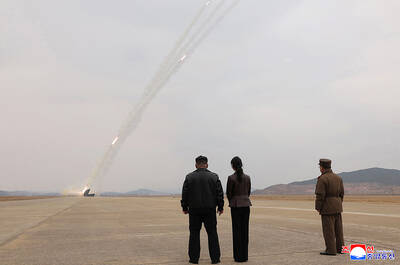
North Korea tested nuclear-capable rocket launchers, state media reported yesterday, a day after Seoul detected the launch of about 10 ballistic missiles. The test comes after South Korean and US forces launched their springtime military drills, due to run until Thursday. North Korean leader Kim Jong-un on Saturday oversaw the testing of the multiple rocket launcher system (MRLS), the Korean Central News Agency (KCNA) said. The test involved 12 600mm-caliber ultra-precision multiple rocket launchers and two artillery companies, it said. Kim said the drill gave Pyongyang’s enemies, within the 420km striking range, a sense of “uneasiness” and “a deep understanding

North Korea yesterday fired about 10 ballistic missiles to the sea toward Japan, the South Korean Joint Chiefs of Staff (JCS) said, days after Pyongyang warned of “terrible consequences” over ongoing South Korea-US military drills. Pyongyang recently dashed hopes of a diplomatic thaw with Seoul, Washington’s security ally, describing its latest peace efforts as a “clumsy, deceptive farce.” Seoul’s military detected “around 10 ballistic missiles launched from the Sunan area in North Korea toward the East Sea [Sea of Japan] at around 1:20pm,” JCS said in a statement, referring to South Korea’s name for the body of water. The missiles


 RSS
RSS