


Taiwan Semiconductor Manufacturing Co (TSMC, 台積電), the world’s largest contract chipmaker, on Friday said that no customer data were compromised in a cyberattack on one of its hardware suppliers.
Some information, including TSMC’s name, was leaked when the supplier was hacked on Thursday, but no TSMC data were stolen, the chipmaker said, without disclosing the name of the vendor.
After being informed of the cybersecurity breach, TSMC terminated the exchange of information with the supplier, in line with its security protocols and standard operating procedures, it said.

Photo: Reuters
TSMC’s hardware components are usually subject to extensive checks and adjustments, including security configurations, before being installed in its systems, it said.
The chipmaker said it remained committed to raising security awareness among its suppliers and ensuring that they comply with security standards.
Taiwanese law enforcement is investigating the incident, it said.
International news media reported that the attack was carried out by a Russia-linked ransomware gang called LockBit, which identified the Taiwanese chipmaker on its “dark Web” leak site on Thursday.
San Francisco-based technology news Web site TechCrunch said that the hardware supplier was Kinmax Technology (擎昊科技), an IT services and consulting group based in Hsinchu that specializes in networking, cloud computing, storage, security and database management.
The compromised information pertained to the initial setup and configuration of Kinmax’s servers, TechCrunch said.
LockBit was demanding TSMC pay US$70 million to prevent it from releasing data it claimed to have stolen from the chipmaker, TechCrunch quoted Equinix cyberthreat intelligence researcher William Thomas as saying.
TechCrunch said that TSMC had shared a copy of the communication it received from Kinmax, which showed that the supplier discovered on Thursday that its internal testing environment had been attacked and some information obtained.
The leaked data were largely information concerning the default configurations of system installations that the supplier provides to its customers, TechCrunch said, citing the Kinmax communication.
Kinmax has suggested that TSMC was not the only client affected by the attack, TechCrunch said.
Tech Web site Cybernews said that LockBit is known for its malware of the same name and has led numerous ransomware attacks since early last year, becoming the world’s most prolific ransomware syndicate.
LockBit has hit more than 1,800 companies, primarily using a “ransomware as a service” model to keep a portion of the profits that it pays to affiliates that carry out the attacks, Cybernews said.
LockBit claimed responsibility for a ransomware attack carried out in May against a plant in Mexico owned by Taiwan’s Hon Hai Precision Industry Co (鴻海精密), an iPhone assembler, TechCrunch reported.
Hon Hai, also known as Foxconn Technology Group (富士康科技集團), reported the attack, but has not disclosed how much money was demanded and whether it paid, TechCrunch said.
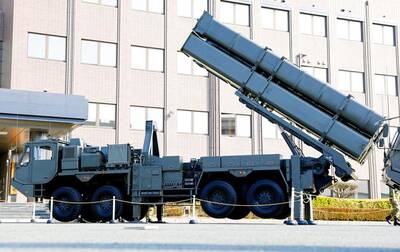
Japan has deployed long-range missiles in a southwestern region near China, the Japanese defense minister said yesterday, at a time when ties with Beijing are at their lowest in recent years. The missiles were installed in Kumamoto in the southern region of Kyushu, as Japan is attempting to shore up its military capacity as China steps up naval activity in the East China Sea. “Standoff defense capabilities enable us to counter the threat of enemy forces attempting to invade our country ... while ensuring the safety of our personnel,” Japanese Minister of Defense Shinjiro Koizumi said. “This is an extremely important initiative for

The nation’s fastest supercomputer, Nano 4 (晶創26), is scheduled to be launched in the third quarter, and would be used to train large language models in finance and national defense sectors, the National Center for High-Performance Computing (NCHC) said. The supercomputer, which would operate at about 86.05 petaflops, is being tested at a new cloud computing center in the Southern Taiwan Science Park in Tainan. The exterior of the server cabinet features chip circuitry patterns overlaid with a map of Taiwan, highlighting the nation’s central position in the semiconductor industry. The center also houses Taiwania 2, Taiwania 3, Forerunner 1 and
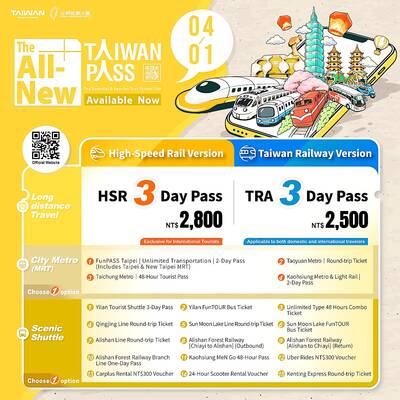
MORE POPULAR: Taiwan Pass sales increased by 59 percent during the first quarter compared with the same period last year, the Tourism Administration said The Tourism Administration yesterday said that it has streamlined the Taiwan Pass, with two versions available for purchase beginning today. The tourism agency has made the pass available to international tourists since 2024, allowing them to access the high-speed rail, Taiwan Railway Corp services, four MRT systems and four Taiwan Tourist Shuttles. Previously, five types of Taiwan Pass were available, but some tourists have said that the offerings were too complicated. The agency said only two types of Taiwan Pass would be available, starting from a three-day pass with the high-speed rail and a three-day pass with Taiwan Railway Corp. The former costs NT$2,800

FIRST TRIAL: Ko’s lawyers sought reduced bail and other concessions, as did other defendants, but the bail judge denied their requests, citing the severity of the sentences Former Taipei mayor Ko Wen-je (柯文哲) was yesterday sentenced to 17 years in prison and had his civil rights suspended for six years over corruption, embezzlement and other charges. Taipei prosecutors in December last year asked the Taipei District Court for a combined 28-year, six-month sentence for the four cases against Ko, who founded the Taiwan People’s Party (TPP). The cases were linked to the Core Pacific City (京華城購物中心) redevelopment project and the mismanagement of political donations. Other defendants convicted on separate charges included Chinese Nationalist Party (KMT) Taipei City Councilor Angela Ying (應曉薇), who was handed a 15-year, six-month sentence; Core Pacific


 RSS
RSS