


Democratic Progressive Party (DPP) members yesterday said that the party is alone in taking responsible steps to deal with incidents of sexual harassment while the other major parties are “hiding” from the issue.
“Among the major political parties, we are the only one directly dealing with MeToo incidents head on,” DPP Legislator Cheng Yun-peng (鄭運鵬) told a news conference at the legislature in Taipei. “The other parties are hiding to avoid discussing the issue.”
“Survey results show that reports about sexual harassment have an effect on the polls, but the DPP — as the ruling party — is tackling the issue head on,” Cheng said.

Photo: CNA
Vice President William Lai (賴清德), who is DPP chairman, and President Tsai Ing-wen (蔡英文) immediately spoke publicly to deal with the situation, showing that the DPP is the only party with a responsible attitude, Cheng said.
Taiwan People’s Party (TPP) Chairman Ko Wen-je (柯文哲) has repeatedly been accused of making misogynistic comments, while there have been allegations of sexual misconduct within the party, Cheng said.
However, the people who made the complaints were told that “Ko does not want to deal with the issue,” Cheng said.
Chinese Nationalist Party (KMT) officials went into hiding after KMT legislators Chen Hsueh-sheng (陳雪生) and Fu Kun-chi (傅?萁), and other party members were accused of sexual harassment, Cheng said.
“The DPP is taking a proactive approach by implementing new measures, but other parties attack the victim,” he said. “They accuse people of having a political vendetta or say that the victim is secretly working for another party,” he said.
After a court on Tuesday upheld a civil case against the KMT’s Chen Hsueh-sheng (陳雪生) regarding a 2020 accusation of sexual harassment at the legislature, Chen accused the victim, DPP Legislator Fan Yun (范雲), of using the ruling to gain political points, Cheng said.
DPP Legislator Liu Shyh-fang (劉世芳) said that harassment is widespread.
“Sexual harassment is not confined to one political party or one gender or a single incident, and all of society must deal with it,” Liu said.
The DPP would propose legislative amendments to bolster punishments for perpetrators and help the people affected, she said.
Solving problems is the DPP’s way, she said.
“We are not like the members of other parties, who are hiding and suppressing the issue,” she said.
Fan said that among the presidential candidates representing the “green,” “blue” and “white” political camps, Lai is the only one who has taken the issue seriously.
“Chairman Lai has ordered all party members and workers to attend gender equality classes, and is working to ensure that reforms are implemented,” she said.
Ko has often made sexist comments in the workplace, which is a form of harassment, while New Taipei City Mayor Hou You-yi (侯友宜), the KMT’s presidential candidate, “to this day has not apologized or dealt with a sexual misconduct case at the New Taipei City Health Department, which resulted in a female staff member committing suicide,” Fan said.
On Tuesday, Tsai wrote on social media that she had ordered Premier Chen Chien-jen (陳建仁) to conduct a government review and draft guidelines to define what constitutes sexual harassment at school and at the workplace.
In an internal DPP meeting, Lai affirmed new regulations stipulating that department and section heads would be dismissed and banned from jobs with the party if they are found to have concealed complaints of sexual harassment and have done nothing to help those affected, DPP officials said.
Lai also initiated steps to amend the DPP charter to enhance reporting, prevention and redress processes when party members are accused of sexual misconduct, the officials said.
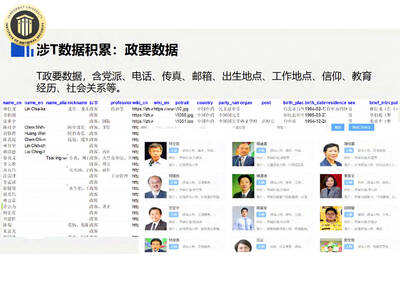
NETWORK-MAPPING PROJECT: The database contains 170 detailed files of Taiwanese politicians and about 23 million records of household registration data in Taiwan China has developed a network-mapping project targeting political figures and parties in Taiwan to monitor public opinion during elections and to craft tailored influence campaigns aimed at dividing Taiwanese society, according to documents leaked by Chinese technology firm GoLaxy (中科天璣). The documents, collected by Taipei-based Doublethink Lab, showed a database was specifically created to gather detailed information on Taiwanese political figures, including their political affiliations, job histories, birthplaces, residences, education, religion and a brief biography about them. Several notable Taiwanese politicians are in the database, including President William Lai (賴清德), former president Tsai Ing-wen (蔡英文), Minister of Foreign Affairs Lin Chia-lung (林佳龍),

RECOGNITION: Former Fijian prime minister Mahendra Chaudhry said that Taiwan’s New Southbound Policy serves as a stabilizing force in the Indo-Pacific region Taiwan can lead the unification of the Chinese people, Nobel Peace Prize laureate and former Polish president Lech Walesa said in Taipei yesterday, adding that as the world order is changing, peaceful discussion would find good solutions, and that the use of force and coercion would always fail. Walesa made the remarks during his keynote address at a luncheon of the Yushan Forum in Taipei, titled “Indo-Pacific Partnership Prospects: Taiwan’s Values, Technology and Resilience,” organized by the Taiwan-Asia Exchange Foundation with the Ministry of Foreign Affairs. Walesa said that he had been at the forefront of a big peaceful revolution and “if
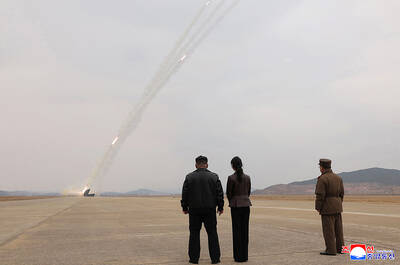
North Korea tested nuclear-capable rocket launchers, state media reported yesterday, a day after Seoul detected the launch of about 10 ballistic missiles. The test comes after South Korean and US forces launched their springtime military drills, due to run until Thursday. North Korean leader Kim Jong-un on Saturday oversaw the testing of the multiple rocket launcher system (MRLS), the Korean Central News Agency (KCNA) said. The test involved 12 600mm-caliber ultra-precision multiple rocket launchers and two artillery companies, it said. Kim said the drill gave Pyongyang’s enemies, within the 420km striking range, a sense of “uneasiness” and “a deep understanding

North Korea yesterday fired about 10 ballistic missiles to the sea toward Japan, the South Korean Joint Chiefs of Staff (JCS) said, days after Pyongyang warned of “terrible consequences” over ongoing South Korea-US military drills. Pyongyang recently dashed hopes of a diplomatic thaw with Seoul, Washington’s security ally, describing its latest peace efforts as a “clumsy, deceptive farce.” Seoul’s military detected “around 10 ballistic missiles launched from the Sunan area in North Korea toward the East Sea [Sea of Japan] at around 1:20pm,” JCS said in a statement, referring to South Korea’s name for the body of water. The missiles


 RSS
RSS