


A Taiwan contingency would affect the entire world, visiting French lawmaker Eric Bothorel said yesterday as he reaffirmed his country’s friendship with Taiwan.
Bothorel, who chairs the French National Assembly’s France-Taiwan Parliamentary Friendship Group, arrived in Taipei yesterday morning with a delegation comprising members of the lower house of the French parliament.
He said he would like to tell Taiwanese: “We stand with you. We are close to you. You will be our friends for a long time.”
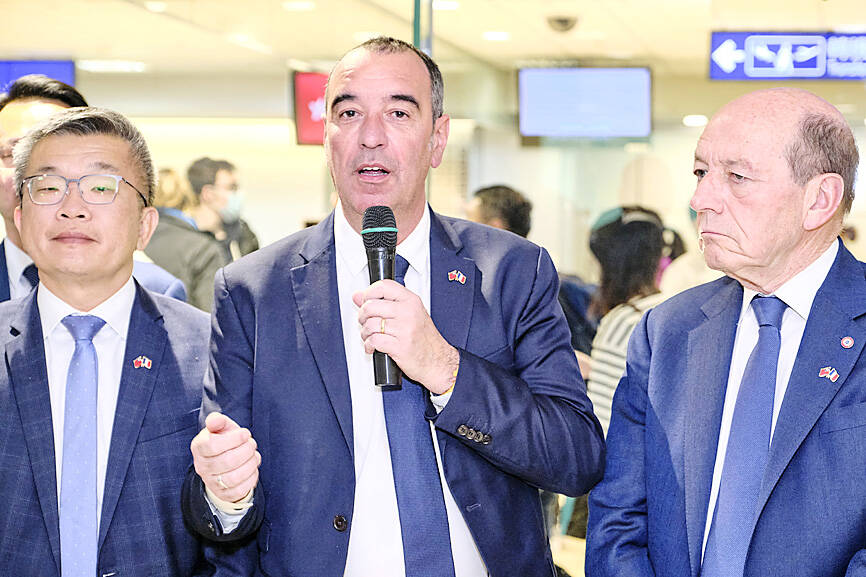
Photo: AP / Ministry of Foreign Affairs
Through the visit, the delegation aims to demonstrate that the relationship between France and Taiwan goes beyond business relations, and plans to discuss how to improve the ties, he said.
France and Taiwan share common values and can learn much from each other, French lawmaker Constance Le Grip said, adding that she hoped to reaffirm the deep friendship between the two countries with the visit.
The trip was scheduled weeks ago, Bothorel said, when asked to comment on French President Emmanuel Macron’s visit to China and his remarks that Europe should avoid being drawn into a dispute with China by the US.
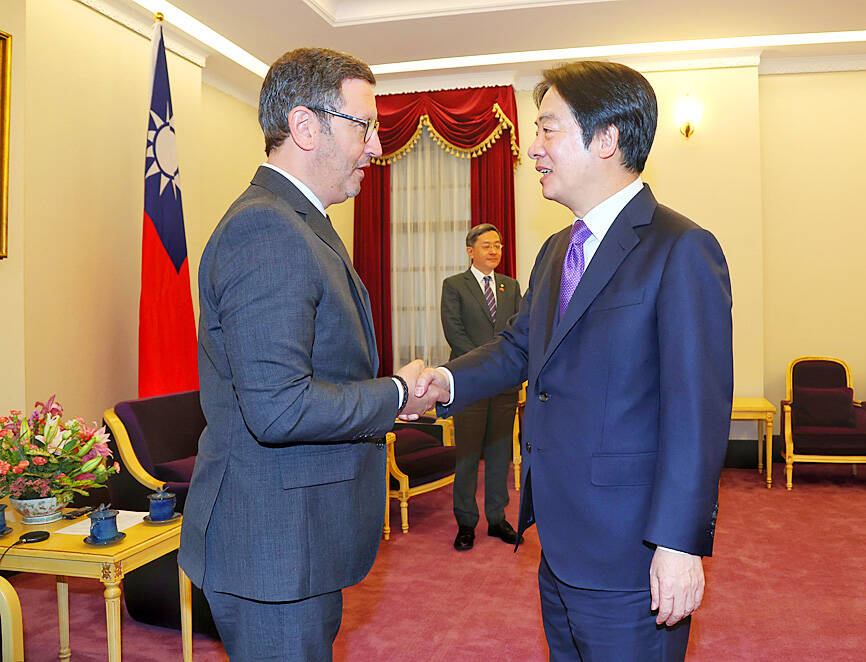
Photo: CNA
France’s policy toward Taiwan remains the same, he said, adding that his country supports the “status quo.”
There is no misunderstanding between France and Taiwan, and Paris will continue to help preserve peace and freedom in the region, he said, citing a French military ship sailing through the Taiwan Strait last week as a gesture of support.
“If something happens to Taiwan, it will change the world,” he said.
The two other members of the delegation are the vice chairs of the French Foreign Affairs Committee Michel Herbillon and Mireille Clapot.
Separately, a Portuguese parliamentary delegation that arrived on Friday at the government’s invitation yesterday met with Vice President William Lai (賴清德).
Although Taiwan and Portugal are far from each other geographically, “their hearts are very close,” as both are free and democratic nations that share common values and ideals in pursuing peace and human rights, Paulo Rios de Oliveira of the Social Democratic Party said.
Meanwhile, the Ministry of Foreign Affairs yesterday thanked the foreign affairs ministers of Belgium and France for voicing their support for Taiwan.
Belgium has a “known and unequivocal position” regarding the cross-strait situation — “We call for restraint, de-escalation and maintaining the ‘status quo’ in the Taiwan Strait,” Belgian Minister of Foreign Affairs Hadja Lahbib said at the Belgian Chamber of Representatives on Friday.
“We condemn all bilateral actions that challenge this ‘status quo,’ and we call on the various parties to engage in dialogue and establish confidence-building measures,” she said.
French Minister for Europe and Foreign Affairs Catherine Colonna told NHK on Sunday that the “status quo” across the Taiwan Strait should not be unilaterally changed.
France, like its European allies and the US, is committed to preserving peace and stability in the Indo-Pacific region, including Taiwan, and is opposed to any use of force in the Strait, she said onboard the French frigate Prairial on Saturday.
The ministry expressed gratitude for their support and pledged to work together with like-minded countries to safeguard peace, stability and prosperity in the region.

Right-wing political scientist Laura Fernandez on Sunday won Costa Rica’s presidential election by a landslide, after promising to crack down on rising violence linked to the cocaine trade. Fernandez’s nearest rival, economist Alvaro Ramos, conceded defeat as results showed the ruling party far exceeding the threshold of 40 percent needed to avoid a runoff. With 94 percent of polling stations counted, the political heir of outgoing Costa Rican President Rodrigo Chaves had captured 48.3 percent of the vote compared with Ramos’ 33.4 percent, the Supreme Electoral Tribunal said. As soon as the first results were announced, members of Fernandez’s Sovereign People’s Party
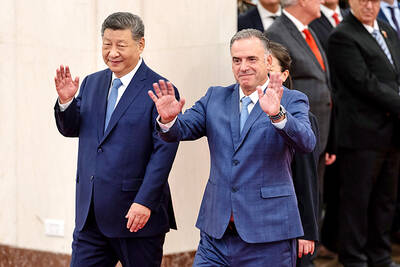
EMERGING FIELDS: The Chinese president said that the two countries would explore cooperation in green technology, the digital economy and artificial intelligence Chinese President Xi Jinping (習近平) yesterday called for an “equal and orderly multipolar world” in the face of “unilateral bullying,” in an apparent jab at the US. Xi was speaking during talks in Beijing with Uruguayan President Yamandu Orsi, the first South American leader to visit China since US special forces captured then-Venezuelan president Nicolas Maduro last month — an operation that Beijing condemned as a violation of sovereignty. Orsi follows a slew of leaders to have visited China seeking to boost ties with the world’s second-largest economy to hedge against US President Donald Trump’s increasingly unpredictable administration. “The international situation is fraught
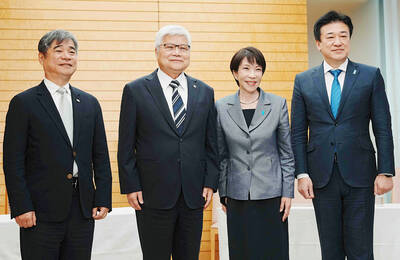
Taiwan Semiconductor Manufacturing Co (TSMC, 台積電) plans to make advanced 3-nanometer chips in Japan, stepping up its semiconductor manufacturing roadmap in the country in a triumph for Japanese Prime Minister Sanae Takaichi’s technology ambitions. TSMC is to adopt cutting-edge technology for its second wafer fab in Kumamoto, company chairman C.C. Wei (魏哲家) said yesterday. That is an upgrade from an original blueprint to produce 7-nanometer chips by late next year, people familiar with the matter said. TSMC began mass production at its first plant in Japan’s Kumamoto in late 2024. Its second fab, which is still under construction, was originally focused on

GROWING AMBITIONS: The scale and tempo of the operations show that the Strait has become the core theater for China to expand its security interests, the report said Chinese military aircraft incursions around Taiwan have surged nearly 15-fold over the past five years, according to a report released yesterday by the Democratic Progressive Party’s (DPP) Department of China Affairs. Sorties in the Taiwan Strait were previously irregular, totaling 380 in 2020, but have since evolved into routine operations, the report showed. “This demonstrates that the Taiwan Strait has become both the starting point and testing ground for Beijing’s expansionist ambitions,” it said. Driven by military expansionism, China is systematically pursuing actions aimed at altering the regional “status quo,” the department said, adding that Taiwan represents the most critical link in China’s


 RSS
RSS