


Japanese fish farmers are ready to help Taiwan after China banned Taiwanese grouper imports, the Sankei Shimbun reported yesterday.
The Chinese General Administration of Customs suspended imports of the fish on Monday last week, citing prohibited chemicals and excessive levels of oxytetracycline allegedly found in grouper imports since December last year.
Soichiro Hayashi, president of the Hayashi Trout Farm in Japan’s Fukushima Prefecture, is leading the push for Taiwanese grouper imports, the newspaper said.
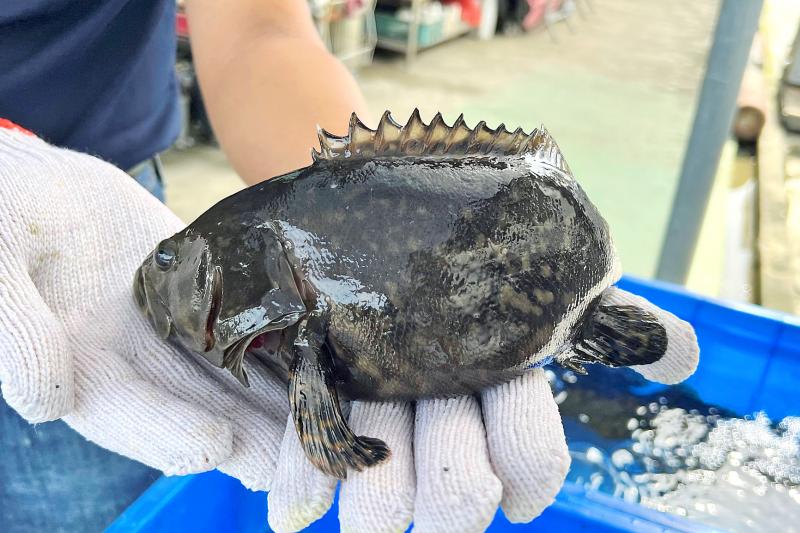
Photo: Yang Chin-cheng, Taipei Times
His call has caught the attention of several large sushi chains, the report said.
Hayashi, who is the Fukushima branch head of the Friends of Lee Teng-hui Association in Japan, is supportive of Taiwan and wants to return Taiwan’s kindness after it helped with relief efforts after the March 11, 2011, earthquake, the report said.
Fish from disaster-stricken areas were difficult to sell immediately after the earthquake, given fears of radiation after the meltdown at the Fukushima Dai-ichi nuclear power plant, Hayashi told the Sankei Shimbun.
“The feeling of not being able to sell the fish that you work so hard to breed resonated with me,” he said.
Former minister of foreign affairs Mark Chen (陳唐山), who heads the Friends of Shinzo Abe Association, established this month, introduced Hayashi to fish farmers in Pingtung County, the newspaper said.
Hayashi plans to import two to three tonnes of grouper samples for restaurateurs, and hopes to send a group to Taiwan to inspect the farms’ conditions before importing larger quantities, it said.
Grouper fish is delicious and many Japanese would support Taiwan in this cause as it fights Chinese oppression, Hayashi told the newspaper, adding that the “democratic fish” could become a trend and add to demand.
Chen Chien-han (陳建翰), a fish farmer in Pingtung, yesterday said that he is grateful for Hayashi’s gesture.
“It is a cycle of kindness,” Democratic Progressive Party Legislator Cheng Yun-peng (鄭運鵬) said yesterday, adding that Japanese businesses are looking for opportunities to help Taiwan.
The Tokyo-based Taiwan Trade Center has contacted several aquatic product importers and traders to arrange a deal, director Raymond Chen (陳英顯) said.
The high price of grouper is its largest obstacle when exporting to Japan, given that Japanese have a wide variety of fish to choose from, Chen said, adding that imported fish is rarely seen in Japan apart from cod and salmon.
Meanwhile, Taiwan-Japan Relations Association Chairman Su Jia-chyuan (蘇嘉全) is planning to visit Japan-Taiwan Exchange Association Chairman Mitsuo Ohashi in Japan this week to exchange views on issues of mutual concern, sources with knowledge of the matter said.
Su is also scheduled to visit the Hayashi Trout Farm during his trip and attend events to promote Taiwanese grouper, they said.
Additional reporting by Lu Yi-hsuan
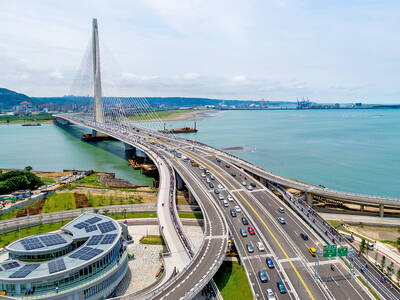
The Ministry of Transportation and Communications yesterday inaugurated the Danjiang Bridge across the Tamsui River in New Taipei City, saying that the structure would be an architectural icon and traffic artery for Taiwan. Feted as a major engineering achievement, the Danjiang Bridge is 920m long, 211m tall at the top of its pylon, and is the longest single-pylon asymmetric cable-stayed bridge in the world, the government’s Web site for the structure said. It was designed by late Iraqi-British architect Zaha Hadid. The structure, with a maximum deck of 70m, accommodates road and light rail traffic, and affords a 200m navigation channel for boats,
Taiwan Semiconductor Manufacturing Co (TSMC, 台積電), the world’s largest foundry service provider, yesterday said that global semiconductor revenue is projected to hit US$1.5 trillion in 2030, after the figure exceeds US$1 trillion this year, as artificial intelligence (AI) demand boosts consumption of token and compute power. “We are still at the beginning of the AI revolution, but we already see a significant impact across the whole semiconductor ecosystem,” TSMC deputy cochief operating officer Kevin Zhang (張曉強) said at the company’s annual technology symposium in Hsinchu City. “It is fair to say that in the past decade, smartphones and other mobile devices were
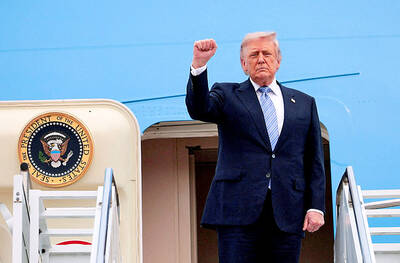
US-CHINA SUMMIT: MOFA welcomed US reassurance of no change in its Taiwan policy; Trump said he did not comment when Xi talked of opposing independence US President Donald Trump yesterday said he has not made a decision on whether to move forward with a major arms package for Taiwan after hearing concerns about it from Chinese President Xi Jinping (習近平). Trump’s comments on Taiwan came as he flew back to Washington after wrapping up critical talks in which both leaders said important progress was made in stabilizing US-China relations even as deep differences persist between the world’s two biggest powers on Iran and Taiwan. “I will make a determination,” Trump said, adding: “I’ll be making decisions. But, you know, I think the last thing we need right
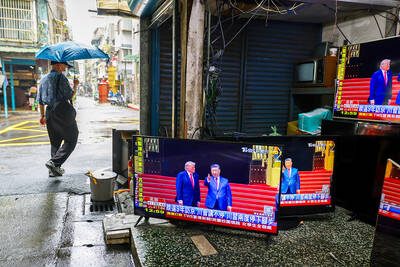
TAIWAN ISSUE: US treasury secretary Scott Bessent said on the first day of meetings that ‘it wouldn’t be a US-China summit without the Taiwan issue coming up’ There were no surprises on the first day of the summit between US President Donald Trump and Chinese President Xi Jinping (習近平), the Mainland Affairs Council (MAC) said yesterday, as the government reiterated that cross-strait stability is crucial to the Asia-Pacific region, as well as the world. As the two presidents met for a highly anticipated summit yesterday, Chinese state media reported that Xi warned Trump that missteps regarding Taiwan could push their two countries into “conflict.” Trump arrived in China with accolades for his host, calling Xi a “great leader” and “friend,” and extending an invitation to visit the White House


 RSS
RSS