


Lithuanian Minister of the Economy and Innovation Ausrine Armonaite yesterday recommended jointly establishing a semiconductor fabrication facility as she welcomed a Taiwanese trade delegation.
Lithuania has the technological capability and know-how to develop a semiconductor industry, but it is important that Lithuania learn from Taiwan’s experiences in the sector, Armonaite said.
Taipei and Vilnius last month collaborated on establishing the Taiwan and Lithuania Center for Semiconductors and Materials Science, and the next step would be to construct a fabrication facility, Armonaite said.
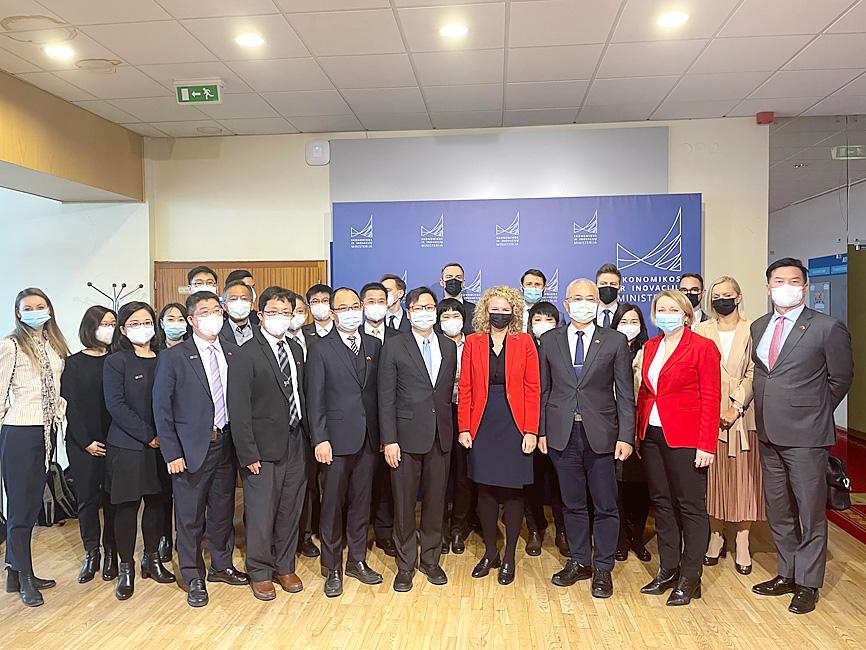
Photo: Screen grab from Facebook
“We are in the process of assessing investment opportunities for Taiwan Semiconductor Manufacturing Co (台積電), United Microelectronics Corp (聯電) and other firms,” she added.
Representative to Lithuania Eric Huang (黃鈞耀) told reporters that the two nations are still exploring different models of collaboration, but Taiwan is sincere in pursuing industrial and academic collaborations with Lithuania.
Taiwan and Lithuania have been steadily increasing collaboration.
In January, Taiwan unveiled the Taiwanese Investment Foundation for Middle and Eastern Europe, which would have access to US$200 million.
The government also created a foundation with access to US$1 billion to help in financing collaborations between Taiwan and Lithuania.
The delegation is to visit Lithuania, the Czech Republic and Slovakia, after a Taiwanese delegation visited the same countries in October last year, led by National Development Council Minister Kung Ming-hsin (龔明鑫).
The delegation is to tour the Lithuanian Center for Physical Sciences and Technology — under which the Taiwan and Lithuania Center for Semiconductors and Materials was founded — local universities and the Santaka Valley, the council said.
The Santaka Valley is an association uniting and integrating the activities of research, technology and academic institutions in Kaunas, Lithuania.
The delegation is to meet with industry representatives in the laser technology, Internet of Things and manufacturing sectors, the council said, adding that the delegation would also be interacting with Lithuanian senators.
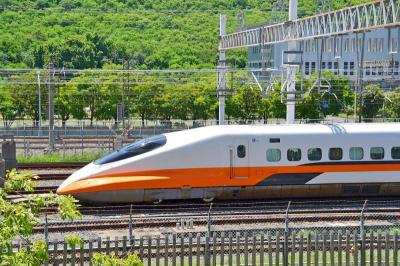
A signaling system malfunction disrupted high-speed rail (HSR) services beginning at 8am today, with trains temporarily reduced to three northbound and three southbound trains per hour as authorities conduct inspections. The malfunction occurred on a section of track in Miaoli County during pre-operation checks early this morning, forcing northbound and southbound trains to use a single track, the HSR operator said. The regular schedule has been replaced with three hourly trains offering only nonreserved seating in each direction, stopping at every station, it said, adding that business class cars would still have reserved seating. Departures from terminal stations are scheduled at the top

‘NO SECURITY RISK’: The Railway Bureau reassured the public that the technicians’ activities were limited to technical guidance and did not involve sensitive systems The Railway Bureau yesterday said it had invited eight Chinese technicians to assist with an airport MRT construction project. The bureau issued the confirmation after an Internet user said Chinese nationals had entered the construction zone of Taiwan Taoyuan International Airport’s Terminal 3 project. They asked why “individuals from an enemy state” were allowed access to such a major national infrastructure project, which raised serious concerns over Taiwan’s industrial safety, sensitive systems and information security. The bureau’s Northern Region Engineering Branch Office said subcontractor Taiwan Handle Industrial Co (台灣手把工業) of the Taoyuan airport MRT’s “Contract No. CU05 Project A14 Station Civil, MEP &
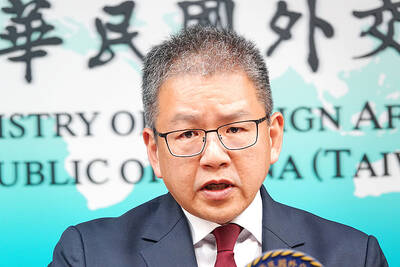
Taiwan is still in the process of assessing the possibility of recruiting workers from Eswatini, the Ministry of Foreign Affairs said yesterday, adding that its goal is to help Eswatini upgrade its vocational training centers. If there are plans to recruit workers from Eswatini, safeguarding national security, protecting public health and ensuring the employment rights of Taiwanese would be prerequisites, Department of West Asian and African Affairs Director-General Yen Chia-liang (顏嘉良) told a news conference. Key considerations would also include filling labor shortages in specific industries, and fostering bilateral professional and technical exchanges, he said. Yen was asked about the progress of labor

A US uncrewed surface vessel (USV) encountered multiple Chinese warships during an autonomous transit of the Taiwan Strait, US defense company Seasats said in a statement on Wednesday. Seasats announced that a Lightfish USV had completed the first autonomous transit of the Taiwan Strait. Over five days, the USV traversed the entire length of the Strait while constantly monitoring surface vessel traffic, the company said. The Lightfish encountered multiple Chinese warships, one of which was a Chinese People’s Liberation Army Navy (PLAN) Type 056 corvette, it said. The Chinese vessels were operating “well within Taiwan’s exclusive economic zone without transmitting their identity via the


 RSS
RSS