


US Olympic figure skater Alysa Liu (劉美賢) and her father, Arthur Liu (劉俊國) — a former political refugee — were among those targeted in a spying operation that the US Department of Justice said was ordered by the Chinese government, Arthur Liu said on Wednesday.
Arthur Liu told reporters that he had been contacted by the FBI in October last year and warned about the scheme just as his 16-year-old daughter was preparing for the Beijing Winter Olympics.
Arthur Liu said he did not tell his daughter about the issue so as not to scare her or distract her from the competition.
“We believed Alysa had a very good chance of making the Olympic team and truly were very scared,” Arthur Liu said.
The justice department earlier on Wednesday announced charges against five men accused of acting on behalf of the Chinese government for a series of brazen and wide-ranging schemes to stalk and harass Chinese dissidents in the US.
Arthur Liu said he and his daughter were included in the criminal complaint as “Dissident 3” and “family member” respectively.
Arthur Liu said he took a stand against China’s bullying by allowing his daughter to compete at the Winter Games, where she placed seventh in the women’s event.
“This is her moment. This is her once-in-a-lifetime opportunity to compete at the Olympic Games. I’m not going to let them stop her from going and I’ll do whatever I can to make sure she’s safe, and I’m willing to make sacrifices so she can enjoy the moment,” Arthur Liu said. “I’m not going to let them win — to stop me — to silence me from expressing my opinions anywhere.”
The father said that he agreed to let his daughter compete with assurances from US officials that Alysa Liu would be closely protected and kept safe while in China.
“They are probably just trying to intimidate us, to ... in a way threaten us not to say anything, to cause trouble to them and say anything political or related to human rights violations in China,” Arthur Liu said.
The justice department said that one of the five people charged “allegedly orchestrated a campaign to undermine the US congressional candidacy of a US military veteran who was a leader of the 1989 pro-democracy demonstrations in Beijing.”
Three people were charged for acting as unregistered agents of China and are in custody.
Two others remain at large and one is a resident of China who acted as an intermediary, it said.
Officials said they are detecting what they called an alarming rise in “transnational repression” — where a foreign government seeks to harass or intimidate US residents — by nations such as China and Iran.
In Beijing, Chinese Ministry of Foreign Affairs spokesman Zhao Lijian (趙立堅) yesterday said that China is “firmly opposed to the US slandering by making an issue of this out of thin air.”
Additional reporting by Bloomberg
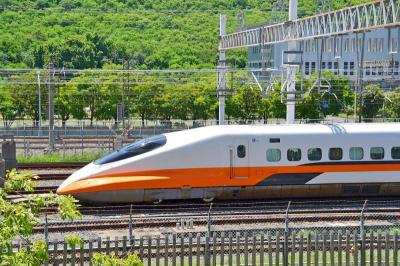
A signaling system malfunction disrupted high-speed rail (HSR) services beginning at 8am today, with trains temporarily reduced to three northbound and three southbound trains per hour as authorities conduct inspections. The malfunction occurred on a section of track in Miaoli County during pre-operation checks early this morning, forcing northbound and southbound trains to use a single track, the HSR operator said. The regular schedule has been replaced with three hourly trains offering only nonreserved seating in each direction, stopping at every station, it said, adding that business class cars would still have reserved seating. Departures from terminal stations are scheduled at the top

‘NO SECURITY RISK’: The Railway Bureau reassured the public that the technicians’ activities were limited to technical guidance and did not involve sensitive systems The Railway Bureau yesterday said it had invited eight Chinese technicians to assist with an airport MRT construction project. The bureau issued the confirmation after an Internet user said Chinese nationals had entered the construction zone of Taiwan Taoyuan International Airport’s Terminal 3 project. They asked why “individuals from an enemy state” were allowed access to such a major national infrastructure project, which raised serious concerns over Taiwan’s industrial safety, sensitive systems and information security. The bureau’s Northern Region Engineering Branch Office said subcontractor Taiwan Handle Industrial Co (台灣手把工業) of the Taoyuan airport MRT’s “Contract No. CU05 Project A14 Station Civil, MEP &
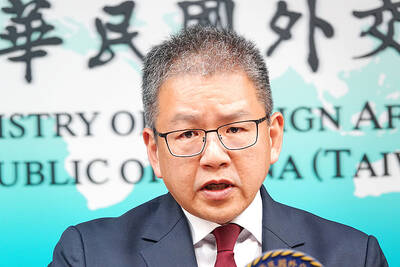
Taiwan is still in the process of assessing the possibility of recruiting workers from Eswatini, the Ministry of Foreign Affairs said yesterday, adding that its goal is to help Eswatini upgrade its vocational training centers. If there are plans to recruit workers from Eswatini, safeguarding national security, protecting public health and ensuring the employment rights of Taiwanese would be prerequisites, Department of West Asian and African Affairs Director-General Yen Chia-liang (顏嘉良) told a news conference. Key considerations would also include filling labor shortages in specific industries, and fostering bilateral professional and technical exchanges, he said. Yen was asked about the progress of labor

A US uncrewed surface vessel (USV) encountered multiple Chinese warships during an autonomous transit of the Taiwan Strait, US defense company Seasats said in a statement on Wednesday. Seasats announced that a Lightfish USV had completed the first autonomous transit of the Taiwan Strait. Over five days, the USV traversed the entire length of the Strait while constantly monitoring surface vessel traffic, the company said. The Lightfish encountered multiple Chinese warships, one of which was a Chinese People’s Liberation Army Navy (PLAN) Type 056 corvette, it said. The Chinese vessels were operating “well within Taiwan’s exclusive economic zone without transmitting their identity via the


 RSS
RSS