


Taiwanese speedskater Huang Yu-ting (黃郁婷) drew criticism after posting an Instagram video showing her wearing the Chinese speedskating team’s uniform during practice ahead of the Winter Olympics in Beijing.
The incident happened two days after the Chinese Taipei Olympic Committee (CTOC) and the Sports Administration announced that a Taiwanese delegation would attend the opening and closing ceremonies of the Games, despite initially saying the delegation would not attend either event.
Huang late on Wednesday said on Facebook that she removed the video after “receiving too many unnecessary comments as well as messages sent to her privately.”

Photo courtesy of Huang Yu-ting via CNA
“Sport is sport. There is no nationality in the world of sports. Every athlete is a friend when we are not competing against each other,” she wrote. “You do not have to cheer for me, but remember to cheer for athletes you support. Winter sports are not popular in Taiwan, but the nation has athletes competing in the Winter Olympics. Do not forget to cheer for them. I believe they will appreciate your support.”
However, Huang’s post failed to assuage her critics.
“Sport is sport? Do not forget that your accomplishments are only possible through the use of resources funded by Taiwanese taxpayers,” one Internet user said.
“You want to be Chinese? Fine, then renounce your Taiwanese nationality and do not come back,” another said.
One suggested that Huang give her Taiwan national team uniform to a Chinese athlete to test whether her theory of “sport is sport” applies to them as well.
In response, Huang said she has only one team uniform and would not be able to compete if she gave it away.
Still, some said people should not make a fuss about Huang’s friendly gesture.
Huang was wearing an outfit given by a friend, and she did not wear it during competition, they said, adding that it was a matter of personal freedom.
Sports Administration Deputy Director-General Lin Che-hung (林哲宏) yesterday said Huang had explained the situation to leaders of the Taiwanese delegation.
“She told us that she and her friend met during training in Germany in 2016 and they were happy to be able to reunite in Beijing. She did not think much of it when she put on the clothes her friend had given her,” Lin said.
“We have accepted Huang’s apology and she remains qualified to represent Taiwan” in the Games, Lin said, adding that the Sports Administration has reminded coaches and athletes to be more cautious with their statements on social media.
CTOC vice chairman Tsai Szu-chuen (蔡賜爵) said they would remind Huang to avoid actions that could touch a nerve.

A signaling system malfunction disrupted high-speed rail (HSR) services beginning at 8am today, with trains temporarily reduced to three northbound and three southbound trains per hour as authorities conduct inspections. The malfunction occurred on a section of track in Miaoli County during pre-operation checks early this morning, forcing northbound and southbound trains to use a single track, the HSR operator said. The regular schedule has been replaced with three hourly trains offering only nonreserved seating in each direction, stopping at every station, it said, adding that business class cars would still have reserved seating. Departures from terminal stations are scheduled at the top

‘NO SECURITY RISK’: The Railway Bureau reassured the public that the technicians’ activities were limited to technical guidance and did not involve sensitive systems The Railway Bureau yesterday said it had invited eight Chinese technicians to assist with an airport MRT construction project. The bureau issued the confirmation after an Internet user said Chinese nationals had entered the construction zone of Taiwan Taoyuan International Airport’s Terminal 3 project. They asked why “individuals from an enemy state” were allowed access to such a major national infrastructure project, which raised serious concerns over Taiwan’s industrial safety, sensitive systems and information security. The bureau’s Northern Region Engineering Branch Office said subcontractor Taiwan Handle Industrial Co (台灣手把工業) of the Taoyuan airport MRT’s “Contract No. CU05 Project A14 Station Civil, MEP &
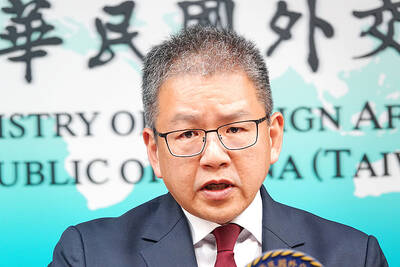
Taiwan is still in the process of assessing the possibility of recruiting workers from Eswatini, the Ministry of Foreign Affairs said yesterday, adding that its goal is to help Eswatini upgrade its vocational training centers. If there are plans to recruit workers from Eswatini, safeguarding national security, protecting public health and ensuring the employment rights of Taiwanese would be prerequisites, Department of West Asian and African Affairs Director-General Yen Chia-liang (顏嘉良) told a news conference. Key considerations would also include filling labor shortages in specific industries, and fostering bilateral professional and technical exchanges, he said. Yen was asked about the progress of labor

A US uncrewed surface vessel (USV) encountered multiple Chinese warships during an autonomous transit of the Taiwan Strait, US defense company Seasats said in a statement on Wednesday. Seasats announced that a Lightfish USV had completed the first autonomous transit of the Taiwan Strait. Over five days, the USV traversed the entire length of the Strait while constantly monitoring surface vessel traffic, the company said. The Lightfish encountered multiple Chinese warships, one of which was a Chinese People’s Liberation Army Navy (PLAN) Type 056 corvette, it said. The Chinese vessels were operating “well within Taiwan’s exclusive economic zone without transmitting their identity via the


 RSS
RSS