


A Taiwanese delegation to Slovakia signed seven memorandums of understanding (MOU) with public and private entities, including a space technology pact that would bring to Taiwan a project related to a blockchain application used by the European Space Agency, officials said on Friday.
The 66-person delegation led by National Development Council Minister Kung Ming-hsin (龔明鑫) and Minister of Science and Technology Wu Tsung-tsong (吳政忠) yesterday concluded their three-day visit to Slovakia.
The two sides on Thursday held a bilateral cooperation conference to exchange views on technology, higher education and innovative research, the Ministry of Science and Technology said in a statement yesterday.
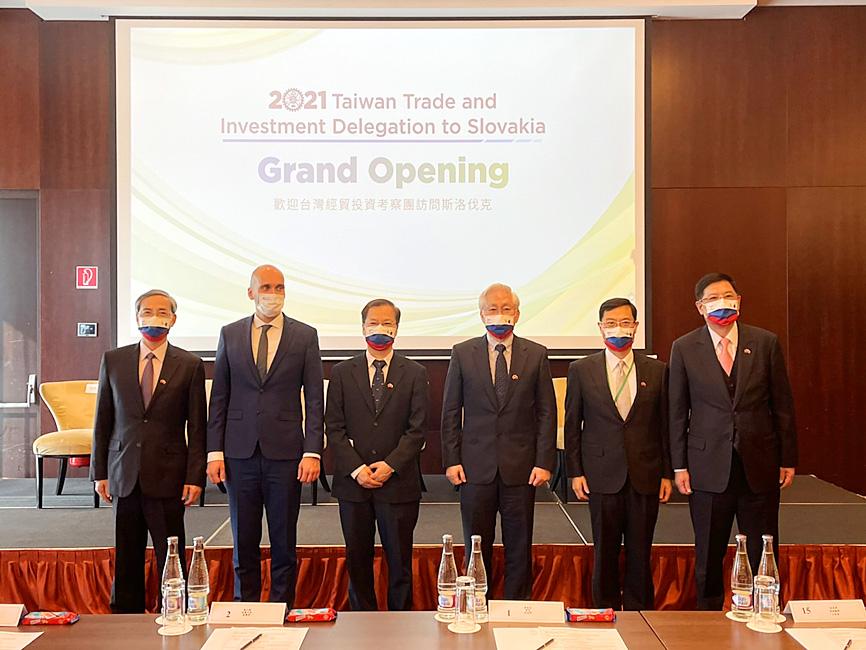
Photo: CNA
The Taiwanese delegation was received by Slovak Academy of Sciences vice president for international relations Zuzana Panczova and other representatives from the Slovak Ministry of Education and Slovak Research and Development Agency, it said.
Since the ministry and the academy in 1996 signed a science and technology cooperation agreement, they have funded more than 20 three-year joint research projects, the ministry said.
Wu on Friday witnessed the signing of an MOU by the Taiwan Space Industry Development Association, the Slovak space company 3IPK and its partner company Decent, laying the foundation for a trilateral cooperation framework, it said.
The association was represented by chairman Wu Jong-shinn (吳宗信), who is also the director-general of the National Space Organization, it said.
The two Slovak companies in February had visited the space organization’s headquarters at the Hsinchu Science Park (新竹科學園區) along with Slovak Economic and Cultural Office Taipei Representative Martin Podstavek.
With the office’s support, 3IPK and Decent would provide a proof of concept project in Taiwan based on a blockchain application used by the European Space Agency, the ministry said.
Decent is a start-up supplying blockchain software as a service, while 3IPK is a space blockchain company that became a member of the Slovak Security and Defense Industry Association in 2019, it added.
Hsinchu Science Park Bureau Director-General Wayne Wang (王永壯) on Friday signed an MOU with the Research Center of the University of Zilina, represented by its director Filip Pastorek, it said.
The research center, established in 2013, focuses on monitoring and evaluating transportation infrastructure, advanced materials, smart architecture and renewable energy, the ministry said.
The two sides’ cooperation creates a win-win situation, as the center specializes in technical research, while the science park is strong in technical applications, the ministry said, adding that their initial cooperation would focus on experience sharing and personnel exchanges.
A Slovak delegation planned to visit Taiwan in May, but the trip has been postponed several times.
Following its visit to Slovakia, the Taiwanese delegation yesterday turned to the Czech Republic, where it plans to stay until Tuesday, next visiting Lithuania from Tuesday to Friday, the Ministry of Foreign Affairs said.

The Ministry of Transportation and Communications yesterday inaugurated the Danjiang Bridge across the Tamsui River in New Taipei City, saying that the structure would be an architectural icon and traffic artery for Taiwan. Feted as a major engineering achievement, the Danjiang Bridge is 920m long, 211m tall at the top of its pylon, and is the longest single-pylon asymmetric cable-stayed bridge in the world, the government’s Web site for the structure said. It was designed by late Iraqi-British architect Zaha Hadid. The structure, with a maximum deck of 70m, accommodates road and light rail traffic, and affords a 200m navigation channel for boats,
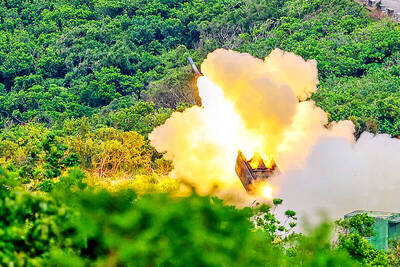
PRECISION STRIKES: The most significant reason to deploy HIMARS to outlying islands is to establish a ‘dead zone’ that the PLA would not dare enter, a source said A High Mobility Artillery Rocket System (HIMARS) would be deployed to Penghu County and Dongyin Island (東引) in Lienchiang County (Matsu) to force the Chinese military to retreat at least 100km from the coastline, a military source said yesterday. Taiwan has been procuring HIMARS and Army Tactical Missile Systems (ATACMS) from the US in batches. Once all batches have been delivered, Taiwan would possess 111 HIMARS units and 504 ATACMS, which have a range of 300km. Considering that “offense is the best defense,” the military plans to forward-deploy the systems to outlying islands such as Penghu and Dongyin so that

Taiwan Semiconductor Manufacturing Co (TSMC, 台積電), the world’s largest foundry service provider, yesterday said that global semiconductor revenue is projected to hit US$1.5 trillion in 2030, after the figure exceeds US$1 trillion this year, as artificial intelligence (AI) demand boosts consumption of token and compute power. “We are still at the beginning of the AI revolution, but we already see a significant impact across the whole semiconductor ecosystem,” TSMC deputy cochief operating officer Kevin Zhang (張曉強) said at the company’s annual technology symposium in Hsinchu City. “It is fair to say that in the past decade, smartphones and other mobile devices were

‘CLEAR MESSAGE’: The bill would set up an interagency ‘tiger team’ to review sanctions tools and other economic options to help deter any Chinese aggression toward Taiwan US Representative Young Kim has introduced a bill to deter Chinese aggression against Taiwan, calling for an interagency “tiger team” to preplan coordinated sanctions and economic measures in response to possible Chinese military or political action against Taiwan. “[Chinese President] Xi Jinping [習近平] has directed the People’s Liberation Army to be ready to invade Taiwan by 2027. China has a plan. America should have one too,” Kim said in a news release on Thursday last week. She introduced the “Deter PRC [People’s Republic of China] aggression against Taiwan act” to “ensure the US has a coordinated sanctions strategy ready should


 RSS
RSS