


Without Taiwan, the US could lose the Indo-Pacific region, former US ambassador to the UN Kelly Craft told an online forum yesterday, advocating Taiwan’s participation in the Quadrilateral Security Dialogue (Quad) that comprises the US, Japan, India and Australia.
Craft made the remarks at the Ketagalan Forum — 2021 Asia-Pacific Security Dialogue. The event, held online, was cohosted by the Ministry of Foreign Affairs and the Prospect Foundation.
Craft had planned to visit Taiwan from Jan. 13 to 15, shortly before she left office after former US president Donald Trump’s election defeat, but the US Department of State abruptly canceled the plan, as well as all other official visits, citing a need to focus on the transition to the administration of incoming US President Joe Biden.
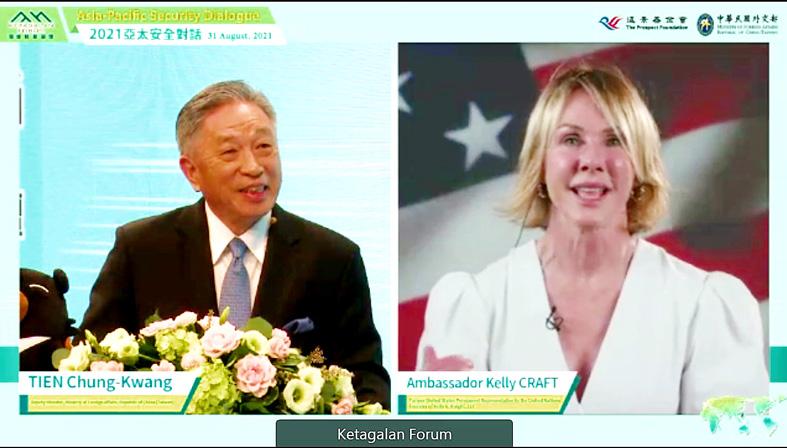
Photo copied by Lu Yi-hsuan, Taipei Times
In her keynote speech, Craft said that what happens in Afghanistan has implications for people everywhere and “we should be worried.”
She condemned China’s Global Times for trying to cast doubt over the US’ commitment to Taiwan.
“Shame on them for using the lives of brave men and women as propaganda. I am here to assure you that they are wrong,” Craft said, after quoting a paragraph from the newspaper’s English-language editorial “Afghan abandonment a lesson for Taiwan’s DPP” published on Aug. 16.
“I was proud to support our commitment to Taipei during the Trump administration and as an American, I am proud to see Biden continuing that policy,” she said. “If Taiwan is lost, we lose, too.”
Taiwan should be included in the Quad as a “plus one” member, Craft said, adding that Taiwan should also participate in Japanese naval exercises.
She advised Taiwan to reinforce its relationships with Quad members, be it bilateral or trilateral, as well as its role in the 5G Clean Network led by the US.
While her title has changed, she has not given up on her fight for Taiwan’s inclusion in the UN and other international organizations, Craft said, calling on the WHO and the International Civil Aviation Organization to include Taiwan.
Speaking in a panel discussion, Project 2049 Institute chairman Randall Schriver — a former US assistant secretary of defense for Indo-Pacific security affairs under Trump — also stressed Washington’s commitment to Taiwan.
“Our competition with China is about freedom and order in the Indo-Pacific [region],” Schriver said.
The Pentagon is becoming more serious about strengthening its deterrence capabilities in the region, he said.
About 52 percent of Americans responding to a poll supported US troops defending Taiwan if it were to be invaded by China, which is an all-time high, Schriver said, citing a survey by the Chicago Council on Global Affairs released last week.
If Taiwan is lost, it would be incredibly difficult to defend the first island chain, the Miyako Strait and freedom of navigation in the South China Sea, he said.
President Tsai Ing-wen (蔡英文) in her speech underscored Taiwan’s contributions to the world.
With the revival of the Quad and the EU’s proposed “Europe Asia Connectivity Strategy,” Taiwan is well positioned to serve as an indispensable partner on democratic renewal, and in sectors such as biotechnology, renewable energy and the semiconductor industry, Tsai said.
“We are willing to shoulder our share of the burden and we will not take our security partner’s cavalry for granted,” Tsai said.
Taiwan is also fully committed to collaborating with its neighbors to prevent armed conflict in the Taiwan Strait, and the East and South China seas, she said.
“We will always defend our democracy and way of life,” Tsai said.
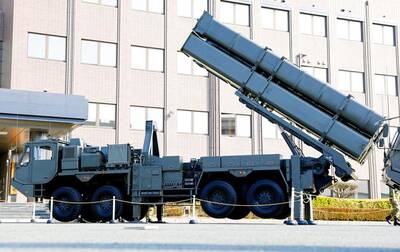
Japan has deployed long-range missiles in a southwestern region near China, the Japanese defense minister said yesterday, at a time when ties with Beijing are at their lowest in recent years. The missiles were installed in Kumamoto in the southern region of Kyushu, as Japan is attempting to shore up its military capacity as China steps up naval activity in the East China Sea. “Standoff defense capabilities enable us to counter the threat of enemy forces attempting to invade our country ... while ensuring the safety of our personnel,” Japanese Minister of Defense Shinjiro Koizumi said. “This is an extremely important initiative for

MORE POPULAR: Taiwan Pass sales increased by 59 percent during the first quarter compared with the same period last year, the Tourism Administration said The Tourism Administration yesterday said that it has streamlined the Taiwan Pass, with two versions available for purchase beginning today. The tourism agency has made the pass available to international tourists since 2024, allowing them to access the high-speed rail, Taiwan Railway Corp services, four MRT systems and four Taiwan Tourist Shuttles. Previously, five types of Taiwan Pass were available, but some tourists have said that the offerings were too complicated. The agency said only two types of Taiwan Pass would be available, starting from a three-day pass with the high-speed rail and a three-day pass with Taiwan Railway Corp. The former costs NT$2,800

POLLS CONCERNS: There are concerns within the KMT that a Cheng Li-wun-Xi Jinping meeting could trigger a voter backlash in elections in November Chinese Nationalist Party (KMT) Chairwoman Cheng Li-wun (鄭麗文) accepted an invitation from Chinese President Xi Jinping (習近平) to visit next month, her party and Chinese state media reported yesterday. Cheng, who took up her role in November last year, “gladly accepted” the invitation to lead a delegation to China, the KMT said in a statement, confirming a Xinhua news agency report. Cheng “looks forward to joint efforts by both parties to advance the peaceful development of cross-strait relations, promote cross-strait exchanges and cooperation, and work for peace in the Taiwan Strait and greater well-being for people on both sides,” the statement said. Chinese
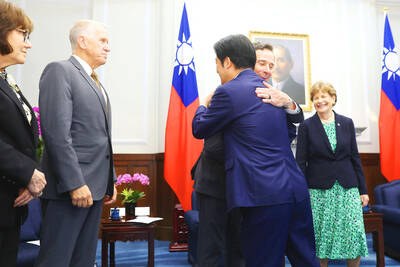
SIGNIFICANT TO THE WORLD: The delegation’s visit aims to send a clear message that bipartisan support for Taiwan is consistent, US Senator Jeanne Shaheen said The US Senate’s bipartisan support for Taiwan remains strong and Taiwan-US ties would continue for decades to come, a US Senate delegation said in Taipei yesterday, while calling on the legislature to swiftly pass a special defense budget bill. A US delegation led by Democratic US Senator Jeanne Shaheen and Republican US Senator John Curtis — both members of the US Senate Committee on Foreign Relations — arrived in Taiwan yesterday for a two-day visit. The other senators of the delegation included Senate Taiwan Caucus cochair Thom Tillis and Senate Committee on Armed Services senior member Jacky Rosen. Shaheen told a news


 RSS
RSS