


A self-declared Chinese defector who late on Friday came ashore in Taichung on an inflatable dinghy has been detained in quarantine awaiting further investigation, the coast guard said yesterday.
The 33-year-old surnamed Zhou (周) reportedly set off for Taiwan from Shishi in China’s Fujian Province on Friday morning on a boat equipped with a propeller and 90 liters of fuel.
He reached the Port of Taichung’s western wharf at about 9pm and climbed on top of an embankment where he stayed, unsure of what to do next.
At about 10:30pm, Lin Hsueh-hsien (林學賢) and his coworker heard calls coming from the embankment and discovered Zhou, who told them he had come from China on a rubber dinghy.
Since he had not eaten, Lin rushed to buy Zhou food and notified his boss, who in turn notified the Coast Guard Administration and Taichung Harbor Police.
Zhou told officers he was fleeing China for freedom and democracy in Taiwan, and denied having a criminal record or wanted status.
He said that he was out of work and was attracted by the economic opportunities in Taiwan.
Coast guard and harbor police officers yesterday said that Zhou is being held in quarantine at a coast guard detention facility while prosecutors investigate.
According to the Immigration Act (入出國及移民法), entering Taiwan without permission or breaking an exit ban is punishable by up to three years in prison, detention and/or a fine of up to NT$90,000.
Fishers said that it would not have been difficult to pilot the inflatable dinghy across the Taiwan Strait, as sailing conditions were good over the past few days.
Wang Yao-chin (王耀進), who leads a fishing association in Taichung, said that a small vessel traveling at about 20 knots (37kph) could travel the approximately 100 nautical miles (185km) from Shishi to Taichung Harbor in four to five hours.
As the type of boat Zhou piloted travels at about 10 knots, it would be possible to cover the distance in about 10 hours, he added.

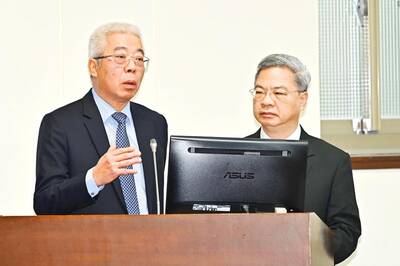
Taiwan has arranged for about 8 million barrels of crude oil, or about one-third of its monthly needs, to be shipped from the Red Sea this month to bypass the Strait of Hormuz and ease domestic supply pressures, CPC Corp, Taiwan (CPC, 台灣中油) said yesterday. The state-run oil company has worked with Middle Eastern suppliers to secure routes other than the Strait of Hormuz, through which about 20 percent of the world’s oil and liquefied natural gas typically passes, CPC chairman Fang Jeng-zen (方振仁) said at a meeting of the legislature’s Economics Committee in Taipei. Suppliers in Saudi Arabia have indicated they
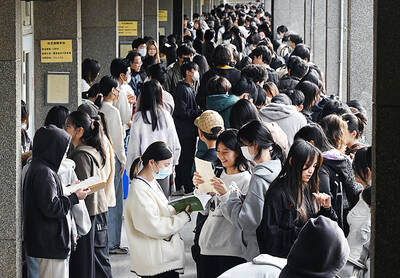
A global survey showed that 60 percent of Taiwanese had attained higher education, second only to Canada, the Ministry of the Interior said. Taiwan easily surpassed the global average of 43 percent and ranked ahead of major economies, including Japan, South Korea and the US, data from the Organisation for Economic Co-operation and Development (OECD) for 2024 showed. Taiwan has a high literacy rate, data released by the ministry showed. As of the end of last year, Taiwan had 20.617 million people aged 15 or older, accounting for 88.5 percent of the total population, with a literacy rate of 99.4 percent, the data

CCP ‘PAWN’? Beijing could use the KMT chairwoman’s visit to signal to the world that many people in Taiwan support the ‘one China’ principle, an academic said Chinese Nationalist Party (KMT) Chairwoman Cheng Li-wun (鄭麗文) yesterday arrived in China for a “peace” mission and potential meeting with Chinese President Xi Jinping (習近平), while a Taiwanese minister detailed the number of Chinese warships currently deployed around the nation. Cheng is visiting at a time of increased Chinese military pressure on Taiwan, as the opposition-dominated Legislative Yuan stalls a government plan for US$40 billion in extra defense spending. Speaking to reporters before going to the airport, Cheng said she was going on a “historic journey for peace,” but added that some people felt uneasy about her trip. “If you truly love Taiwan,

NEW LOW: The council in 2024 based predictions on a pessimistic estimate for the nation’s total fertility rate of 0.84, but last year that rate was 0.69, 17 percent lower An expected National Development Council (NDC) report expects the nation’s population to drop below 12 million by 2065, with the old-age dependency ratio to top 100 percent sooner than 2070, sources said yesterday. The council is slated to release its latest population projections in August, using an ultra-low fertility model, the sources said. The previous report projected that Taiwan’s population would fall to 14.37 million by 2070, but based on a new estimate of the total fertility rate (TFR) — the average number of children born to a woman over her lifetime — the population is expected to reach 12 million by


 RSS
RSS