


President Tsai Ing-wen (蔡英文) and US Ambassador to the UN Kelly Craft yesterday held a virtual meeting, during which Tsai described Taiwan as a “force for good” that deserves a place on the world stage, while Craft reaffirmed Washington’s support for Taiwan’s international participation.
The virtual talk was held at about 11am, after Craft’s trip to Taiwan was abruptly canceled. She had been scheduled to meet with Tsai in person at the Presidential Office in Taipei yesterday morning as part of a three-day visit to Taiwan.
On Tuesday, the US Department of State canceled all of its planned trips, citing a need to focus on the transition to US president-elect Joe Biden’s team.
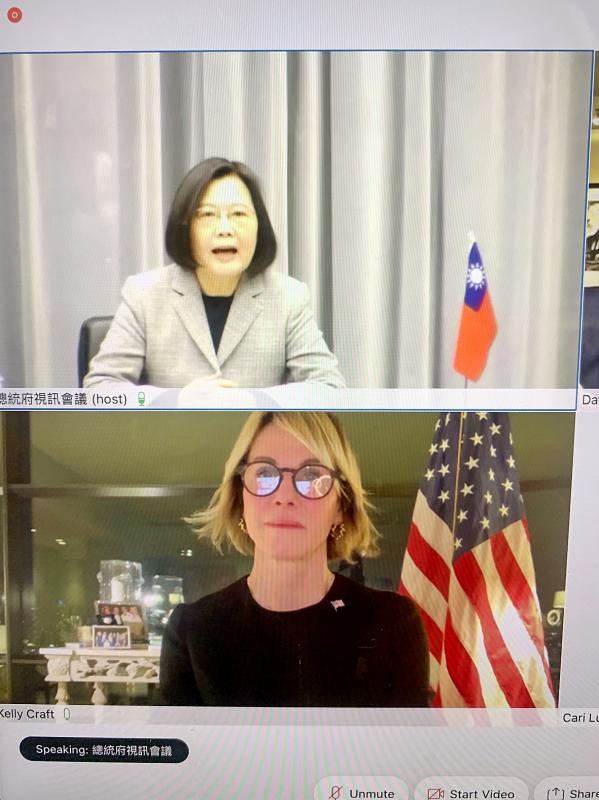
Photo: US Mission to the UN via AP
The virtual meeting was first reported by Chinese-language online news outlet Up Media and followed by three consecutive posts on Twitter from Craft.
“A great privilege to speak today w/President Tsai @iingwen. We discussed the many ways Taiwan is a model for the world, as demonstrated by its success in fighting COVID-19 and all that Taiwan has to offer in the fields of health, technology & cutting-edge science,” Craft wrote.
“Unfortunately, Taiwan is unable to share those successes in @UN venues, including the World Health Assembly, as a result of PRC [People’s Republic of China] obstruction. If the pandemic has taught us anything, it is that more information, more transparency, is part of the answer,” she said in another post on Twitter.
“I made clear to President Tsai that the US stands with Taiwan and always will, as friends and partners, standing shoulder to shoulder as pillars of democracy,” she added.
In a video released by the Presidential Office, Tsai thanked Craft for “always speaking up for Taiwan at the most important time.”
“The people of Taiwan have been inspired by your action. They actually like you a lot,” Tsai told the ambassador, citing many examples, including Craft’s post on Twitter last year that supported Taiwan’s UN participation and showed a Formosan black bear doll with the ambassador.
Taiwan would continue to demonstrate that it is a vital partner to the world, Tsai said, expressing the hope that the US would continue to support the nation’s bid to join the UN.
The Republic of China left the UN in 1971 after the General Assembly passed Resolution 2758, which stated that the UN would henceforth recognize the PRC as the sole legitimate government of China.
As a result, Taiwan lost its Security Council seat, as one of the UN’s founding nations, and its representation at the global body.
US Deputy Assistant Secretary of State for East Asian and Pacific Affairs David Feith, American Institute in Taiwan Director Brent Christensen and Minister of Foreign Affairs Joseph Wu (吳釗燮), among others, joined yesterday’s virtual meeting, the Presidential Office said.
Asked whether Taiwan or the US proposed the videoconference, a source familiar with the matter said that the solution resulted from a joint discussion.
The timing of Craft’s planned visit was finalized last month, following her luncheon with Taipei Economic and Cultural Office in New York Director James Lee (李光章) in September last year and the US elections in November last year, the person said.
Additional reporting by staff writer and AFP

KEY INDUSTRY: The vice premier discussed a plan to create a non-red drone supply chain by next year, which has been allocated a budget of more than NT$7.2 billion The government has budgeted NT$44.2 billion (US$1.38 billion) to cultivate Taiwan’s uncrewed aerial vehicle (UAV) industry over the next five years, which would make the nation a major player in the industry’s democratic supply chain in the Asia-Pacific region, Premier Cho Jung-tai (卓榮泰) said yesterday. Cho made the remarks during a visit to the facilities of Cub Elecparts Inc (為升電裝). Democratic Progressive Party (DPP) Legislator Chen Su-yueh (陳素月) and Chinese Nationalist Party (KMT) Legislator Hsieh Yi-fong (謝依鳳) also participated in the trip. Cub Elecparts has transitioned from the automotive industry to the defense industry, which is the top priority among the nation’s
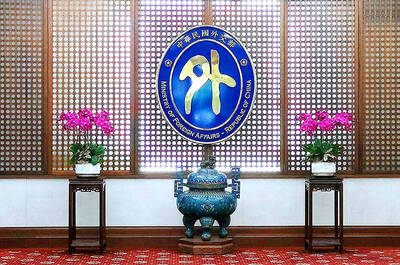
SOUTH KOREA DISPUTE: If Seoul continues to ignore its request, Taiwan would change South Korea’s designation on its arrival cards, the foreign ministry said If South Korea does not reply appropriately to a request to correct Taiwan’s name on its e-Arrival card system before March 31, the government would take corresponding measures to change how South Korea is labeled on the online Taiwan Arrival Card system, the Ministry of Foreign Affairs said yesterday. South Korea’s e-Arrival card system lists Taiwan as “China (Taiwan)” in the “point of departure” and “next destination” fields. Taipei has asked Seoul to change the wording. Since March 1, South Koreans who hold government-issued Alien Resident Certificates (ARC) have been identified as from “South Korea” rather than the “Republic of Korea,” the

‘UNFRIENDLY’: Changing the nationality listing of Taiwanese residents to ‘China’ goes against EU foreign policy as well as democratic and human rights principles, MOFA said Taiwan yesterday called on Denmark to correct its designation of the nationality of Taiwanese residents as “China” or face retaliatory measures. The Danish government in 2024 changed the nationality of Taiwanese citizens on their residence permits from “Taiwan” to “China.” The decision goes against EU foreign policy and contravenes democratic and human rights principles, Ministry of Foreign Affairs (MOFA) spokesman Hsiao Kuang-wei (蕭光偉) said. Denmark should present a solution acceptable to Taiwan as soon as possible and correct the erroneous designation to preserve the longstanding friendship between the two nations, Hsiao said. The issue could damage Denmark’s image and business reputation in Taiwan,
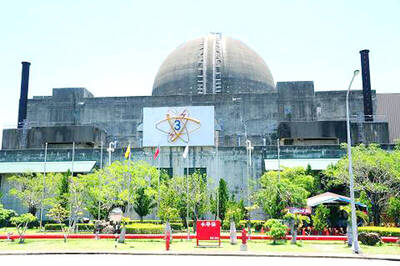
SUFFICIENT: The president said Taiwan has enough oil for next month, with reserves covering more than 100 days and natural gas enough for 12 to 14 days A restart plan for the Guosheng Nuclear Power Plant in New Taipei City’s Wanli District (萬里) and the Ma-anshan Nuclear Power Plant in Pingtung County’s Hengchun Township (恆春) would be submitted to the Nuclear Safety Commission by the end of the month, President William Lai (賴清德) said yesterday, reversing the government’s policy to abolish nuclear energy. On May 17 last year, Taiwan shut down its last nuclear reactor and became the first non-nuclear nation in East Asia, fulfilling the Democratic Progressive Party (DPP) government’s pledge of a “nuclear-free homeland.” Even without nuclear power, Taiwan can maintain a stable electricity supply until 2032,


 RSS
RSS